
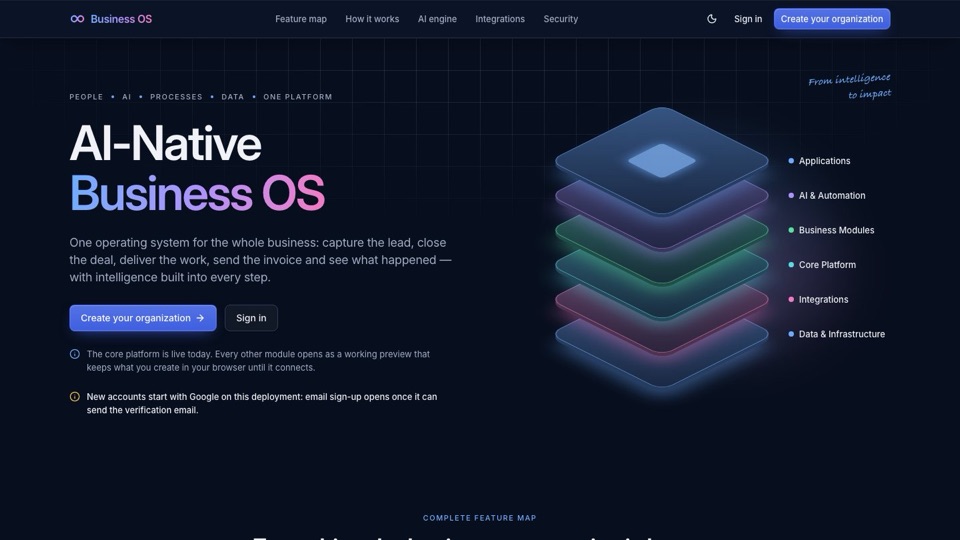
AI business software is a unified operating system where AI agents act as first-class users with their own identities and permissions. Unlike simple chatbots, these systems bridge the gap between getting an answer and getting the work done by executing real tasks within your business workflows.
What is AI Business Software?
True AI business software is not just a chat box in the corner of your screen. If you are only using a window to ask questions, you are using a chatbot, not an AI-native operating system.
Modern, high-growth businesses need systems where AI agents are treated with the same importance as human employees. This means they have their own identities, their own access levels, and their own permissions. They do not just suggest text; they perform actions.
When AI is integrated into the core of your business, it bridges the gap between getting an answer and getting the work done. Instead of telling you how to do something, the software performs the task within your existing workflows, following the same rules and compliance standards as a human staff member.
- Identity-driven: Agents sign in and act under specific roles.
- Permission-aware: Agents can only see and touch the data they are allowed to access.
- Action-oriented: They move from "answering" to "executing."
- Workflow-integrated: They operate within your actual business processes.
The Problem with Fragmented Tools
Most small and medium enterprises (SMEs) suffer from "software sprawl." You might run your leads in a spreadsheet, handle customer queries on WhatsApp, manage HR in a separate app, and track invoices in a fourth tool. To top it off, your important documents are scattered across various email threads.
This fragmentation creates several critical business risks:
- Data Silos: Because nothing talks to anything else, you lack a single source of truth.
- Security Holes: Bolted-together software often leads to inconsistent permissions. One tool might be secure, but the connection to another creates a gap.
- Duplicate Data: You end up entering the same customer name in three different places, leading to errors and confusion.
- Limited AI Intelligence: When your tools are separate, an AI can only see one small piece of your business at a time. It cannot see the customer's WhatsApp message and then check the invoice in your accounting software to give you a complete answer.
The Unified AI-Native Foundation
Instead of bolting modules together, BusinessOS provides a single, unified foundation. Most all-in-one tools grow by adding disconnected products on top of each other. This creates "seams" where data gets lost or security is compromised. We take the opposite approach: we build the foundation first, then build the modules on top of it.
By using a master architecture, we ensure that everything shares a single source of truth. This is achieved through a unified database and a set of core services that every module must use.
The Core Shared Services
Every module in the ecosystem—whether it is CRM, HR, or Operations—shares these essential components:
- One Identity: A single way to know who is performing an action.
- One Permission Engine: A unified set of rules governing what users and agents can see.
- One Search: A single way to find any file, message, or record across the whole company.
- One Audit Log: A complete, unchangeable record of every action taken.
- One File Store: A central place for all documents and uploads.
This architecture allows AI agents to work with full context. An agent can follow up on an overdue invoice or qualify a new lead because it has access to the same data and follows the same rules as your team.
From Answers to Finished Work
The goal of AI-native software is to move from "answering questions" to "executing multi-step tasks." We call this the gap between an answer and "done."
Consider a small business owner in Palghar. They don't want a long, clever explanation of how to create a GST bill. They want the bill created, the tax lines calculated correctly, and the file sent to the customer in the right language. This is the level of execution we aim for.
Real-World Agentic Workflows
Our technology allows for complex, step-by-step task flows. An agent follows a cycle: plan, act with a tool, check the result, and remember.
| Capability | Traditional Software/Chatbot | Agentic AI Software |
|---|---|---|
| Task Execution | Tells you how to make a bill. | Drafts the GST bill and provides the file. |
| Communication | Drafts a text in English. | Translates messages into Marathi or Hindi for the customer. |
| Follow-ups | Requires you to set a manual reminder. | Remembers the invoice and checks if payment arrived by Friday. |
| Data Handling | You copy-paste data from a sheet to a doc. | Reads a spreadsheet and produces a clean, printable price list. |
By integrating tools directly, the system allows for seamless transitions between documents, spreadsheets, and communication channels like WhatsApp.
Enterprise-Grade Security and Audit
When you give an AI agent the power to act, security becomes the most important feature. You cannot have an agent that can grant itself permission to see your payroll or bank details. Our architecture is built to prevent this by design.
We enforce security at the deepest level of the system. We use PostgreSQL row-level security (RLS) to ensure that data is isolated at the database level. This means even if a piece of software has a bug, the database itself prevents one organization from seeing another's data.
Multi-Layered Protection
- Identity & Access: We support secure sign-in via passkeys, two-factor authentication (2FA), and SSO (Google or Microsoft).
- Strict Permissions: Our permission engine controls roles, record sharing, and hidden fields. It includes checks that stop any user or agent from granting themselves unauthorized access.
- The Audit Log: We maintain an append-only audit log. This is a permanent, unchangeable record of who (or which agent) did what and when. This log is searchable and can be exported as a CSV for compliance.
- Tenant Isolation: Automated tests check data isolation for every single table in our database to ensure your data stays yours.
The Roadmap to an AI-Driven Business
We are building a complete ecosystem where agents work as an "always-on" company. We are starting with a solid foundation and expanding upward through specialized modules.
The BusinessOS foundation is already live in alpha. It provides the essential building blocks: identity, organizations, permissions, files, search, and the audit log. This foundation ensures that every new module we build is secure and integrated from day one.
Development Stages
| Module | What it covers | Status |
|---|---|---|
| Foundation | Identity, organizations, permissions, files, search, audit | Live in alpha |
| CRM and Sales | Contacts, deals, pipeline, quotes | Next; not built yet |
| Work and Communication | Tasks, projects, messages | Specified |
| HR | People, teams, leave, payroll | Specified |
| Operations and Documents | Processes, approvals, documents | Specified |
| Automation and AI Agents | Agents working across every module | Specified |
| App Builder | Drag-and-drop internal apps | Specified |
Our vision is to move beyond fragmented tools toward a single, intelligent operating system. If you want to help shape the upcoming CRM module to fit your specific business needs, you can reach out to us to join the early release.
Frequently Asked Questions
- How is AI different from a standard chatbot?
- Standard chatbots provide answers in a window; AI business software uses agents that have identities, permissions, and the ability to execute tasks like sending invoices or qualifying leads.
- Is my business data secure in an AI system?
- Yes. By using a unified foundation with database-level row-level security (RLS) and an append-only audit log, every action taken by a human or an agent is tracked and isolated.
- Can AI handle Indian business requirements?
- Yes. The architecture is designed for the Indian context, supporting GST invoices and translating communications into languages like Marathi and Hindi.
- What makes software 'AI-native'?
- AI-native means AI agents are treated as first-class users of the system, governed by the same permissions, approvals, and audit logs as human employees.
- Why shouldn't I just use multiple specialized AI tools?
- Using multiple tools often leads to duplicate data and security holes. A unified foundation ensures all modules share one source of truth and one permission engine.
Questions people ask
How is AI different from a standard chatbot?
Standard chatbots provide answers in a window; AI business software uses agents that have identities, permissions, and the ability to execute tasks like sending invoices or qualifying leads.
Is my business data secure in an AI system?
Yes. By using a unified foundation with database-level row-level security (RLS) and an append-only audit log, every action taken by a human or an agent is tracked and isolated.
Can AI handle Indian business requirements?
Yes. The architecture is designed for the Indian context, supporting GST invoices and translating communications into languages like Marathi and Hindi.
What makes software 'AI-native'?
AI-native means AI agents are treated as first-class users of the system, governed by the same permissions, approvals, and audit logs as human employees.
Why shouldn't I just use multiple specialized AI tools?
Using multiple tools often leads to duplicate data and security holes. A unified foundation ensures all modules share one source of truth and one permission engine.