
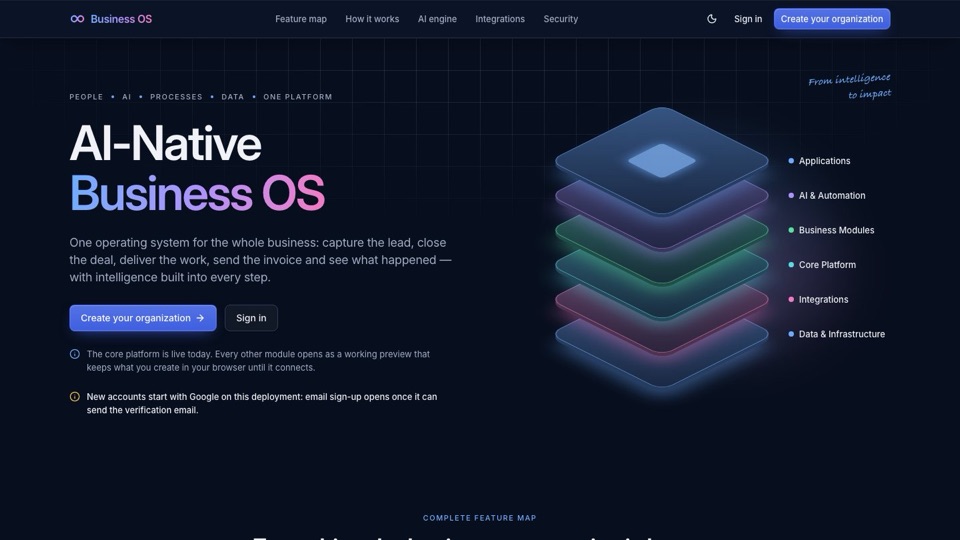
What BusinessOS is
BusinessOS is a multi-tenant, AI-native operating system for a whole business, built by AskShiva. Its foundation is live in early release: secure sign-in with passkeys and two-factor codes, organisations and teams, one permission engine, database-level data isolation, files, search, notifications and an append-only audit log. CRM is the first business module, and it is not built yet.
A typical Indian SME runs leads in a spreadsheet, customers on WhatsApp, HR in another app, invoices in a fourth and documents in someone's email. Nothing talks to anything, nobody can say who changed what, and AI tools can see only one small piece at a time.
BusinessOS starts from the other end: one foundation first, then every module on top of it.
- Multi-tenantone platform, many organisations
- RLSisolation enforced in the database
- Passkeysplus two-factor and SSO
- Auditappend-only, searchable, exportable
Why the foundation comes first
Most all-in-one business tools grew by bolting products together. Each module has its own users, its own permissions and its own idea of a customer. The seams show up as security holes and duplicate data.
BusinessOS is defined by a master architecture and a set of written decision records. Everything shares one identity, one permission engine, one search, one file store, one event bus, one audit log and one design system. Our database is the source of truth; open-source systems accelerate the work behind our own interfaces.
What is live today
- Secure sign-in. Email and password with mandatory verification, two-factor codes, passkeys, and Google or Microsoft sign-in when set up; session management.
- Organisations and teams. Departments, teams and workspaces, with members invited by link.
- Roles and permissions. One engine for roles, record sharing and hidden fields, with checks that stop anyone giving themselves more access.
- Separate data per organisation. PostgreSQL row-level security with a signed tenant context; automated tests check isolation for every table.
- Audit log. An append-only record of who did what and when, with search and CSV export.
- Files, search, notifications and realtime. Versioned uploads with previews and signed links, search, comments and timelines, in-app and email notifications.
The modules on the roadmap
| Module | What it covers | State |
|---|---|---|
| Foundation | Identity, organisations, permissions, files, search, audit | Live in alpha |
| CRM and sales | Contacts, deals, pipeline, quotes | Next; not built yet |
| Work and communication | Tasks, projects, messages | Specified |
| HR | People, teams, leave, payroll | Specified |
| Operations and documents | Processes, approvals, documents | Specified |
| Automation and AI agents | Agents working across every module | Specified |
| App builder | Drag-and-drop internal apps | Specified |
An HRMS built by the same team is already running separately as an early release at hrms.businessos.si.
What "AI-native" means here
AI-native does not mean a chat box in the corner of every screen. It means AI agents are first-class users of the system: they sign in with an identity, act within permissions, and every action they take lands in the same audit log as a person's.
That is the bridge to Shiva Agents. An agent that follows up on overdue invoices or qualifies inbound leads should be governed exactly like a new employee doing the same job. The agentic architecture guide explains why permissions, approvals and audit matter more than model choice.
The technology
A TypeScript monorepo: a Next.js web app, a NestJS API with a typed SDK, PostgreSQL 18 with pgvector for search and AI features, Valkey for queues and caching, and Better Auth for sign-in with MFA and passkeys. Events go through an outbox so nothing is lost between a change and the jobs it triggers.
Get access
The BusinessOS foundation is open in alpha with test data. If you want to shape the CRM module for your business, write to me.
Open businessos.siWrite to meNext: Agentic Architecture, the field notes behind all four platforms.
Questions people ask
What is BusinessOS?
BusinessOS is a multi-tenant, AI-native platform for running a whole business in one place: CRM, sales, work, communication, HR, operations, documents and analytics on one foundation, with AI agents across all of it.
What is an AI operating system for business?
It is one system where every part of the business shares the same identity, permissions, data and audit trail, and where AI agents can work across modules instead of inside one isolated tool.
Is BusinessOS available today?
The foundation runs as an early release: sign-in, organisations and teams, roles and permissions, files, search, notifications and a full audit log. Business modules such as CRM are not built yet, so it should be used with test data only.
How does BusinessOS keep each company's data separate?
PostgreSQL row-level security keeps one organisation's records away from another's inside the database itself, and automated tests check this for every table.
Who is BusinessOS for?
Small and medium businesses, mid-sized companies, agencies and departments inside larger companies that want one secure workspace instead of many disconnected tools.
Will BusinessOS work with AI agents?
Yes. AI agents are a planned module, and the platform is designed so agents, such as those from Shiva Agents, can act across CRM, HR and operations with the same permissions and audit as people.