
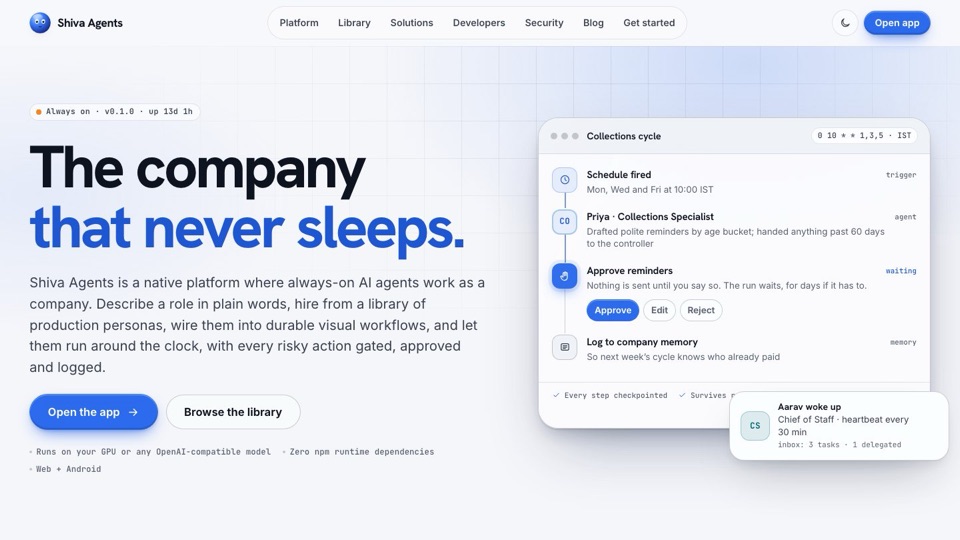
What Shiva Agents is
Shiva Agents is an AskShiva platform for running AI agents as an always-on company. Agents have personas, memory, tools, autonomy levels and heartbeats; they work alone or in teams; and visual workflows, where any node can be an agent or a whole team, run durably and pause for your approval before risky steps. It exposes an MCP server, an A2A agent card and an OpenAI-compatible API.
Most agent demos are a single loop in a notebook. That is fine until the agent has to run every morning, wait two days for a manager to approve a refund, survive a server restart and explain later exactly what it did. Shiva Agents is built for that second world.
- 23runnable workflow patterns
- 20workflow node types
- MCP + A2Aopen agent protocols
- Audithash-chained record of every action
Agents that work like a company
Agent Studio
Build an agent the way you would brief a new hire: role, goal, backstory and style; skills such as writing, research, design, coding, data analysis, translation or planning; the tools it may use; and an autonomy level from Observe through Assist and Act to Autonomous. Or describe the agent in plain language and Shiva drafts it.
Heartbeats and standing orders
Agents do not only wait for prompts. A scheduler wakes them on heartbeats (cron, in IST) to work their inbox or follow standing orders, and event triggers fire when a task finishes or a run fails. Agents can delegate to and consult each other.
Agent library
A library of production personas across more than twenty departments, nine department-in-a-box blueprints and 23 runnable workflow patterns, each installable in one click.
Proven multi-agent team patterns
One Team node can run any of the topologies that research and practice have shown to work. The agentic architecture guide explains each in depth.
| Pattern | How it works | Known from |
|---|---|---|
| Assembly-line SOP | Each role hands a typed artefact to the next | MetaGPT, ChatDev |
| Group chat | A speaker selector picks who talks next | AutoGen / AG2, AgentScope |
| Debate and judge | Agents argue; a judge decides | Multi-agent debate research |
| Manager and crew | A manager plans and assigns to specialists | CrewAI |
| Role-play pair | Two agents with fixed roles iterate | CAMEL |
| Handoff network | Agents pass control to the right specialist | Swarm, Agents SDK |
| Task and progress ledgers | An orchestrator tracks facts, plan and progress | Magentic-One |
Durable visual workflows
Workflows are drawn on a canvas, n8n-style, except that any node can be an agent or a whole team. There are 20 node types: triggers (manual, schedule, webhook, event), Agent with an optional verifier loop, Team, fan-out map, model call, branch by rules or by model, verify, merge, set state, isolated code, wait, approval, ask a human, HTTP, memory, assign to the company inbox, notify, sub-workflow and result. Describe a workflow in plain language and the architect builds it for you.
The engine underneath is what makes it production-grade:
- Token-based execution with dead-path elimination and bounded cycles.
- Retries, timeouts, and token and step budgets on every run.
- A checkpoint after every step, and resume after a restart.
- Approvals that can wait for days, with idle runs leaving memory.
- Time travel: fork a run from any earlier step to try a different path.
Governance: approvals, audit and data residency
Agents that act need limits. Every tool carries a risk class (read, fetch, write, external, critical) that is gated by the agent's autonomy level. Approvals can become standing "always allow" or "always deny" rules. There is a kill switch.
Every action lands in a hash-chained audit log, so the record cannot be quietly edited after the fact. A data-residency guard keeps Indian personal data and children's data away from models hosted outside India or off the local machine. Agents disclose that they are AI when they talk to outsiders.
Open protocols: MCP, A2A and an OpenAI-compatible API
Shiva Agents is designed to plug into everything else rather than be a walled garden.
- OpenAI-compatible API. Call
/v1/chat/completionswith the model set to an agent role or a workflow, so any OpenAI client can talk to your agents. - MCP server. Agents and workflows are available as tools to any Model Context Protocol client.
- A2A. An Agent2Agent card at
/.well-known/agent-card.jsonand a JSON-RPC endpoint let other agents discover and delegate to yours. - Webhooks and streams. Webhooks with idempotency keys, a server-sent event stream and OpenTelemetry traces for every run.
Every GodEngine and AskShiva product is registered as a connection, so agents can operate those products through an allow-list only.
Built lean
The whole platform runs on Node 24 with TypeScript and no npm runtime dependencies; storage is the built-in SQLite. There is a web dashboard (overview, live operations floor, org chart, chat, studio, task board, workflow canvas, library, runs with a live graph and trace, approvals, memory, tools, models, audit and settings), a 3D office view where every agent sits at a desk and real events move them around, and an Android app. Status today: version 0.1.
Get access
Shiva Agents is in early release. If you want a department of agents running for your business, write to me.
Open shivaagents.siWrite to meNext: BusinessOS, the operating system these agents will work inside.
Questions people ask
What is Shiva Agents?
Shiva Agents is a platform where persona-driven AI agents work as a company: they have roles, memory, tools, autonomy levels, inboxes and heartbeats, and they collaborate in proven multi-agent patterns inside durable visual workflows.
What is an AI agent platform?
An AI agent platform is software for building, running and governing AI agents: defining what each agent can do, connecting tools, orchestrating agents together, and keeping a record of what they did. Shiva Agents adds durability, approvals and audit on top.
Does Shiva Agents support MCP?
Yes. Shiva Agents exposes an MCP server, so MCP clients can use its agents and workflows as tools. It also publishes an A2A agent card and offers an OpenAI-compatible chat completions endpoint.
Which multi-agent patterns does it support?
A single Team node can run an assembly-line SOP, a group chat with a speaker selector, debate with a judge, a manager with a crew, a role-play pair, a handoff network, or orchestrator task and progress ledgers.
How does Shiva Agents keep agents safe?
Each tool has a risk class and each agent has an autonomy level from Observe to Autonomous. Risky actions wait for human approval, there is a kill switch, every action goes into a hash-chained audit log, and a residency guard keeps Indian personal data away from non-Indian models.
What happens if the server restarts mid-workflow?
Runs are checkpointed after every step and resume after a restart. An approval can wait for days without holding memory, and you can fork a run from any earlier step.