
The MSME Data Gap
AI for MSME means moving away from simple chatbots toward intelligent agents that actually perform business tasks. Instead of just answering questions, these agents use a unified data foundation to handle real work like invoicing and customer follow-ups.
For most Indian small and medium enterprises, business operations are scattered across a dozen different places. You might track your sales leads in a simple spreadsheet, talk to your customers on WhatsApp, manage your staff in a separate HR app, and keep your invoices in a folder or someone's email. This is the reality for many growing businesses.
This fragmented setup creates a massive "data gap." When your tools don't talk to each other, you end up with disconnected data silos. You might find that nobody in the office actually knows who changed a customer's phone number or updated a payment status because the information is stuck in a private WhatsApp chat or a local file.
Standard AI tools often fail to solve this because they are "context-blind." They can answer a general question, but they can only see one tiny piece of your business at a time. They don't know what is in your spreadsheet, so they can't help you with your actual workflow.
A Unified AI-Native Foundation
To solve the data gap, you cannot just bolt an AI onto existing, messy tools. You need a foundation built for AI from the ground up. This is what BusinessOS provides.
Most "all-in-one" business tools are actually just a collection of different products stuck together. Because they were built separately, each module has its own different way of handling users, permissions, and customer data. These "seams" between tools create security holes and lead to duplicate data entry.
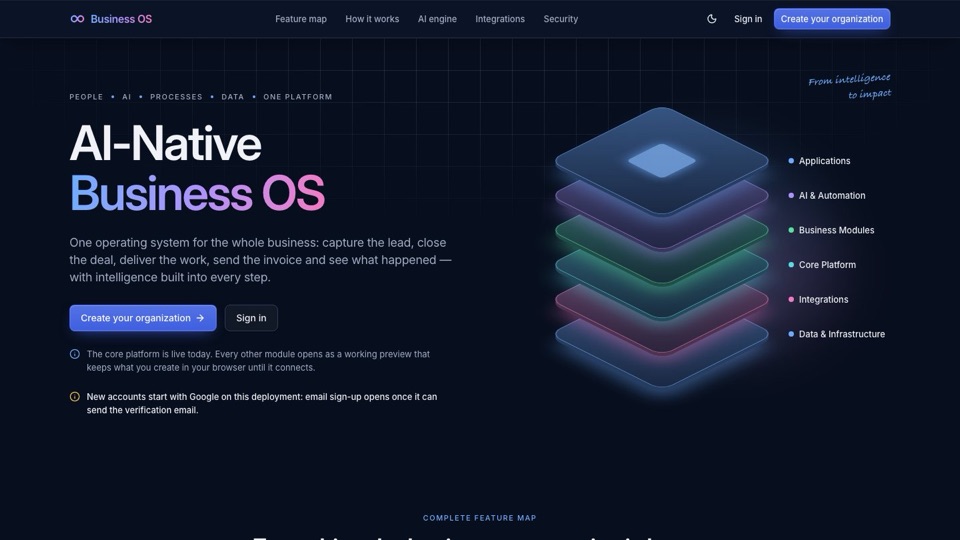
BusinessOS takes a different approach. It starts with a single, unified foundation. Everything in your business—from your files to your customer contacts—shares one identity, one permission engine, and one audit log. This creates a "single source of truth."
When your data is unified, AI agents finally have the full context they need to be useful. They don't have to guess who a customer is or what they bought; they can see the entire history because everything lives in one secure, shared environment.
AI Agents as First-Class Employees
In a traditional setup, AI is just a chat box in the corner of your screen. In an AI-native system, AI agents are treated as "first-class employees." This is a fundamental shift in how you manage your business automation.
What does it mean for an agent to be a "first-class employee"? It means the agent has its own identity and its own set of permissions within your system. Just like you wouldn't give a new intern access to your bank account without supervision, you don't give an AI agent unlimited access to your business. It operates within strict rules defined by your organization.
Because they have identities and permissions, agents can actually perform work, such as:
- Following up on overdue invoices by checking payment status.
- Qualifying inbound leads by asking the right questions and updating your CRM.
- Updating records across different modules when a task is completed.
Security is a primary concern for any business owner. That is why every single action an agent takes is recorded in an append-only audit log. This means you have a permanent, unchangeable record of exactly what the agent did, when it did it, and what the result was. You are never left wondering if an AI made a mistake; you can simply check the log.
From 'Answering' to 'Doing'
Most people are used to AI that just gives you information. AskShiva is designed to bridge the gap between getting an answer and finishing a task. We call this the "gap between answer and done."
A business owner in a place like Palghar doesn't just want a clever explanation of how to calculate tax. They want the actual invoice created, formatted correctly, and sent to the customer in the language they understand. AskShiva is built to handle that exact workflow.
Consider a typical workflow using AskShiva's task flows:
- The Request: You say, "Make a GST bill for Sharma Traders for ₹18,400."
- The Action: AskShiva drafts the invoice, calculates the tax lines, and provides you with a finished file.
- The Communication: You say, "Send it on WhatsApp, in Marathi."
- The Result: AskShiva translates the covering message into Marathi and prepares it for sending.
This is a multi-step flow that would normally take a human several minutes of clicking, typing, and switching between apps. With AskShiva, it is a single conversation. You can even use voice commands to manage your business, speaking to your computer and hearing the reply back.
Built for the Indian Workflow
Many AI tools are built for Western markets where business is done via email and standard English documents. But Indian commerce runs on a different set of pillars: WhatsApp, GST, and UPI. An assistant designed for the US market treats these as "edge cases," but for us, they are the main case.
Our technology is designed to understand and interact with the specific requirements of Indian business, including:
- Language: The ability to translate customer messages into Marathi, Hindi, and other Indian languages to ensure clear communication.
- Taxation: Handling complex GST tax lines and producing official, downloadable GST invoices.
- Communication: Integrating seamlessly with the way your customers actually want to talk to you—on WhatsApp.
By focusing on these local requirements, we ensure that AI isn't just a novelty, but a practical tool that fits into the way you actually run your shop or office every day.
Enterprise-Grade Security for Small Business
As you move from manual processes to AI-driven automation, you are putting more of your business data into the digital realm. We believe that small businesses deserve the same level of security as large corporations.
We implement several layers of protection to keep your business data private and secure:
| Security Feature | How it Protects You |
|---|---|
| Access Control | Secure sign-in using Passkeys, Two-Factor Authentication (2FA), and SSO. |
| Data Isolation | We use PostgreSQL row-level security (RLS) to ensure your data is strictly separated from other organizations at the database level. |
| Auditability | An append-only, searchable, and exportable audit log provides complete transparency for every action. |
This architecture ensures that even as you add more AI agents to your team, your data remains isolated and your history remains transparent.
The Roadmap to Full Automation
We are building the future of Indian MSME operations one layer at a time. We believe in building a solid foundation first before adding complex features. Our development is organized into clear stages:
Current Status: The Foundation
The core foundation—which includes Identity, Permissions, Files, Search, and the Audit Log—is currently live in alpha. This is the essential "operating system" that allows everything else to work securely.
In Development: Sales and Communication
We are currently working on the CRM and Sales modules. This will include tools for managing contacts, deals, pipelines, and quotes, allowing you to start automating your sales process.
The Future: Full Business Automation
Our long-term roadmap includes several key modules designed to automate entire departments:
- HR: Managing people, teams, leave, and payroll.
- Operations: Automating processes, approvals, and document management.
- Automation & AI Agents: The "Shiva Agents" that work across every module to perform tasks autonomously.
- App Builder: A drag-and-drop tool to create your own internal business apps without needing to write code.
Questions people ask
How is AI different in BusinessOS compared to standard chatbots?
Standard chatbots are just boxes in a corner; BusinessOS AI agents are first-class users with identities, permissions, and audit logs, allowing them to perform actual work across your business modules.
Can AI help with Indian tax requirements?
Yes, AskShiva is designed to handle Indian business documents like GST invoices, calculating tax lines and producing downloadable files.
Will AI agents be able to communicate with my customers on WhatsApp?
Yes, the architecture is built to bridge the gap between a task and a finished result, such as preparing a translated message for WhatsApp in Marathi or Hindi.
Is my business data secure when using AI?
Yes, BusinessOS uses PostgreSQL row-level security and an append-only audit log to ensure data isolation and a complete record of every action taken by humans or agents.
Can I use voice commands to manage my business?
Yes, AskShiva features voice-in-the-browser capabilities, allowing you to speak your requests and hear the replies.