
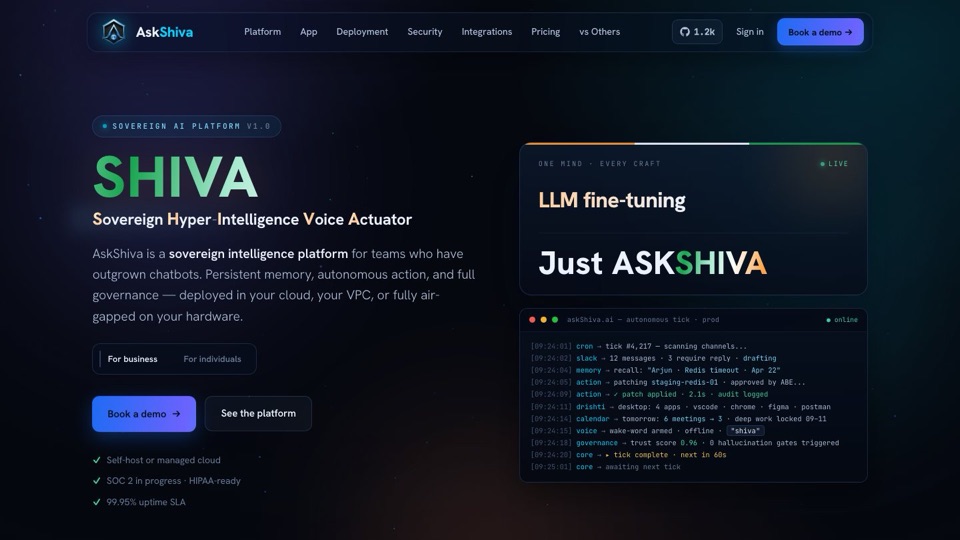
The Verdict: Is AskShiva Right for You?
AskShiva is an agentic AI assistant currently in a closed early release, specifically designed for builders and business owners. Unlike standard chatbots that only provide text answers, it focuses on "done" by turning your prompts into finished files like documents, spreadsheets, and web pages.
If you are tired of asking an AI to "write a draft" only to have to copy, paste, and format it yourself, AskShiva is built for that specific frustration. It aims to bridge the gap between getting an answer and completing a task.
It is particularly well-suited for users operating within the Indian business ecosystem. Instead of treating things like GST or WhatsApp as secondary features, AskShiva treats them as primary use cases. It is designed to handle the actual workflows of a business owner, not just the theoretical questions of a student.
- For Builders: It produces downloadable files including code, documents, and sheets.
- For Business Owners: It handles real-world tasks like creating invoices and translating customer messages.
- For Local Operators: It understands the necessity of Indian languages and local business formats.
Key Capabilities: Beyond the Chatbox
Most AI tools you encounter are "chatbots." You ask a question, and they give you a paragraph. AskShiva moves into the territory of "agentic AI." This means the system doesn't just talk; it acts. It uses an architecture that allows it to plan a task, use specific tools to execute it, check if the result is correct, and then remember that result for later.
One of the most practical features for a busy professional is the ability to produce downloadable files. You are not stuck staring at a text box. If you ask for a price list, you get a file you can actually use. If you ask for a spreadsheet, you get a sheet. This includes documents, code, and web pages.
To ensure you aren't left hanging when technology fails, AskShiva uses a sophisticated "model routing with fallback" system. The AI picks the best model for your specific request. If that model fails or the provider has an outage, the system automatically switches to a different model. This ensures your work continues even when the underlying tech hits a snag.
For those who prefer talking over typing, the platform supports voice interaction directly in your web browser. It uses speech-to-text so you can speak your commands, and text-to-speech so you can hear the reply. This makes it much easier to manage business tasks while you are on the move or busy with physical inventory.
Current Feature Status
| Capability | Status |
|---|---|
| Chat with streamed answers and model fallback | Built |
| Voice in the browser | Built |
| Tasks that produce downloadable files | Built |
| Email, Google, and session management | Built |
| Memory across conversations | Partly built |
| Agents and parallel task flows | Partly built |
| Image and short video creation | Partly built |
| Paid plans with Indian payments/GST | Planned |
Contextual Memory and Continuity
One of the biggest headaches with standard AI is having to repeat yourself. You have to explain who your customers are, what your business does, and what your standard terms are every single time you start a new chat. AskShiva is designed to solve this through contextual memory.
The assistant keeps memory across different conversations. This means it builds a foundation of knowledge about your specific business operations. This continuity allows for intelligent follow-ups that feel natural and efficient.
Consider this real-world example: You might ask AskShiva to "Make a GST bill for Sharma Traders, ₹18,400." The AI drafts the invoice with the correct tax lines and provides the file. Later, you can simply say, "Send it on WhatsApp, in Marathi." Because the AI remembers the previous interaction, it knows exactly which invoice and which customer you are talking about. You don't have to re-explain the details of the transaction.
You can even use this memory for reminders. After creating an invoice, you could say, "Remind me if they have not paid by Friday." The AI uses the context of the transaction to set that reminder for you.
Built for the Indian Workflow
Many AI models are built with a Western business context in mind. They assume you communicate via email and use standard international formats. But Indian commerce operates differently. It runs on WhatsApp, it relies heavily on UPI, and it is multilingual.
AskShiva treats Indian business needs as the primary use case, not an edge case. For example, a GST invoice is not a "special request"; it is a standard, first-class output. The system understands how these documents need to look and the specific tax calculations required.
Communication is another key area. A business owner in a city like Palghar might need to communicate with a customer in a different region. AskShiva can translate customer messages into Marathi, Hindi, and other Indian languages. This allows you to maintain professional communication in the language your customer prefers, even if you are typing in English.
This localized approach makes the AI feel less like a foreign tool and more like a local assistant who understands the specific flow of Indian commerce.
For more information on how these language features work, you can read about the Hindi assistant capabilities.
The Agentic Architecture
To move from simple text to complex tasks, AskShiva uses an "agentic architecture." This is a technical way of saying the AI works like a human employee. Instead of just predicting the next word in a sentence, it follows a cycle: it plans a sequence of steps, acts using specific tools, checks its own work to ensure accuracy, and remembers the result.
This architecture allows for several advanced capabilities:
- Step-by-Step Task Flows: For complex requests, the AI breaks the job down into manageable pieces.
- Parallel Agents: The system can run several agents at the same time to complete multi-step tasks more quickly.
- Tool Usage: The AI can use external tools to interact with files, spreadsheets, or communication platforms.
For businesses looking to process large amounts of work, there is a focus on efficiency. Bulk work can be processed on open models via a private GPU server. This approach is designed to optimize costs compared to relying solely on expensive, paid APIs for every single small task.
If you want to understand the deeper technical logic behind these agents, you can explore the AI architecture overview.
Current Development Status
AskShiva is currently in a closed early release phase. This means it is not yet open to the general public, but the core foundations are already in place. The team is currently focusing on refining the most important features before a wider launch.
What is currently available:
- Chat functionality with streamed answers.
- Voice interaction within the browser.
- The ability to produce and download files.
- Session management and sign-in (Google, Email, etc.).
What is in development:
The team is actively building out memory controls, more advanced agents, and the ability to run parallel task flows. There is also work being done on image and short video creation capabilities. Furthermore, the roadmap includes paid plans that will support Indian payment gateways and provide GST invoices for the subscriptions themselves.
If you are a builder or a small business owner in India and want to be part of this early stage, you can apply to join the closed release at askshiva.ai.
To learn more about how to get started once you have access, please refer to the user guide.
Frequently Asked Questions
- What makes AskShiva different from a standard AI chatbot?
- While chatbots provide information, AskShiva is an agentic assistant that performs tasks, such as creating a GST bill or a price list, and provides the finished file.
- Can I use AskShiva with my voice?
- Yes, AskShiva features voice capabilities in the browser, allowing you to speak your requests and hear the replies.
- Does AskShiva support Indian languages?
- Yes, it is built to handle Indian languages, including translating messages into Marathi and Hindi for business communication.
- How does AskShiva handle task failures?
- It uses model routing with fallback, meaning it can switch to a different AI model if the primary one fails, ensuring your work isn't interrupted.
- How can I get access to AskShiva?
- AskShiva is currently in a closed early release. You can apply to join by visiting askshiva.ai.

Questions people ask
What makes AskShiva different from a standard AI chatbot?
While chatbots provide information, AskShiva is an agentic assistant that performs tasks, such as creating a GST bill or a price list, and provides the finished file.
Can I use AskShiva with my voice?
Yes, AskShiva features voice capabilities in the browser, allowing you to speak your requests and hear the replies.
Does AskShiva support Indian languages?
Yes, it is built to handle Indian languages, including translating messages into Marathi and Hindi for business communication.
How does AskShiva handle task failures?
It uses model routing with fallback, meaning it can switch to a different AI model if the primary one fails, ensuring your work isn't interrupted.
How can I get access to AskShiva?
AskShiva is currently in a closed early release. You can apply to join by visiting askshiva.ai.