
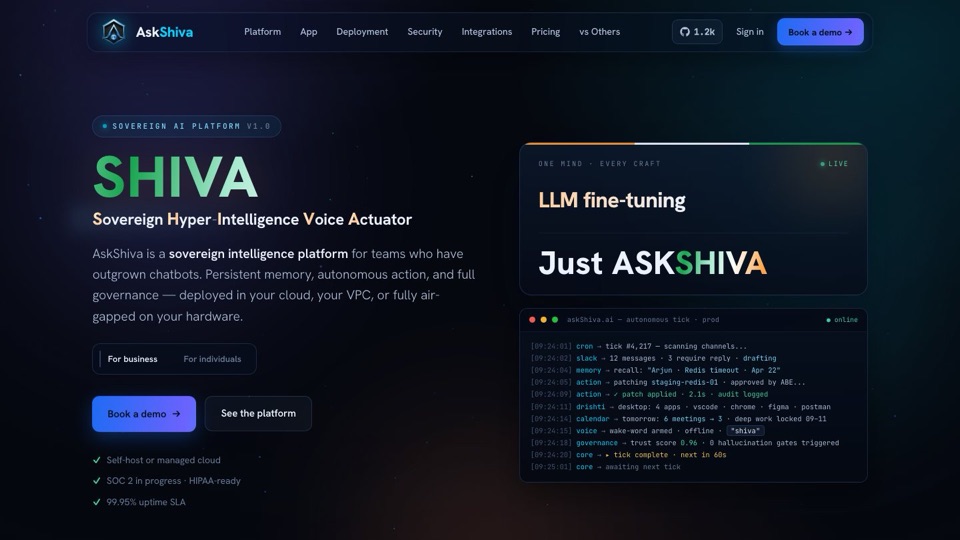
From Answering Questions to Completing Tasks
An AI assistant is a tool that goes beyond providing information to delivering actual results. It can transform simple text or voice requests into finished work like documents, spreadsheets, and code, bridging the gap between getting an answer and finishing a task.
Many people mistake AI for a more advanced search engine. While a search engine gives you a list of websites to read, an AI assistant performs the work for you. It doesn't just tell you how to create a spreadsheet; it creates the file and provides it to you as a downloadable output.
For a business owner, this means moving from "how-to" to "done." Instead of spending time researching tax formats or document layouts, you can simply ask the assistant to produce them. This includes a wide variety of digital assets such as:
- Documents: Professional letters, reports, or memos.
- Web Pages: Simple digital layouts for products or services.
- Spreadsheets: Organized data tables ready for accounting or inventory.
- Translations: Converting text between different languages.
- Code: Writing scripts or snippets to automate digital tasks.
The goal is to move from a conversation that ends in a paragraph of text to a conversation that ends with a finished file in your hand. This is a fundamental shift in how we use technology to manage daily business operations.
Executing Multi-Step Agentic Workflows
Modern AI is moving toward what developers call "agentic architecture." This means the assistant does not just react to a single prompt; it can plan, act, and verify its own work through a series of steps.
An advanced assistant uses these workflows to handle complex instructions that require more than one action. Instead of just giving a one-off answer, an agentic system can break a large goal into smaller, manageable pieces. This often involves running several agents in parallel to handle different parts of a single complex flow.
The process generally follows a logical loop that mimics how a human employee might work:
- Planning: The assistant analyzes your request and determines the steps needed to complete it.
- Acting: The assistant uses a specific tool (like a calculator, a file writer, or a search tool) to perform an action.
- Checking: The assistant reviews the result of the action to ensure it meets your requirements and is accurate.
- Remembering: The assistant stores the outcome so it can be used for the next step or a future request.
This ability to "think" through a process makes the AI much more than a chatbot. It becomes a digital worker capable of managing a workflow from start to finish.
Maintaining Context Through Memory
One of the biggest frustrations with basic AI is having to repeat yourself. If you tell an AI your company name in one chat, you often have to tell it again in the next. An AI assistant with memory solves this by keeping context across different conversations.
When an assistant has long-term memory, it builds a continuous understanding of your business and your preferences. This allows for much more intelligent follow-ups. For example, if you have previously discussed an unpaid invoice, you can simply say, "Remind me if they haven't paid by Friday," and the AI will know exactly which customer and which invoice you are talking about.
This capability is central to ai with long-term memory, which allows the tool to act as a true partner rather than a temporary assistant. By remembering details like customer names, specific product lists, or business addresses, the AI reduces the mental load on the business owner.
Currently, memory features are being actively developed. While the ability to keep context across conversations is already a core part of the experience, advanced controls to manage exactly what the AI remembers are being finalized for wider release.
Voice and Multilingual Interaction
For many business owners, typing on a small screen is not the most efficient way to work. Modern assistants are designed to be spoken to directly in the browser. This creates a natural, hands-free way to manage business tasks while you are busy with physical work or managing a shop.
The technology works through a seamless loop: your spoken words are converted to text, processed by the AI, and then the AI's response is read back to you through your device's speakers. This makes the interaction feel like a real conversation rather than a data entry task.
Furthermore, language is a critical factor for businesses operating in diverse markets. An assistant designed for a global market might struggle with local nuances, but a specialized assistant is built to handle Indian languages like Hindi and Marathi. This allows users to communicate in their native tongue, making technology much more accessible.
Research is even looking toward the future of this technology, with work being done on fully offline, on-device voice processing. This would mean that in the future, you could speak to your AI assistant in your local language even without an active internet connection.
Practical Business Applications
For a small business owner in India, an AI assistant is most valuable when it handles tasks that are specific to the local economy. General-purpose AI often treats Indian business needs as "edge cases," but a specialized assistant treats them as the main priority.
Consider these real-world scenarios that an AI assistant can handle:
- GST Compliance: You can ask the assistant to "Make a GST bill for Sharma Traders, ₹18,400." The assistant will draft the invoice with the correct tax lines calculated and provide it as a finished file.
- Local Language Communication: After creating a bill, you can say, "Send it on WhatsApp, in Marathi." The assistant can translate the covering message into the local language and prepare the message for sending.
- Data Conversion: You can take a messy spreadsheet from last month and ask the assistant to "Make a one-page price list from last month's sheet." It will read the data and produce a clean, printable document.
This level of integration turns the AI into a specialized ai assistant for small business owners, capable of handling the specific paperwork and communication styles required to run a business in India.
Smart Model Routing and Reliability
Not every task requires the most powerful, expensive AI model. A simple translation task is different from a complex data analysis or a multi-step agentic workflow. To be efficient and reliable, a professional assistant uses "Smart Model Routing."
This means the assistant automatically picks the most suitable AI model for each specific request. This approach provides several key benefits:
| Feature | How it Works | Benefit to You |
|---|---|---|
| Model Routing | Matches the task difficulty to the right AI model. | Faster responses and more efficient use of resources. |
| Model Fallback | If one AI provider fails or goes offline, the system automatically switches to another. | Your work continues without interruption, even during outages. |
| Bulk Processing | Large amounts of work can be routed to open models on private GPU servers. | Lower costs and higher privacy for large-scale data tasks. |
By using this architecture, the assistant ensures that you aren't paying for high-end intelligence when a simpler model would suffice, while also ensuring that a single technical failure doesn't stop your entire business operation in its tracks.
Frequently Asked Questions
- How is an AI assistant different from a search engine?
- A search engine provides links and information for you to read, while an AI assistant performs actions like drafting an invoice, creating a spreadsheet, or translating a message.
- Can an AI assistant remember my previous instructions?
- Yes, advanced assistants use memory to keep context across different conversations so you don't have to repeat details like customer names or business settings every time you start a new chat.
- Can I talk to an AI assistant instead of typing?
- Yes, many modern assistants support voice interaction where you can speak directly in the browser and hear the AI's reply read back to you.
- Can an AI assistant help with Indian business tasks?
- Yes, they are specifically designed to handle needs like generating GST invoices and communicating in Indian languages like Marathi or Hindi.
- What are AI agents?
- Agents are tools that allow an AI to follow step-by-step task flows. This involves a cycle of planning a job, using a tool to act, and then checking its own work to ensure accuracy.

Questions people ask
How is an AI assistant different from a search engine?
A search engine provides links and information, while an AI assistant performs actions like drafting an invoice or creating a spreadsheet.
Can an AI assistant remember my previous instructions?
Yes, advanced assistants use memory to keep context across conversations so you don't have to repeat yourself.
Can I talk to an AI assistant instead of typing?
Yes, many modern assistants support voice interaction where you can speak and hear the response in the browser.
Can an AI assistant help with Indian business tasks?
Yes, they can handle specific needs like generating GST invoices and communicating in Indian languages like Marathi or Hindi.
What are AI agents?
Agents are tools that allow an AI to follow step-by-step task flows, such as planning a job, using a tool, and checking its own work.