
What are AI agents for Indian businesses?
AI agents are digital workers that go beyond simple chat to actually complete multi-step business tasks. Instead of just answering questions, they use tools to handle real work like drafting GST invoices or managing customer follow-ups.
- Beyond Chatbots: While a chatbot might explain how to create a bill, an AI agent actually drafts the document and prepares it for sending.
- First-Class Workers: They act as digital employees with their own identities, following the same permissions and audit logs as your human staff.
- Workflow Integration: For Indian SMEs, this means agents that understand the local business rhythm, including WhatsApp communication and GST requirements.
The Problem with Fragmented Data
Most Indian small and medium enterprises face a common struggle: data is scattered everywhere. A typical business owner might find their sales leads trapped in a spreadsheet, customer chats living on WhatsApp, HR details in a separate app, and important invoices buried in an email inbox.
When your business information is siloed like this, traditional AI tools hit a wall. They can only see one small piece of the puzzle at a time, making them unable to help with complex, end-to-end tasks.
This fragmentation creates two major risks for growing businesses:
- Security Holes: Trying to bolt different, disconnected tools together often creates gaps in how data is protected.
- Duplicate Work: Without a single source of truth, you end up entering the same customer details into multiple systems, leading to errors and wasted time.
A Foundation-First Approach with BusinessOS
Most "all-in-one" business tools are actually a collection of separate products bolted together. This is why they often feel clunky; each module has its own users, its own permissions, and its own way of defining a "customer."
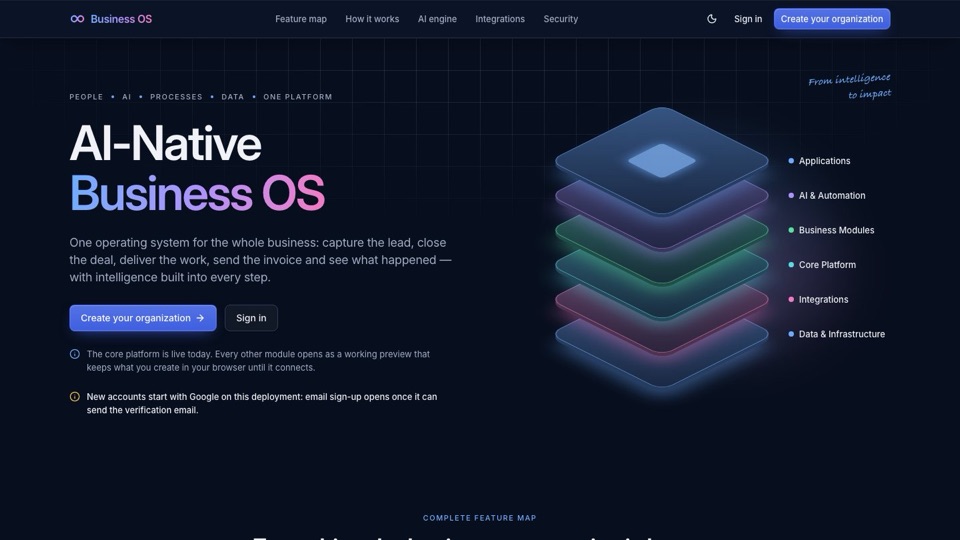
BusinessOS takes a different path. It is an AI-native operating system built on a single, master architecture. Instead of stitching tools together, everything is built on one foundation. This means every part of your business shares:
- One Identity: A single way to manage who is who in your company.
- One Permission Engine: A unified way to control who can see or edit specific data.
- One Audit Log: A complete history of every action taken across the entire system.
- One File Store: A centralized place for all your documents and attachments.
Security is not an afterthought. We use PostgreSQL row-level security to ensure strict data isolation. This means your organization's data is physically and logically separated from others, even though we run on a multi-tenant platform. You can trust that your sensitive business information remains yours alone.
If you want to see how this foundation works, you can explore the BusinessOS core architecture.
Agents That Do the Work
When we talk about "Agentic AI," we aren't talking about a chat box in the corner of your screen. We are talking about agents that are integrated into the very fabric of your business operations.
In the BusinessOS roadmap, agents are designed to work across every module, from CRM to HR and Operations. They don't just suggest actions; they execute them using a specific cycle to ensure accuracy:
- Plan: The agent breaks down a complex request into logical steps.
- Act: The agent uses specific tools to perform a task (like updating a record or generating a file).
- Check: The agent verifies that the task was completed correctly.
- Remember: The agent records the outcome so it can use that context in the next task.
Imagine an agent that monitors your sales pipeline. It can automatically follow up on overdue invoices or qualify inbound leads from your website, acting much like a human employee would, but with the speed of software.
Bridging the Gap Between Answer and Done
There is a massive difference between getting an answer and getting a result. If you ask a standard AI, "How do I make a GST bill?", it will give you a text explanation. If you use AskShiva, you get the actual bill.
AskShiva is designed to bridge this gap. It turns conversational requests—whether typed or spoken—into finished work. Here is how that looks in a real business day:
| Your Request | The Agent's Output |
|---|---|
| "Make a GST bill for Sharma Traders, ₹18,400." | A drafted, tax-compliant invoice file ready for your review. |
| "Send it on WhatsApp, in Marathi." | A translated message and the document prepared for sending. |
| "Remind me if they haven't paid by Friday." | A scheduled follow-up task based on the previous invoice context. |
| "Make a one-page price list from last month's sheet." | A clean, printable document generated from your existing data. |
This is the power of an assistant that has "memory." Because it remembers who Sharma Traders is and what you discussed previously, you don't have to re-explain the details every time you talk to it.
Built for the Indian Context
Many AI tools are built for Western markets where business happens over email and Slack. But Indian business runs on a different rhythm. To be truly useful for an Indian SME, AI must understand WhatsApp, GST, and UPI.
We are building technology that treats these local realities as the "main case," not an edge case. This includes:
- Multilingual Support: The ability to translate customer messages into Marathi, Hindi, and other Indian languages before they are sent or answered.
- Local Document Standards: Treating GST-compliant invoices as primary, first-class outputs of the system.
- Voice Interaction: While we currently support voice in the browser, our research lab is focused on developing fully offline, on-device voice support for Indian languages. This ensures that even with a spotty connection, the technology remains accessible.
For more on how AI is transforming local commerce, see our guide on AI for Small Business in India.
Enterprise-Grade Security for SMEs
A common fear for business owners is: "If I let an AI agent act on my behalf, how do I know it won't make a mistake or access things it shouldn't?"
In a structured system like BusinessOS, an AI agent is governed by the exact same rules as a human employee. It doesn't have "magic" access; it only has the permissions you explicitly grant it. We ensure security through several layers:
- Append-Only Audit Logs: Every single action an agent takes is recorded in a permanent, searchable, and exportable log. You can see exactly who (or what) did what and when.
- Single Permission Engine: You don't have to set permissions for every single tool. One engine controls access across the entire organization, preventing unauthorized data exposure.
- Modern Authentication: We support secure sign-in methods including passkeys, two-factor authentication (2FA), and Single Sign-On (SSO) to keep your business identity safe.
We believe that small businesses deserve the same level of security and oversight as large enterprises. By treating agents as "first-class users," we make it possible to automate your business without losing control of your data.
Frequently Asked Questions
- How are AI agents different from standard chatbots?
- Standard chatbots provide answers; AI agents use tools to complete tasks, such as drafting an invoice or following up on a payment, while following your business's specific permissions.
- Can AI agents handle Indian tax requirements like GST?
- Yes, agents can be designed to work with Indian business documents, such as generating GST-compliant invoices as first-class outputs.
- Is my business data secure when using AI agents?
- Yes, in a system like BusinessOS, agents operate under the same row-level security and audit logs as human users, ensuring strict data isolation.
- Do these agents support local Indian languages?
- Yes, the technology is built to handle translations for Marathi, Hindi, and other languages, and is working toward offline voice support for Indian languages.
- Can I track what an AI agent does in my company?
- Yes, every action an agent takes is recorded in an append-only audit log, allowing you to see exactly who (or what) did what and when.
Questions people ask
How are AI agents different from standard chatbots?
Standard chatbots provide answers; AI agents use tools to complete tasks, such as drafting an invoice or following up on a payment, while following your business's specific permissions.
Can AI agents handle Indian tax requirements like GST?
Yes, agents can be designed to work with Indian business documents, such as generating GST-compliant invoices as first-class outputs.
Is my business data secure when using AI agents?
Yes, in a system like BusinessOS, agents operate under the same row-level security and audit logs as human users, ensuring strict data isolation.
Do these agents support local Indian languages?
Yes, the technology is built to handle translations for Marathi, Hindi, and other languages, and is working toward offline voice support for Indian languages.
Can I track what an AI agent does in my company?
Yes, every action an agent takes is recorded in an append-only audit log, allowing you to see exactly who (or what) did what and when.