
Automating Indian Business Workflows
We bridge the gap between getting an AI answer and getting the work done. Our focus is on agentic architecture where AI agents follow up on invoices, qualify leads, and manage tasks within your business operating system.
Most AI tools today are just clever chatbots. You ask them a question, they give you a paragraph, and then you have to do the actual work yourself. We believe that is not automation; that is just a faster way to read text.
Our approach is different. We build systems where AI agents have their own identity, permissions, and audit logs, just like human employees. Instead of just telling you how to write a follow-up, an agent can actually perform the follow-up, check if the task was completed, and record the outcome in your records.
This is what we call "Agentic AI." It is the difference between a tool that talks and a tool that acts. By integrating these agents into your core business processes, you move from manual data entry to automated execution.
The Problem with Fragmented Tools
Typical Indian SMEs face a massive "fragmentation tax." Every day, your team is jumping between different apps to keep the business running. You might run your leads in a spreadsheet, talk to customers on WhatsApp, manage HR in a separate app, and handle invoices in a fourth tool. To top it off, your important documents are scattered across various email threads.
This disconnected way of working creates three major problems for a growing business:
- Data Silos: Because nothing "talks" to anything else, you end up with duplicate data. You might update a customer's phone number in one place, but your sales team is still using the old number on WhatsApp.
- Security Holes: When data is scattered across multiple apps, it becomes nearly impossible to track who has access to what. It is difficult to ensure that a junior staff member cannot see sensitive payroll information.
- Limited AI Intelligence: Standard AI tools can only see one small piece of your business at a time. If an AI can only see your email but not your sales spreadsheet, it cannot help you effectively.
When your business information is trapped in these silos, you cannot truly automate. You cannot automate a process that you cannot see in its entirety.
The BusinessOS Foundation
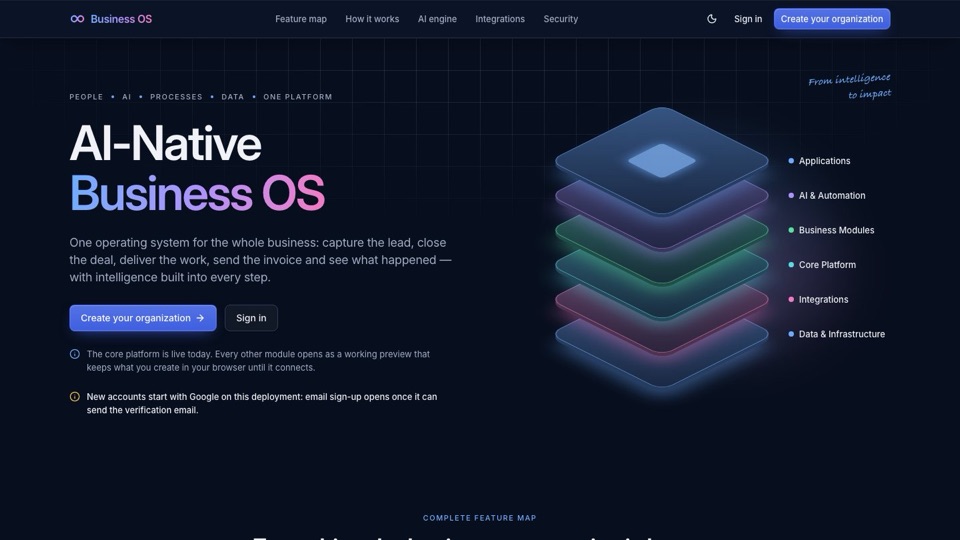
To solve fragmentation, we don't just add another app to your pile. We build on a multi-tenant, AI-native operating system called BusinessOS. Instead of bolting products together, we start with a solid foundation and build modules on top of it.
BusinessOS is designed to be the single source of truth for your entire organization. It is built on a master architecture where everything shares the same identity, the same permission engine, and the same audit log. This ensures that as you add more tools—like a CRM or HR module—they all work together seamlessly.
Our architecture is built with enterprise-grade security at its core. We use PostgreSQL row-level security (RLS) to ensure strict data isolation. This means that even though many organizations use our platform, your data is mathematically isolated and cannot be seen by others. Every single change is recorded in an append-only, searchable audit log, so you always know exactly who did what and when.
Currently, the BusinessOS foundation is live in early release, providing secure sign-in, organization management, and a robust permission engine. We are building the future of business management, one module at a time.
From Chatbots to AI Agents
There is a massive difference between a basic chatbot and a true AI agent. A chatbot is reactive; it waits for you to ask a question and then provides a response. An AI agent is proactive and capable of executing complex workflows.
Our agents follow a "Plan, Act, Check" loop. They can plan a series of steps, use tools to perform those steps, check if the result is correct, and remember the context for the next task. This is the core of AskShiva, our AI assistant designed to turn requests into finished work.
Consider the difference in a real-world scenario:
| Feature | Basic Chatbot | AI Agent (Agentic AI) |
|---|---|---|
| Primary Goal | Provide information/answers | Complete a specific task |
| Workflow | Single turn (Question & Answer) | Multi-step (Plan, Act, Verify) |
| Integration | Limited to the chat window | Works across CRM, HR, and Ops |
| Accountability | No identity or permissions | Has its own identity and audit log |
Because our agents are "first-class users," they operate within the same rules as your human employees. If a human employee doesn't have permission to see the payroll module, the AI agent won't have permission either. This makes automation safe and scalable.
Built for the Indian Context
Most AI models are trained on Western business workflows. They understand US-style invoices and English-only communication. But India is different. Indian business runs on WhatsApp, GST, UPI, and a dozen different languages every single day.
We build our automation to handle the reality of Indian commerce. Our agents don't just "know" about GST; they treat GST invoices as first-class outputs. An agent can draft a professional invoice, calculate the tax lines correctly, and prepare it for delivery.
Communication is also a key focus. Our systems are designed to bridge language gaps. For example, an agent can take a customer message in Marathi or Hindi, translate it for your English-speaking manager, and then draft a reply in the customer's native language. This allows you to scale your business across different states without language being a barrier.
Whether it is managing payments via UPI-related workflows or generating complex tax documents, our AI is built to work in the environment where your customers actually live.
Robust and Secure Engineering
We don't cut corners on the technology that powers your business. Our stack is chosen for reliability, speed, and extreme data security. We use a TypeScript monorepo, utilizing Next.js for our web applications and NestJS for our API. This ensures a consistent and typed codebase from the front end to the back end.
Our data layer is powered by PostgreSQL 18. We use pgvector to enable advanced AI search features, allowing our agents to find relevant information across your entire history of documents and messages. To ensure nothing is lost between a database change and an automated task, we use an "outbox" pattern for all events.
Security is not an afterthought; it is baked into the code. We support modern, secure sign-in methods, including:
- Passkeys: For passwordless, biometric-based security.
- Two-Factor Authentication (2FA): Mandatory verification for sensitive actions.
- SSO (Single Sign-On): For seamless integration with Google or Microsoft accounts.
We believe that for an AI to be trusted with your business, the underlying engineering must be rock solid.
The Roadmap for Automation
We are building a complete ecosystem, and we are doing it in stages to ensure the foundation is perfect before we add complexity. Our roadmap is focused on moving from a secure core to a fully automated business environment.
Current Focus: The Foundation
We have already established the core identity, organization, and permission systems. We have implemented secure sign-in, file management, and the append-only audit log. This is the "operating system" layer that makes everything else possible.
In Development: Business Modules
The next major step is the rollout of specific business modules. Our first major focus is the CRM and sales module, which will handle contacts, deals, pipelines, and quotes. This will be the first place where you can see the power of integrated AI agents working with your sales data.
Future Vision: Full Automation
Our long-term goal is to provide a complete suite of automated tools. This includes:
- Work and Communication: Automated task and project management.
- HR: Automated payroll, leave management, and team organization.
- Operations: Automated document workflows and approval processes.
- App Builder: A drag-and-drop tool to build your own internal apps on top of the BusinessOS foundation.
Frequently Asked Questions
- What is the difference between a chatbot and an AI agent?
- A chatbot provides answers, while an AI agent performs tasks. Our agents have identities and permissions, allowing them to act within your business systems like an employee.
- How do you ensure data security for my business?
- We use PostgreSQL row-level security (RLS) and a single permission engine to ensure strict data isolation between different organizations and teams.
- Can the AI handle Indian languages?
- Yes, our systems are designed to translate and communicate in languages like Marathi and Hindi to suit Indian business workflows.
- How is AI activity tracked in the system?
- Every action an AI agent takes is recorded in an append-only, searchable audit log, ensuring full transparency for human oversight.
- What makes an AI 'AI-native'?
- An AI-native system means AI agents are first-class users that follow the same permissions, approvals, and audit rules as your human staff.
Questions people ask
What is the difference between a chatbot and an AI agent?
A chatbot provides answers, while an AI agent performs tasks. Our agents have identities and permissions, allowing them to act within your business systems like an employee.
How do you ensure data security for my business?
We use PostgreSQL row-level security (RLS) and a single permission engine to ensure strict data isolation between different organizations and teams.
Can the AI handle Indian languages?
Yes, our systems are designed to translate and communicate in languages like Marathi and Hindi to suit Indian business workflows.
How is AI activity tracked in the system?
Every action an AI agent takes is recorded in an append-only, searchable audit log, ensuring full transparency for human oversight.
What makes an AI 'AI-native'?
An AI-native system means AI agents are first-class users that follow the same permissions, approvals, and audit rules as your human staff.