
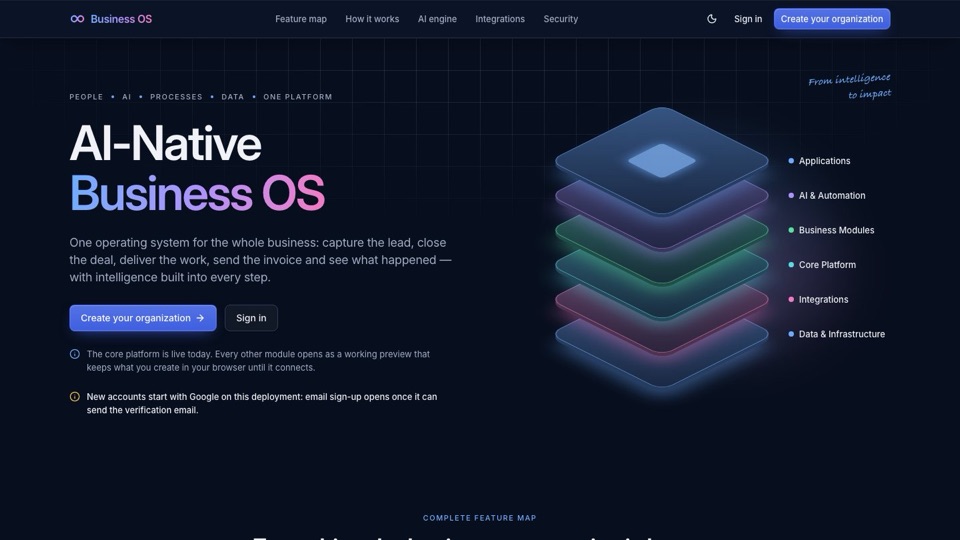
BusinessOS is a multi-tenant, AI-native operating system designed to unify the fragmented digital workflows of Indian businesses. It provides a secure, single foundation for managing your entire organization, moving beyond disconnected spreadsheets and chat apps to a unified environment where AI agents act as integrated team members.
What is an AI Business OS?
For many Indian small and medium enterprises (SMEs), running a business feels like a constant battle against data fragmentation. You might track your sales leads in a messy Excel sheet, talk to customers on WhatsApp, manage your staff through a separate HR app, and store important invoices in various email threads. When nothing talks to anything else, you lose the ability to see the full picture of your business.
An AI Business OS changes this by providing a single, secure foundation. Instead of "bolting" different software tools together, BusinessOS is built from the ground up as a single system. It replaces the chaos of disconnected apps with a unified environment where your data lives in one place.
- A multi-tenant, AI-native operating system: Built by the team at AskShiva, this is a platform designed from the first line of code to work with AI as a core component.
- Unified Data: It replaces the need for separate apps for leads, HR, invoices, and documents.
- A Single Source of Truth: Your data is isolated by organization and team, ensuring that what you see is accurate and up-to-date.
- Agentic Architecture: This goes beyond simple chatbots. In BusinessOS, AI agents are "first-class users," meaning they have their own identities and can actually perform work within your business rules.
A Unified Foundation, Not Bolted-on Apps
Most business software is built by taking several different products and "bolting" them together. While this seems fast, it creates massive headaches for business owners. You end up with security holes between apps, duplicate data entries, and different sets of permissions for every single tool you use.
BusinessOS takes a different approach. We start with a master architecture. This means everything in your business—from your sales team to your accounting—shares the same core identity, the same permission rules, and the same audit log. This creates a seamless experience where your data flows naturally from one department to another without manual entry or security risks.
Core Security and Management Features
Because we focus on a unified foundation, we provide enterprise-grade security features that are often missing in smaller, disconnected apps:
- Secure Sign-in: We support modern, secure methods including passkeys, two-factor authentication (2FA), and Single Sign-On (SSO) via Google or Microsoft.
- Organized Workspaces: Easily manage different departments, teams, and workspaces within a single organization.
- Robust Permissions: A single permission engine controls who can see what, including the ability to hide specific fields from certain users.
- Append-only Audit Log: Every single change is recorded in a searchable, permanent log. You can export this via CSV to see exactly who did what and when.
Security is not just an afterthought; it is enforced at the most fundamental level. We use PostgreSQL row-level security (RLS) with a signed tenant context. This ensures that your data is strictly isolated from every other organization using the platform. Automated tests check this isolation for every single table in our database to guarantee your privacy.
AI Agents as Employees
When people hear "AI," they often think of a chat box sitting in the corner of a screen. While chatbots are useful, they are not "AI-native." An AI-native system treats AI agents as actual employees of your company.
In BusinessOS, an AI agent has its own identity. It doesn't just suggest text; it can actually perform actions. However, because it is part of the core operating system, it must follow the same rules as a human. If a human employee isn't allowed to see the payroll data, the AI agent won't be allowed to see it either. Every action an agent takes—whether it is qualifying a lead or following up on an invoice—is recorded in the same audit log as your human staff.
The Power of Agentic Workflows
Imagine a scenario where a customer hasn't paid an invoice. Instead of you having to check your bank account and then send a manual WhatsApp message, an AI agent can monitor the status and handle the follow-up. It can follow up on overdue invoices or qualify inbound leads while remaining strictly governed by your established rules and approval processes.
The focus of our architecture is not just on which AI model is the "smartest," but on how those models are governed. We focus on permissions, approvals, and auditability. This ensures that as you give AI agents more responsibility, you never lose control of your business processes.
Modules for Every Department
We are building BusinessOS layer by layer. We started with the "Foundation"—the essential plumbing that makes a business run—and we are now building the specific tools your departments need to thrive. Our roadmap is designed to turn your business into a fully automated, AI-driven organization.
| Module | What it covers | Current State |
|---|---|---|
| Foundation | Identity, organizations, permissions, files, search, and audit logs. | Live in Alpha |
| CRM and Sales | Managing contacts, deals, pipelines, and quotes. | Next (Not built yet) |
| Work and Communication | Tasks, projects, and messaging. | Planned |
| HR | People, teams, leave, and payroll. | Planned |
| Operations and Automation | Processes, approvals, documents, and AI agents. | Planned |
| App Builder | Drag-and-drop internal apps. | Planned |
While the CRM is the first major business module on our roadmap, the foundation is already live and ready for testing. We are also building a separate, specialized HRMS that is already running in early release at hrms.businessos.si.
Built for Reliability and Speed
For builders and technical owners, the architecture of BusinessOS is designed to be modern, scalable, and extremely reliable. We use a TypeScript monorepo approach, which allows us to maintain high speed and consistency across our entire stack. Our web application is built with Next.js, while our API is powered by NestJS, providing a typed, robust SDK for developers.
Our data layer is built on PostgreSQL 18, utilizing pgvector to enable advanced search and sophisticated AI features. To handle high-speed operations, we use Valkey for efficient queuing and caching. Finally, we employ the "outbox pattern" for our event system. This is a critical design choice that ensures no event—such as a notification or a task trigger—is ever lost between a database change and the action it is supposed to trigger.
The Bridge Between Answer and Done
The true power of BusinessOS comes from its integration with AskShiva. Most AI tools provide "answers"—a paragraph of text or a suggestion. BusinessOS is designed to provide "done"—the finished work.
AskShiva acts as the intelligence layer that turns your requests into completed tasks. Instead of just getting a suggestion on how to handle a customer, you can go from a simple conversation to a completed, formatted document or a multi-step task flow. This is the "bridge" we have built between having an idea and having a finished result.
Designed for the Indian Context
Business in India has unique requirements that global software often ignores. We don't treat these as "edge cases"; we treat them as the main case. BusinessOS and AskShiva are built to handle the realities of Indian commerce, including:
- GST Compliance: Generating proper GST-compliant invoices is a first-class capability.
- WhatsApp Integration: Since much of Indian business happens on WhatsApp, our tools are designed to work within that ecosystem.
- Language Diversity: We are working toward seamless translation and communication in Marathi, Hindi, and other Indian languages to ensure your business can communicate effectively with anyone.
Whether you are a small shop owner in Palghar or a growing tech startup in Bangalore, our goal is to provide the tools that handle the "boring" parts of business—the bookkeeping, the follow-ups, and the documentation—so you can focus on growing your company. For more on how this applies to your specific needs, explore our guides on AI for MSME in India or our specialized AI bookkeeping for India GST.
Frequently Asked Questions
- How is my data kept secure in a multi-tenant system?
- We use PostgreSQL row-level security (RLS) with a signed tenant context to ensure strict data isolation between different organizations. This means your data is physically and logically separated from other companies.
- What makes this 'AI-native' instead of just having a chatbot?
- In an AI-native system, agents are treated like employees; they have identities, follow your specific permissions, and their actions are logged in the audit trail, just like a human user.
- Can I see who changed a specific record in the system?
- Yes, the system includes an append-only, searchable audit log that records who did what and when. You can export these logs via CSV for your own records.
- Is the CRM module available now?
- The CRM module is currently on our roadmap and is not yet built. The current live foundation focuses on identity, permissions, and file management.
- How do I get access to the BusinessOS alpha?
- The foundation is open in alpha with test data. You can write to us to request access or to help us shape the upcoming CRM module.
Questions people ask
How is my data kept secure in a multi-tenant system?
We use PostgreSQL row-level security (RLS) with a signed tenant context to ensure strict data isolation between different organizations.
What makes this 'AI-native' instead of just having a chatbot?
In an AI-native system, agents are treated like employees; they have identities, follow your specific permissions, and their actions are logged in the audit trail.
Can I see who changed a specific record in the system?
Yes, the system includes an append-only, searchable audit log that records who did what and when, which can be exported via CSV.
Is the CRM module available now?
The CRM module is currently on the roadmap and is not yet built; the current live foundation focuses on identity, permissions, and file management.
How do I get access to the BusinessOS alpha?
The foundation is open in alpha with test data. You can write to us to request access or to help shape the upcoming CRM module.