
AI for Tier 2 and Tier 3 cities is about moving beyond simple chatbots to systems that actually complete business tasks. Instead of just providing information, these tools bridge the gap between a digital answer and a finished real-world action like sending an invoice or updating a spreadsheet.
The Gap Between Information and Execution
For many small business owners in India's growing urban centers, technology often feels like an extra chore rather than a helper. Most current digital tools require significant manual effort to keep everything organized. A typical business owner might run leads in a spreadsheet, manage customers on WhatsApp, track HR in one app, and handle invoices in a fourth, with documents scattered across emails.
This creates disconnected silos where nothing "talks" to anything else. When you use a standard AI, you often get a clever paragraph explaining how to perform a task, but the task itself remains unfinished. You still have to copy the text, open the correct app, and manually enter the data.
Small business owners in growing cities do not need a lecture on how to do a task; they need the task finished. To be truly useful, AI must bridge the gap between a simple answer and a completed business process. It needs to move from providing information to driving execution.
Why Agentic AI is the Key for Growing Cities
To understand how AI can actually help a business, we have to distinguish between a "chatbot" and an "agent." Most people are used to traditional AI, which is essentially just a chat box in the corner of a screen. You ask it a question, and it gives you text back. While helpful, it is still just a tool you have to manage.
Agentic AI is different. It uses what is known as an agentic architecture. This means the AI doesn't just talk; it acts. In a system designed for business, an AI agent is treated as a "first-class user." This means the agent can sign in, act within specific permissions, and follow complex workflows just like a human employee would.
When an AI is "agentic," it can plan a series of steps, use a tool to perform an action, check its own results to ensure they are correct, and remember the outcome for next time. This makes the technology much more reliable for high-stakes business work.
For those building these systems, the focus shifts from choosing the best AI model to perfecting the permissions, approvals, and audit logs that allow these agents to work safely.
Automating Daily Indian Business Workflows
The real value of AI in Tier 2 and Tier 3 cities comes from its ability to handle the specific, repetitive tasks that eat up a business owner's day. Instead of just talking about work, the AI performs it.
Consider these practical examples of how these workflows look in a real Indian business context:
- Document Creation: Instead of manually typing out tax details, you can tell the AI, "Make a GST bill for Sharma Traders, ₹18,400." The AI drafts the invoice with the correct tax lines and provides a finished file.
- Data Transformation: You can ask the AI to "Make a one-page price list from last month's sheet." The AI reads your spreadsheet and produces a clean, professional page that is ready to be printed or shared.
- Communication and Follow-ups: Because modern AI can maintain memory across conversations, it understands context. If you tell it to "Remind me if they have not paid by Friday," it remembers which invoice and which customer you are talking about, allowing for automated, context-aware follow-ups.
This moves the business owner from being a data entry clerk to being a manager of digital assistants.
Built for Indian Languages and Voice
Business in India does not happen in a vacuum of English text. It happens on WhatsApp, through UPI payments, and across a dozen different languages. An AI designed for a Western market might treat these as "edge cases," but for an Indian SME, these are the main events.
To be useful, AI must handle the reality of Indian commerce. This includes:
- Voice-to-Voice Interaction: Many busy owners prefer speaking over typing. Modern AI allows users to speak directly in the browser and hear the reply spoken back to them. This makes technology accessible to everyone, regardless of their typing speed or comfort with digital interfaces.
- Multilingual Communication: AI can act as a bridge between you and your customers by translating messages into Marathi, Hindi, and other local languages before they are sent.
- Contextual Awareness: The AI understands the specific documents used in India, such as GST invoices, treating them as standard, first-class outputs.
By integrating voice and local language support, AI becomes a tool that fits into the existing rhythm of a local shop or a growing manufacturing unit, rather than a tool that forces the owner to change how they work.
A Unified Foundation for Business Data
One of the biggest hurdles to using AI effectively is "fragmented data." Most businesses have their information scattered across different apps and files. When data is disconnected, an AI can only see one small piece of the puzzle at a time, making it impossible for it to perform complex, multi-step tasks effectively.
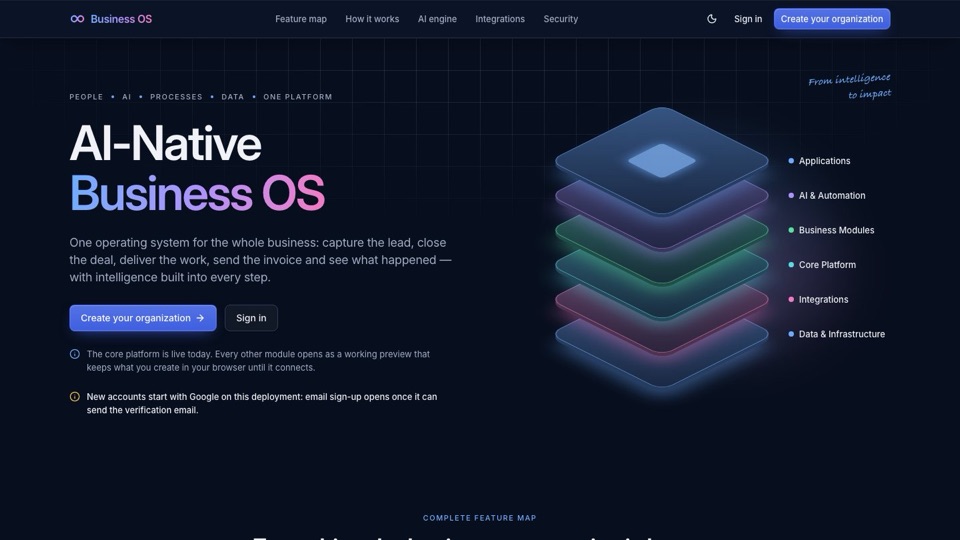
To solve this, businesses need a unified foundation—a single source of truth. This is the core philosophy behind BusinessOS. Instead of bolting different products together, which creates security holes and duplicate data, a proper system starts with a master architecture.
A professional business operating system provides several key layers:
| Feature | How it works for your business |
|---|---|
| Identity & Permissions | One single engine that controls who can see what, whether they are a human or an AI agent. |
| Data Isolation | Uses database-level security (like PostgreSQL row-level security) to ensure your data stays private and secure. |
| Centralized Files & Search | All documents, spreadsheets, and messages are stored in one place, making them searchable by both humans and AI. |
| Audit Logs | An "append-only" record that tracks every change, ensuring you always know who (or what) modified your data. |
When you have this foundation, AI agents can work across different modules—like CRM, HR, or Operations—because they are all drawing from the same reliable pool of information.
The Future: Always-On AI Employees
We are moving toward a future where AI moves from being a "helper" to being an "always-on company agent." This is the evolution from simple assistance to autonomous business processes.
In this new model, these agents work across all parts of your business. They don't just wait for you to ask a question; they monitor workflows. They can qualify inbound leads, follow up on overdue payments, or manage schedules across your CRM and Operations modules. They function as digital employees that never sleep, working side-by-side with your human team.
The ultimate goal is an "AI-native operating system." In this environment, humans and AI agents operate within the same permission structures and use the same tools. You aren't just using a tool to help you work; you are managing a team of digital workers that help you grow your business.
As these technologies mature, the gap between "thinking" and "doing" will continue to shrink, allowing SMEs in Tier 2 and Tier 3 cities to compete on a global scale with much less administrative overhead.
Frequently Asked Questions
- How is AI different for small businesses in Tier 2/3 cities compared to large corporations?
- While large corporations often use AI for massive data analysis, small businesses need AI that performs specific, practical tasks like creating GST bills or managing customer follow-ups in local languages.
- Can AI work if I don't want to type everything?
- Yes, modern AI assistants allow you to speak directly in the browser and receive spoken replies, making it much faster for busy owners to get things done.
- Will AI understand my local language?
- AI is increasingly designed for Indian contexts, capable of translating and communicating in languages like Hindi and Marathi to match how business is actually conducted.
- Is my business data safe when using AI agents?
- When built on a proper foundation, AI agents follow the same strict permission and audit log rules as human employees, ensuring your data remains isolated and secure.
- What is an 'agentic' AI agent?
- An agentic AI is one that doesn't just talk; it can actually use tools to plan a task, act on it, check its own results, and remember the outcome for the next time.
Questions people ask
How is AI different for small businesses in Tier 2/3 cities compared to large corporations?
While large corps use AI for data analysis, small businesses need AI that performs specific tasks like creating GST bills or sending WhatsApp messages in local languages.
Can AI work if I don't want to type everything?
Yes, modern AI assistants allow you to speak directly in the browser and receive spoken replies, making it much faster for busy owners.
Will AI understand my local language?
AI is increasingly designed for Indian contexts, capable of translating and communicating in languages like Hindi and Marathi.
Is my business data safe when using AI agents?
When built on a proper foundation, AI agents follow the same strict permission and audit log rules as human employees, ensuring data isolation.
What is an 'agentic' AI agent?
An agentic AI is one that doesn't just talk, but can actually use tools to plan, act, check its own results, and remember the outcome.