
Building the Future of Business with AI
We are an AI software company in India focused on agentic AI architecture. We build AI-native operating systems and assistants that turn requests into finished work, moving beyond simple chatbots to create agents that act as first-class members of your organization.
Most business owners are used to "chatting" with AI—asking it to write an email or summarize a text. We are building something different. We focus on agentic AI, which means the AI doesn't just talk; it acts. Instead of giving you a draft, our technology aims to complete the task, such as sending an invoice or managing a follow-up, directly within your business workflow.
- Agentic Architecture: We design systems where AI agents have their own identities and permissions to perform real-world tasks.
- AI-Native Operating Systems: We build the foundational software that allows AI to live at the core of your business operations.
- From Answers to Actions: Our goal is to close the gap between a user asking a question and a task being marked as "done."
The BusinessOS Foundation
Most modern business tools are built by "bolting" different products together. A company might use one app for leads, another for WhatsApp messages, a third for HR, and a fourth for invoicing. This creates massive problems: security holes, duplicate data, and a lack of clarity on who changed what.
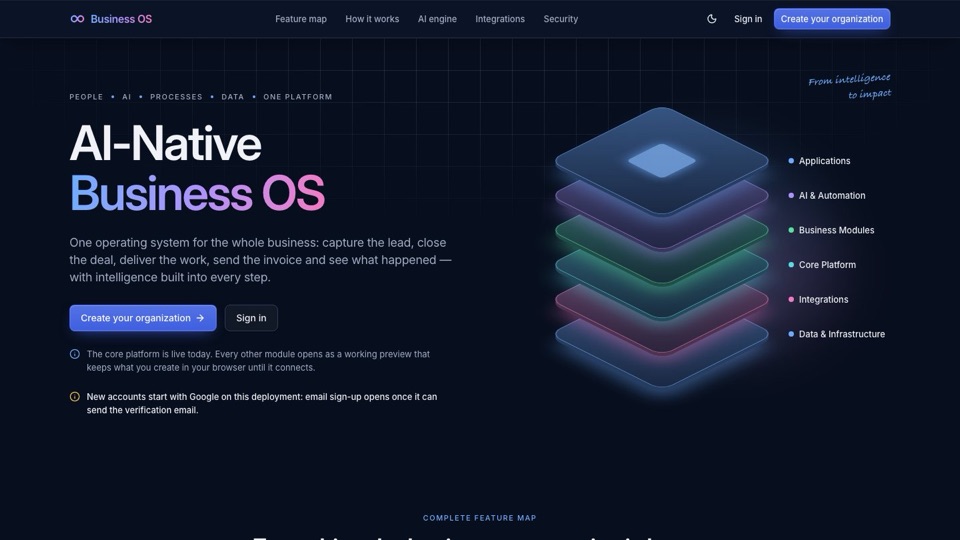
BusinessOS is an AI-native operating system designed to solve this fragmentation. Instead of a collection of disconnected tools, it provides a single, secure foundation for your entire company. It is built to be the "source of truth" for your business data.
Core Infrastructure Features
We believe that for AI to work effectively, the underlying data must be organized and secure. Our foundation includes:
- Unified Identity: A single permission engine ensures that everything—from files to search to communication—is unified under one set of rules.
- Secure Access: We use modern authentication, including secure sign-in with passkeys, two-factor codes, and SSO (Google or Microsoft).
- Data Isolation: Using PostgreSQL row-level security, we ensure strict multi-tenant data isolation. Your data stays separate and secure.
- Complete Accountability: An append-only audit log records every action taken within the system, making it searchable and exportable for total transparency.
Currently, the foundation is live in alpha. While the CRM module is currently being developed, the core identity and permission layers are ready to support the modules on our roadmap, including Work, HR, Operations, and Automation.
AI Agents as First-Class Users
In traditional software, an "AI feature" is usually just a chat box tucked into a corner of the screen. In our agentic architecture, we treat AI agents as first-class users. This means we treat an AI agent much like we would treat a new human employee.
When an agent is assigned to a task—such as qualifying an inbound lead or following up on an overdue invoice—it operates within your established business rules. It signs in with its own identity and follows the exact same permission structures as a human staff member.
Governance and Accountability
This approach solves the "black box" problem of AI. Because agents are integrated into the core system, they are subject to the same governance as your team:
- Identity: Every agent has a clear identity within the system.
- Permissions: Agents can only access the files and data they are explicitly permitted to see.
- Auditability: Every single action an agent takes is recorded in the same append-only audit log used by human users. This ensures you always know exactly what the AI did and why.
AskShiva: From Answer to Done
AskShiva is our AI assistant designed to bridge the gap between a user's request and a completed task. While a standard chatbot might explain how to create a bill, AskShiva actually creates the bill and prepares it for delivery.
Imagine a small business owner in Palghar. They don't want to spend time formatting documents. They can simply say, "Make a GST bill for Sharma Traders, ₹18,400." AskShiva drafts the invoice with the correct tax lines and provides the file. The user can then say, "Send it on WhatsApp, in Marathi," and the assistant handles the translation and the preparation for sending.
Key Capabilities
| Capability | How it Works |
|---|---|
| Multi-step Tasks | Handles complex flows like drafting documents, spreadsheets, or web pages. |
| Memory | Maintains context across different conversations so you don't have to repeat details. |
| Voice Interaction | Speak directly in your browser and hear the AI's response. |
| Model Routing | Automatically switches between AI models so work continues even if one provider fails. |
By using model routing with fallback, we ensure reliability. If one AI provider has an outage, the system automatically switches to another, ensuring your business operations are never interrupted. Explore AskShiva capabilities.
Built for the Indian Business Context
Most AI tools are built for Western markets, where business is conducted primarily in English via email. But Indian commerce runs on a different rhythm. It runs on WhatsApp, UPI, and GST. It operates in a dozen different languages simultaneously.
We are building technology that treats these "edge cases" as the main case. Our focus is on practical, real-world outputs that matter to Indian MSMEs (Micro, Small, and Medium Enterprises):
- Localized Communication: Translating customer messages into Marathi, Hindi, and other regional languages to ensure clear communication.
- GST Compliance: Generating invoices and documents that meet the specific legal requirements of the Indian tax system.
- Voice and Connectivity: We are currently researching offline, on-device voice capabilities for Indian languages, aiming to provide AI assistance even in areas with unstable internet connections.
For more information on how AI is transforming local commerce, see our guides on AI for MSMEs and AI for small businesses in India.
The Technology Behind the Intelligence
To support the complex requirements of agentic workflows and secure data isolation, we use a modern, robust technology stack. Our architecture is designed for scale, security, and reliability.
Our Engineering Stack
- Core Language: A TypeScript monorepo for consistent development across the entire system.
- Web & API: We use Next.js for our web applications and NestJS for our API, supported by a typed SDK.
- Database: PostgreSQL 18 is our source of truth, utilizing
pgvectorto enable advanced AI search and vector capabilities. - Real-time & Queues: We use Valkey for efficient queuing and caching, ensuring that background tasks and events are processed reliably.
- Authentication: We employ Better Auth to provide modern, secure sign-in experiences, including Multi-Factor Authentication (MFA) and passkeys.
By using an "outbox" pattern for events, we ensure that no task is lost between a database change and the background job it triggers. This level of technical rigor is what allows our AI agents to operate reliably in a production environment.
Frequently Asked Questions
- What makes an AI company "AI-native"?
- AI-native means AI agents are integrated into the core system with their own identities and permissions, rather than just being a chat box on the side of a screen.
- Can AI agents handle sensitive business data?
- Yes. Our architecture uses PostgreSQL row-level security and a single permission engine to ensure agents follow the same strict data isolation as human users.
- Does the AI understand Indian business documents?
- Yes, our tools are designed to handle Indian-specific requirements, such as generating GST-compliant invoices and communicating in local languages.
- How does the AI maintain context in a conversation?
- Through advanced memory systems that keep context across different conversations, so you don't have to re-explain your business or customers every time.
- What happens if an AI model provider goes down?
- We use model routing with fallback. This means the system automatically switches to another model to ensure your work is not interrupted.
Questions people ask
What makes an AI company 'AI-native'?
AI-native means AI agents are integrated into the core system with their own identities and permissions, rather than just being a chat box on the side of a screen.
Can AI agents handle sensitive business data?
Yes. Our architecture uses PostgreSQL row-level security and a single permission engine to ensure agents follow the same strict data isolation as human users.
Does the AI understand Indian business documents?
Yes, our tools are designed to handle Indian-specific requirements, such as generating GST-compliant invoices and communicating in local languages.
How does the AI maintain context in a conversation?
Through advanced memory systems that keep context across different conversations, so you don't have to re-explain your business or customers every time.