
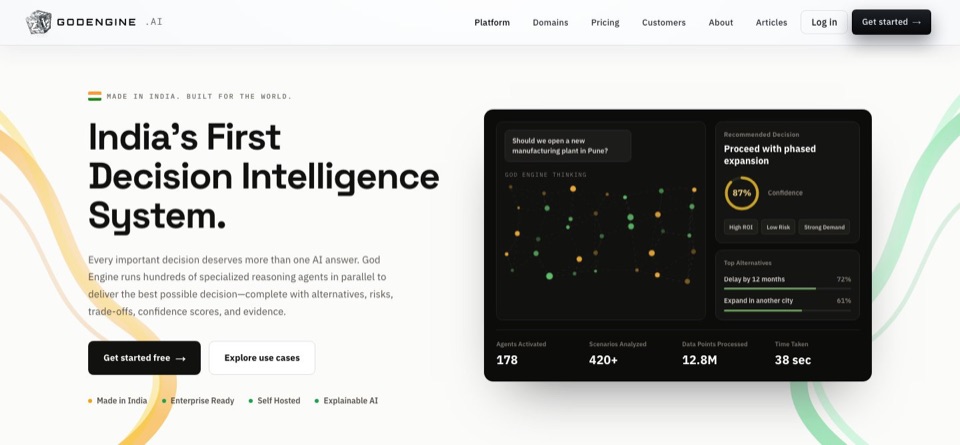
What is GodEngine?
GodEngine is a decision intelligence engine designed to solve high-stakes questions by building models of the world. Instead of providing a single wall of text, it constructs a knowledge graph of entities, facts, and causal links to help you navigate uncertainty.
Most AI tools are designed to answer questions. GodEngine is designed to help you decide. When you face a complex choice, you don't just need a fluent paragraph; you need to understand the moving parts: what is true right now, what causes what, what might happen next, and what it will cost if you are wrong.
Unlike a standard chatbot, GodEngine treats every question as a small model of the world. It extracts the underlying structure of your problem and shows you that structure through a knowledge graph. This allows you to see the reasoning, the scenarios, and the sources behind every conclusion.
| Feature | Standard Chatbots | GodEngine |
|---|---|---|
| Primary Goal | Fluency and conversation | Decision support and auditability |
| Output Format | A single block of prose | Structured reports with causal graphs |
| Handling Uncertainty | Often masks uncertainty with confidence | Probes multiple plausible scenarios |
| Verification | Requires manual fact-checking | Linked to entities, links, and sources |
How the Engine Works
The engine operates through a process called the resolve pipeline. This is not a single "black box" step, but a sequence of stages that work together to break down your query. Because the pipeline uses server-sent events, the system streams its reasoning in real-time. You don't sit staring at a loading spinner; you watch the engine think.
The Resolve Pipeline Stages
- Break it down: The engine pulls entities, facts, and cause-and-effect links out of your question. For example, if you ask, "Should we open a second outlet in Vasai this year, or invest in delivery first?", the engine identifies "Vasai outlet," "delivery investment," "year," and the causal relationship between them.
- Gather sources: It collects supporting sources and attaches them directly to the facts they support, ensuring you can trace the origin of any claim.
- Build scenarios: The engine builds a set of plausible scenarios. It doesn't just guess; it "probes" them. It asks: What has to be true for this scenario to happen? What specific event would break this scenario? What are the consequences?
- Write the report: Finally, it produces a structured report laying out options, likely outcomes, risks, and the reasoning behind each.
Decision Intelligence vs. Chatbots
The fundamental difference lies in how the two systems treat truth and certainty. Large language models are excellent at producing fluent answers. However, in high-stakes business environments, fluency is a risk because it can mask uncertainty. A chatbot might give you a very confident-sounding answer that is factually hollow.
Auditability Over Fluency
GodEngine prioritizes auditability. Every claim in a GodEngine report points back to an entity, a link in the graph, or a specific source. If a step in the reasoning looks wrong to you, you can click through to see exactly which step the engine took and why it believed that specific link was valid.
Decisions as Bets
Real-world operators do not think in terms of "the" answer; they think in terms of bets under uncertainty. GodEngine mirrors this by providing scenarios instead of a single answer. It shows you several different futures and outlines the conditions required for each to occur. This allows you to prepare for multiple outcomes rather than gambling on one.
The Numbers Check
To add another layer of reliability, GodEngine includes a "numbers check" feature. This feature compares the figures provided in the answers against computed facts. While it is currently a work in progress and has known misses, it is designed to show its working so that you can verify the math rather than simply taking the AI's word for it.
Who Should Use GodEngine?
GodEngine is built for people who have to explain their decisions to others—whether that is a board of directors, a co-founder, or a bank. It is for those who need a defensible rationale, not just a quick suggestion.
- Founders: When you are deciding between entering new markets, making key hires, or choosing between different pricing strategies.
- Finance and Business Analysts: For those who need to produce scenario-based write-ups that can withstand scrutiny.
- Operators: For leaders weighing a change that touches multiple departments, such as a major shift in supply chain or organizational structure.
- Researchers: For mapping the complex causal trends behind social or economic events.
Engineering and Architecture
The engine is built on an agentic architecture. This follows a "plan, act, and verify" loop, ensuring that the agent doesn't just jump to a conclusion but follows a structured path of investigation.
A key technical detail is the consistency of the experience. The web and Android apps render the same real-time event stream. This means the knowledge graph you see on your desktop is the exact same graph the engine is building on your phone; the mobile app is not a simplified version, but a different view of the same live data.
For those interested in the underlying mechanics of how these agents operate, the agentic architecture guide provides a deep dive into the plan, act, and verify loop.
Privacy and Availability
Strategic questions are often sensitive. You wouldn't want to paste your company's most confidential expansion plans into a public chatbot. GodEngine is designed with this privacy concern in mind.
The architecture is built to route different stages of the pipeline to self-hosted, private models. This allows you to use the power of the engine while keeping your data on your own infrastructure. Currently, the ability to route every stage to a self-hosted, private model is a work in progress, but it is a high priority for the roadmap.
Access: GodEngine is currently available via invitation only on the web and Android. You can request access or reach out to the founder with a specific decision question you would like the engine to reason through.
Current Capabilities and Roadmap
We believe in being transparent about what is ready to use and what is currently being built. The engine is evolving rapidly.
| Capability | Status |
|---|---|
| Streaming decision reports | Built |
| Cause-and-effect breakdown & knowledge graphs | Built |
| Scenario building and probing | Built |
| Web and Android apps (same engine) | Built |
| Deeper simulation modes (multiple agents) | Working / Being sped up |
| Time-series forecasting (TimesFM) | Partly built |
| Full routing to self-hosted private models | Partly built |
| Finalized billing and usage limits | In progress |
Frequently Asked Questions
- Is GodEngine just another AI chatbot?
- No. While chatbots provide fluent prose, GodEngine builds a causal model of the world to show you the reasoning and risks behind a decision.
- Can I use GodEngine on my phone?
- Yes, GodEngine is available on both web and Android, running the same engine and rendering the same events on both platforms.
- How does GodEngine handle data privacy?
- The architecture is designed to route pipeline stages to self-hosted open models on private GPU servers to keep sensitive strategic questions private.
- How do I know if the AI is hallucinating?
- GodEngine provides citations for every claim and includes a numbers check to compare answers against computed facts, allowing you to audit the reasoning.
- How can I get access to GodEngine?
- GodEngine is currently open by invitation. You can ask for access or write to the founder with a decision you want the engine to reason through.

Questions people ask
Is GodEngine just another AI chatbot?
No. While chatbots provide fluent prose, GodEngine builds a causal model of the world to show you the reasoning and risks behind a decision.
Can I use GodEngine on my phone?
Yes, GodEngine is available on both web and Android, running the same engine and rendering the same events on both platforms.
How does GodEngine handle data privacy?
The architecture is designed to route pipeline stages to self-hosted open models on private GPU servers to keep sensitive strategic questions private.
How do I know if the AI is hallucinating?
GodEngine provides citations for every claim and includes a numbers check to compare answers against computed facts, allowing you to audit the reasoning.
How can I get access to GodEngine?
GodEngine is currently open by invitation. You can ask for access or write to the founder with a decision you want the engine to reason through.