
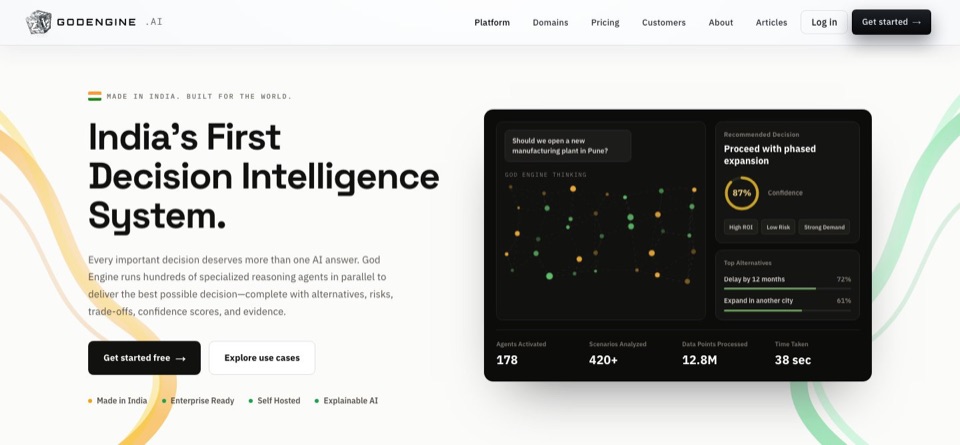
What is GodEngine Strategic Reasoning?
GodEngine is a decision intelligence engine that builds causal models to solve complex business questions. Instead of just giving you a chat response, it maps out causes, effects, and scenarios to provide an auditable framework for high-stakes decisions.
Most AI tools are designed to be conversational. They are excellent at producing fluent prose, but fluency is not the same as accuracy. In a high-stakes business environment, a chatbot might give you a confident-sounding answer that is logically hollow. GodEngine was built for the opposite approach.
When you ask a question, the engine doesn't just search for a text pattern. It treats your question as a small model of the world. It identifies the moving parts—what is true right now, what causes what, and what the cost of being wrong might be. It then builds a structured representation of those relationships so you can see the logic behind the conclusion.
The Resolve Pipeline
GodEngine operates through a process we call the "Resolve Pipeline." Unlike standard LLM interfaces where you wait for a single block of text to appear, GodEngine streams its reasoning in real-time. You can watch the engine work through several distinct stages.
1. Ask
You begin by entering a decision question into the web interface or the Android app. A decision question is typically a fork in the road, such as: "Should we open a second outlet in Vasai this year, or invest in delivery first?"
2. Break it down
The engine immediately begins extracting entities, facts, and cause-and-effect links from your query. It doesn't just hold these in memory; it places them into a clickable knowledge graph. This allows you to see the structural "skeleton" of the problem the engine is trying to solve.
3. Gather sources
For every fact the engine identifies, it seeks out and attaches supporting sources. This ensures that the model is grounded in reality rather than just predicting the next likely word in a sentence.
4. Build scenarios
This is where the engine moves from description to simulation. It builds a set of plausible futures and "probes" them. It asks: What has to be true for this outcome to happen? What specific event would break this scenario? This helps you move from a single answer to a map of possibilities.
5. Write the report
Finally, the engine produces a structured report. This isn't just a chat bubble; it is a formal document detailing your options, the likely outcomes, the associated risks, and the specific reasoning used to reach those conclusions.
Reasoning You Can Audit
The biggest risk in high-stakes decision-making is the "certainty trap." Large language models are so good at sounding human that users often mistake fluency for truth. GodEngine is designed to prevent this by providing structural evidence instead of just confident prose.
In a GodEngine report, every claim is traceable. If the engine makes a statement about market growth or operational cost, that claim points back to a specific entity in the knowledge graph, a specific link in the causal chain, or a cited source. If a step in the reasoning looks wrong to you, you can click through to see exactly which step the engine took and why it believed that path was valid.
The Numbers Check
Mathematical errors are a common failure point for standard AI. GodEngine includes a "numbers check" designed to compare figures in the text against computed facts. While this feature is still being refined and has known misses, the engine handles this by showing its working. It prioritizes showing you the math rather than asking you to trust it blindly.
Scenarios Instead of Single Answers
In the real world, decisions are rarely about finding the "one right answer." Instead, decisions are bets made under conditions of uncertainty. A business owner isn't just looking for a "yes" or "no"; they are looking for the conditions under which a choice becomes the right one.
GodEngine treats your decision as a series of potential futures. Instead of one definitive response, it provides several. This helps operators understand the prerequisites for different outcomes. For example, if you are deciding on a new pricing strategy, the engine might show you three different outcomes based on different levels of competitor response, showing you exactly what must be true in the market for each outcome to occur.
| Feature | Standard Chatbots | GodEngine Reasoning |
|---|---|---|
| Output Style | Fluent, conversational prose | Structured, causal reports |
| Logic | Probabilistic word prediction | Causal model of the world |
| Verification | "Trust the text" | Audit via knowledge graph & sources |
| Uncertainty | Often hides uncertainty in prose | Explicitly probes multiple scenarios |
Private Models and Data Security
Strategic questions are sensitive. A founder deciding on a raise or a company deciding on a merger cannot simply paste their internal strategy into a public chatbot without significant risk. Data privacy is a core requirement for any tool used in business intelligence.
GodEngine is designed with a privacy-first architecture. We have built the pipeline so that every stage can be routed to self-hosted open models running on our own private GPU servers. This means your strategic questions do not necessarily need to be shared with outside providers. While the ability to route every stage to a private model is currently partly built, it remains a top priority for our development roadmap.
For those interested in the infrastructure required to run these models privately, you can refer to our AI hardware guide.
Who Should Use GodEngine?
GodEngine is built for people who have to explain their decisions to others—whether that is a board of directors, a co-founder, or a finance team. If your decision requires a defensible rationale, GodEngine is for you.
- Founders: When you are choosing between entering new markets, making key hires, or shifting your pricing strategy.
- Finance and Business Analysts: When you need to produce a defensible, scenario-based write-up rather than just a single projected number.
- Researchers: When you are trying to map the complex causal drivers behind specific economic or social trends.
- Operators: When you are managing complex organizational changes that touch multiple different teams and departments simultaneously.
Frequently Asked Questions
- How is GodEngine different from a standard AI chatbot?
- While chatbots provide fluent prose that can hide uncertainty, GodEngine builds a causal model of the world, showing the links and scenarios behind the answer.
- Can I verify the facts in a GodEngine report?
- Yes. Every claim in a report is linked to a specific entity, a link in the knowledge graph, or a cited source.
- Does GodEngine work on mobile?
- Yes, the engine runs on both web and Android, providing the same synchronized graph experience on both platforms.
- How does GodEngine handle complex numbers?
- It uses a 'numbers check' to compare answers against computed facts, showing its working to ensure accuracy.
- How can I get access to GodEngine?
- GodEngine is currently open by invitation. You can ask for access or write to the founder with a decision you want to see it reason through.

Questions people ask
How is GodEngine different from a standard AI chatbot?
While chatbots provide fluent prose that can hide uncertainty, GodEngine builds a causal model of the world, showing the links and scenarios behind the answer.
Can I verify the facts in a GodEngine report?
Yes. Every claim in a report is linked to a specific entity, a link in the knowledge graph, or a cited source.
Does GodEngine work on mobile?
Yes, the engine runs on both web and Android, providing the same synchronized graph experience on both platforms.
How does GodEngine handle complex numbers?
It uses a 'numbers check' to compare answers against computed facts, showing its working to ensure accuracy.
How can I get access to GodEngine?
GodEngine is currently open by invitation. You can ask for access or write to the founder with a decision you want to see it reason through.