
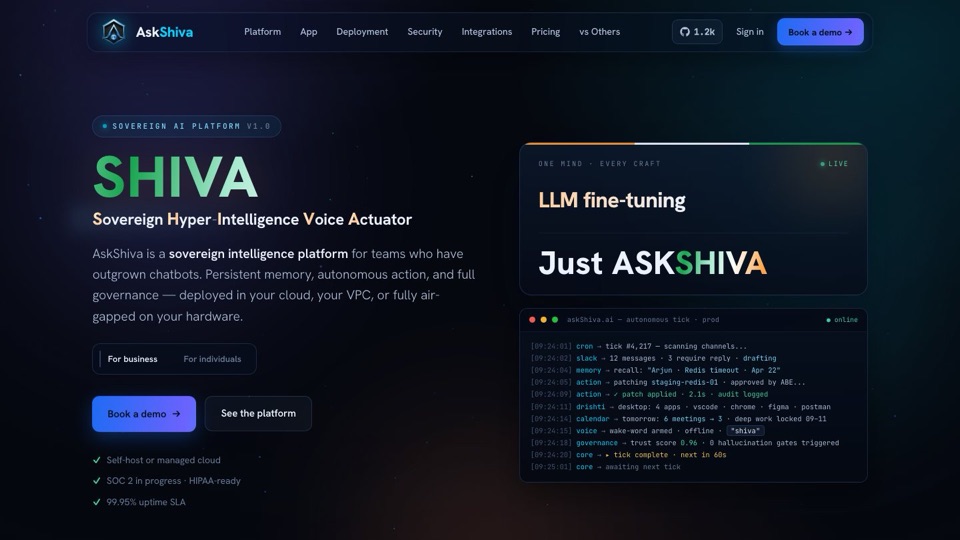
Small business AI refers to intelligent tools that move beyond simple chat to execute real-world business tasks. Instead of just providing information, these tools produce finished work like formatted invoices, spreadsheets, and translations to help owners get things done.
What is Small Business AI?
Most people think of AI as a chatbot that gives you long paragraphs of text. While that is useful for learning, it doesn't actually finish your work. For a small business owner, a paragraph explaining how to calculate tax is not as useful as a finished document that is ready to send to a client.
Small business AI is different because it focuses on the gap between an answer and a finished task. It is not just a conversational partner; it is a practical tool designed to handle the actual labor of running a shop, a service, or a small factory.
- Execution over Explanation: Instead of just explaining how to create a price list, the AI produces the final, printable result.
- Agentic Behavior: It acts as an agent that can plan a sequence of steps, use a specific tool to perform a task, check its own work to ensure accuracy, and remember the context of what it just did.
- Task-Oriented: It focuses on outputs like downloadable files, spreadsheets, and web pages rather than just text responses.
From Chatting to Completing Tasks
The real value of an AI assistant for a business owner is the ability to turn a simple command into a professional output. You should not have to spend your time formatting cells in a spreadsheet or manually calculating tax lines for every single sale.
Consider a typical workday for a trader. You might have a pile of data in a spreadsheet from last month. Instead of spending an hour cleaning it up, you can simply ask the AI to transform that data into a clean, one-page price list that is ready to be printed or shared with customers on WhatsApp.
Here are some specific ways this works in a real business environment:
- Professional Document Creation: You can generate GST bills with correct tax lines. The AI doesn't just write the text; it provides a downloadable file that you can actually use for your accounting.
- Data Transformation: You can take messy, unorganized information and turn it into structured, readable documents like price lists or inventory summaries.
- Workflow Automation: The AI can handle multi-step workflows. This might involve writing a document, creating a spreadsheet to track it, and then preparing a translation for the recipient.
This ability to move from a thought to a finished file is what separates a simple AI chatbot from a true business agent.
An Assistant That Remembers Your Business
One of the biggest frustrations with standard AI is having to repeat yourself. Every time you start a new chat, you have to explain who your customers are, what your business name is, and what your standard pricing looks like. This is a waste of time for a busy entrepreneur.
A specialized AI with memory solves this by keeping context across different conversations. It builds a continuous understanding of your business operations so that the assistant grows more helpful the more you use it.
The Power of Continuity
Because the AI remembers the context of your previous interactions, it can perform intelligent follow-ups. For example, if you have already generated an invoice for a customer, the AI knows who that customer is and what they owe. If you ask it later, "Remind me if they have not paid by Friday," the AI can check the specific invoice it created earlier and give you an informed answer.
This continuity means:
- Fewer repeated instructions for the same tasks.
- Better follow-up actions based on historical data.
- A seamless transition between different types of tasks, such as moving from an invoice to a payment reminder.
Built for the Indian Business Ecosystem
Most AI tools are built for a Western business context. They assume you communicate primarily in English and use specific software. But Indian business happens differently. It happens on WhatsApp, it involves GST compliance, and it relies on UPI for payments. It also happens in a dozen different languages simultaneously.
AskShiva is designed to treat these "edge cases" as the main case. It is built to understand the specific rhythm of Indian commerce.
| Feature | Standard AI Approach | AskShiva Approach |
|---|---|---|
| Language | Primarily English-centric | Supports Marathi, Hindi, and other Indian languages |
| Documents | General text/PDFs | First-class GST invoice generation |
| Communication | Email-focused | Optimized for WhatsApp workflows |
This means you can take a customer message, have the AI translate it into Marathi or Hindi, and then prepare a professional response in the same flow. It handles the documents that actually matter to an Indian business owner, ensuring they are formatted correctly and ready for local use.
Voice-First Interaction
Running a business often means your hands are busy. Whether you are in a warehouse, a shop, or traveling, typing long instructions on a phone is not always practical. This is why voice is a core part of the experience.
With an AI voice assistant capability, you can speak directly into your browser. The system converts your speech into text, processes the request, and then reads the answer back to you. This creates a natural, hands-free way to manage your business tasks on the go.
We are also conducting research in our lab to enable fully offline, on-device voice processing for Indian languages. The goal is a future where you can use voice commands even without a reliable internet connection, making the technology even more accessible in various parts of the country.
Reliable Agentic Architecture
For a business, reliability is everything. You cannot afford for your assistant to stop working just because one service provider has a technical problem. Our architecture is built to ensure that your work continues, even when the underlying technology faces issues.
We use a method called model routing with fallback. This means the system automatically picks the most suitable AI model for the specific task you have requested. If that model or its provider experiences an outage, the system can switch to another model to ensure your task is completed. This prevents a single point of failure from stopping your business operations.
Furthermore, our architecture allows for complex, heavy-duty work through several methods:
- Parallel Tasking: We employ a set of tools and agents that can run in parallel. This allows the AI to complete complex, multi-step flows much faster by doing several things at once.
- Bulk Processing: For large-scale work, we can run tasks on open models hosted on our own private GPU servers. This is a more efficient way to handle high volumes of work compared to relying solely on paid APIs.
By combining these technical strategies, we provide a robust environment where the AI acts as a reliable digital employee rather than a temperamental toy.
Frequently Asked Questions
- How is this different from a standard AI chatbot?
- While a chatbot provides information, this AI is designed to produce finished work like files, spreadsheets, and invoices.
- Can the AI handle Indian tax requirements?
- Yes, it is built to handle Indian business documents, such as generating GST invoices with correct tax lines.
- Does the AI remember my previous instructions?
- Yes, it uses memory context across conversations so you don't have to repeat details like customer names or business info.
- Can I use it via voice?
- Yes, you can speak in your browser and hear the AI's response read back to you.
- What happens if the AI service goes down?
- The system uses model routing with fallback, switching to another model so a single provider outage doesn't stop your work.

Questions people ask
How is this different from a standard AI chatbot?
While a chatbot provides information, this AI is designed to produce finished work like files, spreadsheets, and invoices.
Can the AI handle Indian tax requirements?
Yes, it is built to handle Indian business documents, such as generating GST invoices with correct tax lines.
Does the AI remember my previous instructions?
Yes, it uses memory context across conversations so you don't have to repeat details like customer names or business info.
Can I use it via voice?
Yes, you can speak in your browser and hear the AI's response read back to you.
What happens if the AI service goes down?
The system uses model routing with fallback, switching to another model so a single provider outage doesn't stop your work.