
What is BusinessOS?
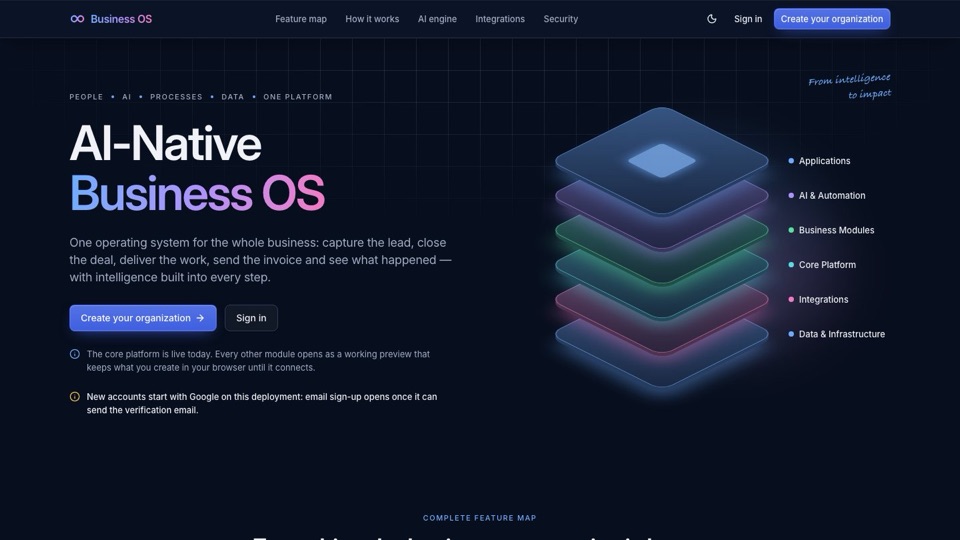
BusinessOS is a multi-tenant, AI-native operating system designed to serve as the unified foundation for your entire business. Built by AskShiva, it provides a secure, single source of truth to replace the fragmented mess of spreadsheets, messaging apps, and disconnected software.
For many growing companies, business data is scattered everywhere. You might track your leads in a spreadsheet, talk to customers on WhatsApp, manage HR in a separate app, and handle invoices in a fourth tool. When nothing talks to anything else, it becomes impossible to know who changed what or to get a clear picture of your business health.
BusinessOS solves this by starting from the other end. Instead of bolting new apps onto old, disconnected tools, we build a master architecture first. Once the foundation is solid, every business module—from CRM to HR—is built on top of that same core. This ensures that your data is never duplicated and your security is never compromised by "seams" between different software products.
- An AI-native operating system for your entire business, built by AskShiva.
- A multi-tenant platform that provides a single foundation for all business modules.
- Designed to eliminate fragmented data across spreadsheets, WhatsApp, and separate apps.
The Unified Foundation
Most "all-in-one" business tools are actually a collection of different products stuck together. This creates "seams" where data gets lost or security holes appear because each module has its own idea of what a "user" or a "customer" is. BusinessOS is different because it is defined by a master architecture.
Because every module sits on the same foundation, they all share the same core services. This means when you update a customer's name in one place, it is updated everywhere instantly. There is no need to export a CSV from one app to import it into another.
Everything in BusinessOS shares:
- One Identity: A single way to define who is using the system.
- One Permission Engine: A consistent set of rules for who can see or edit what.
- One Search: A unified way to find any file, record, or message across the whole company.
- One File Store: A central place for all your documents and uploads.
- One Event Bus: A system that ensures when something happens, the rest of the business knows about it.
- One Audit Log: A single, append-only record of every action taken in the system.
Enterprise-Grade Security
When you move your business operations to a digital platform, security is the most important factor. You need to know that your data is isolated and that only the right people can access it. We use advanced database technology to ensure that your organization's data remains strictly private.
We use PostgreSQL row-level security (RLS) with a signed tenant context. This means the database itself enforces data isolation, making it technically impossible for one organization to accidentally see another organization's data. To ensure this works perfectly, we run automated tests that verify data isolation for every single table in our system.
We also prioritize easy and secure access for your team. You can choose from several secure sign-in methods, including:
- Passkeys: For fast, passwordless, and highly secure login.
- Two-Factor Authentication (2FA): An extra layer of protection via codes.
- SSO: Single Sign-On via Google or Microsoft for enterprise-ready security.
AI-Native, Not Just AI-Added
When people talk about "AI tools," they often mean a chat box sitting in the corner of a screen that you have to copy and paste information into. BusinessOS is "AI-native," which means the AI is built into the very structure of the system.
In BusinessOS, AI agents are treated as "first-class users." This means an AI agent has its own identity and its own specific permissions. An agent isn't just a bot that can talk; it is a digital worker that can actually perform tasks within the boundaries you set.
For example, if you have an agent designed to follow up on overdue invoices, that agent follows the same rules as a human employee. It has permission to see specific invoices, it can see the customer's contact details, and it can perform actions like sending a reminder. Most importantly, every single action the agent takes is recorded in the same append-only audit log as a human user. You will always know exactly what the AI did, when it did it, and why.
This architecture is the bridge to what we call Shiva Agents, where AI agents can work as an always-on part of your company.
What is Live Today
The BusinessOS foundation is currently in early release (alpha) with test data. While the full suite of business modules is being built, the core infrastructure is already operational and ready to support your data. This foundation provides the essential "plumbing" for any modern business operation.
Current live capabilities include:
- Secure Authentication: Full session management, including email/password, 2FA, passkeys, and SSO.
- Organization & Team Management: Create workspaces and invite team members via secure links.
- Robust Permissions: A deep engine for managing roles, sharing specific records, and hiding sensitive fields.
- File Management: Versioned file uploads with instant previews and secure, signed links for sharing.
- Real-time Notifications: In-app and email notifications to keep your team updated.
- Search & Audit: A searchable, append-only audit log that can be exported as a CSV for compliance.
If you are looking for a dedicated HR management tool, our team is also running a separate early release at hrms.businessos.si.
The Roadmap Ahead
We are building BusinessOS module by module, starting with the foundation and moving upward. Our goal is to create a complete ecosystem where every part of your business communicates seamlessly. Here is our planned development path:
| Module | What it covers | Status |
|---|---|---|
| Foundation | Identity, organizations, permissions, files, search, audit | Live in alpha |
| CRM and Sales | Contacts, deals, pipelines, quotes | Next (not built yet) |
| Work & Communication | Tasks, projects, messages | Specified |
| HR | People, teams, leave, payroll | Specified |
| Operations & Documents | Processes, approvals, documents | Specified |
| Automation | AI agents and a drag-and-drop internal app builder | Specified |
We are particularly focused on the CRM module as our first major business application. While it is not built yet, it will be the first way users interact with the BusinessOS foundation to manage their sales pipelines and customer relationships.
Frequently Asked Questions
- Is the CRM module available now?
- The CRM module is on the roadmap but is not built yet. It will cover contacts, deals, pipelines, and quotes.
- How does BusinessOS handle data privacy?
- It uses PostgreSQL row-level security with a signed tenant context to ensure strict data isolation between different organizations.
- What makes BusinessOS 'AI-native'?
- Unlike tools that just add a chat box, BusinessOS gives AI agents their own identities and permissions, allowing them to work within the system's rules.
- How can I get access?
- The foundation is currently open in alpha with test data. If you want to help shape the CRM module for your specific business needs, please reach out to us.
Questions people ask
Is the CRM module available now?
The CRM module is on the roadmap but is not built yet. It will cover contacts, deals, pipelines, and quotes.
How does BusinessOS handle data privacy?
It uses PostgreSQL row-level security with a signed tenant context to ensure strict data isolation between different organizations.
What makes BusinessOS 'AI-native'?
Unlike tools that just add a chat box, BusinessOS gives AI agents their own identities and permissions, allowing them to work within the system's rules.
Can I use it for my small business in India?
Yes, the system is designed to integrate with the way Indian businesses operate, moving away from fragmented WhatsApp and spreadsheet workflows.
How can I get access?
The foundation is currently open in alpha with test data. You can reach out to shape the CRM module for your specific business needs.