
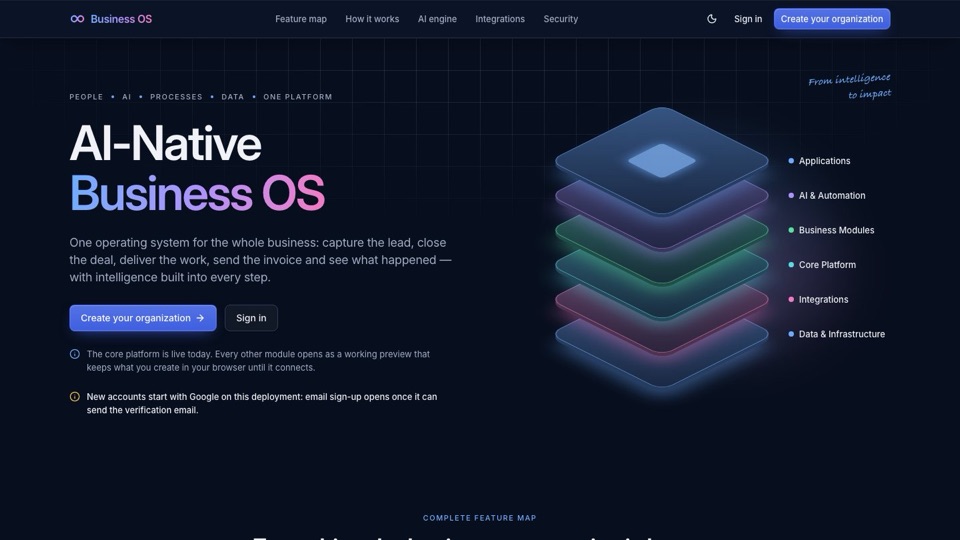
What is BusinessOS India?
BusinessOS India is an AI-native, multi-tenant operating system designed to provide a unified foundation for entire businesses. Built by AskShiva, it aims to replace fragmented workflows by connecting all business data, permissions, and AI agents into a single, secure source of truth.
- An AI-native, multi-tenant operating system for entire businesses.
- Built by AskShiva to bridge the gap between disconnected apps and unified workflows.
- Designed to solve the "fragmentation problem" where leads, HR, and invoices live in separate apps.
Moving Beyond Fragmented Workflows
For many Indian SMEs, running a business feels like a constant battle against scattered information. You might track your sales leads in a spreadsheet, talk to your customers on WhatsApp, manage your staff in a separate HR app, and keep your invoices in a fourth tool or buried in an email inbox.
This "fragmentation problem" creates several real-world headaches for business owners and builders:
- Disconnected Tools: When your data lives in different places, nothing talks to anything else. This leads to duplicate data entry and manual errors.
- Security Holes: Managing different logins and permissions across five different apps makes it difficult to control who sees what.
- Limited AI Intelligence: If you try to use AI tools to help your business, they often only see a small piece of the puzzle at a time because your data is siloed. An AI cannot help you manage a customer if it cannot see the invoice or the previous chat.
A Unified Foundation First
Most all-in-one business tools are built by acquiring or "bolting" different products together. This creates "seams" in your business operations—places where data gets lost or security is weakened because the different parts don't share the same rules.
BusinessOS takes a different approach. Instead of adding modules to a mess, we build a master architecture first. We believe that for AI to work effectively, it needs a solid ground to stand on. Our foundation includes:
- One Identity: Every user, whether human or AI, uses the same identity system.
- One Permission Engine: A single set of rules that controls access to everything, from a specific file to a customer record.
- One Audit Log: A complete history of every action taken across the entire system.
- One Source of Truth: A single database that serves as the foundation for every module we build.
By starting with this architecture, we ensure that as you add more tools—like CRM or HR—they fit together perfectly from day one.
Enterprise-Grade Security & Isolation
Security is not an afterthought in a multi-tenant system; it is baked into the database itself. BusinessOS uses a multi-tenant architecture powered by PostgreSQL row-level security (RLS) to ensure strict data isolation between different organizations.
This means your data is physically and logically separated from other companies using the system. We use signed tenant contexts and automated tests to verify that isolation is enforced for every single table in our database.
How we protect your business:
- Secure Access: We support modern, secure sign-in methods including passkeys, two-factor authentication (2FA), and Single Sign-On (SSO) via Google and Microsoft.
- Immutable Audit Logs: We maintain an append-only audit log. This records exactly who did what and when. These logs are searchable and can be exported as CSV files for your own compliance needs.
- Granular Permissions: Our permission engine allows for complex roles and record sharing, including the ability to hide specific fields from certain users.
True AI-Native Architecture
When we say BusinessOS is "AI-native," we don't just mean there is a chat box in the corner of your screen. A chat box is just a window; an AI-native system is built around the capabilities of AI agents.
In our architecture, AI agents are "first-class users." This means an AI agent has its own identity and its own set of permissions. When an agent performs a task, it is governed by the same rules as a human employee.
This architecture enables what we call "Shiva Agents." Because the agent operates within the same governance and audit logs as your staff, it can perform complex, autonomous tasks such as:
- Following up on overdue invoices.
- Qualifying inbound leads based on your specific business rules.
- Updating records across different modules without needing a human to bridge the gap.
For more on how this works, read our AI-native architecture guide.
The Roadmap: From Foundation to Agents
We are building BusinessOS layer by layer, starting with the most critical infrastructure. We believe in perfecting the foundation before adding complex business logic.
| Module | What it covers | Status |
|---|---|---|
| Foundation | Identity, organisations, permissions, files, search, and audit logs. | Live in alpha |
| CRM & Sales | Contacts, deals, pipeline, and quotes. | Next (In development) |
| Work & Communication | Tasks, projects, and messages. | Planned |
| HR | People, teams, leave, and payroll. | Planned |
| Operations & Documents | Processes, approvals, and documents. | Planned |
| Automation & AI Agents | Autonomous agents working across modules. | Planned |
| App Builder | Drag-and-drop internal apps for your specific needs. | Planned |
Note: An HRMS built by the same team is already running separately as an early release at hrms.businessos.si.
The Technology Behind the OS
To build a system that is both highly scalable and incredibly secure, we use a modern, robust technology stack. Our development follows a TypeScript monorepo approach to ensure consistency across the entire platform.
- Frontend & API: We use Next.js for our web application and NestJS for our API, providing a typed SDK for developers.
- Database: Our core is powered by PostgreSQL 18. We use
pgvectorto enable advanced AI-powered search and vector capabilities. - Performance: We use Valkey for high-performance queues and caching to ensure the system remains fast as you scale.
- Reliability: Events move through an "outbox" pattern, ensuring that nothing is lost between a database change and the background jobs it triggers.
Frequently Asked Questions
- Is BusinessOS available for Indian SMEs?
- Yes. BusinessOS is designed to handle Indian business realities, such as managing complex workflows and integrating with tools like WhatsApp.
- How is data kept secure between different companies?
- We use PostgreSQL row-level security (RLS) with signed tenant contexts. This ensures strict data isolation so that one organization can never access another's data.
- What makes BusinessOS "AI-native"?
- It means AI agents are treated as employees with their own identities, permissions, and audit trails, rather than just being simple chat boxes.
- Can I use my existing login for BusinessOS?
- Yes, we support Google and Microsoft SSO, as well as passkeys and two-factor authentication for secure access.
- What modules are currently live?
- The core foundation is currently live in alpha. This includes secure sign-in, organization management, permissions, files, search, and the audit log.
Questions people ask
Is BusinessOS available for Indian SMEs?
Yes, BusinessOS is designed specifically to handle Indian business realities like GST, WhatsApp, and multiple local languages.
How is data kept secure between different companies?
We use PostgreSQL row-level security with signed tenant contexts to ensure strict data isolation between organizations.
What makes BusinessOS 'AI-native'?
It means AI agents are treated as employees with their own identities, permissions, and audit trails, rather than just chat boxes.
Can I use my existing login for BusinessOS?
Yes, we support Google and Microsoft SSO, alongside passkeys and two-factor authentication.
What modules are currently live?
The core foundation is live in alpha, including secure sign-in, organization management, permissions, files, search, and the audit log.