
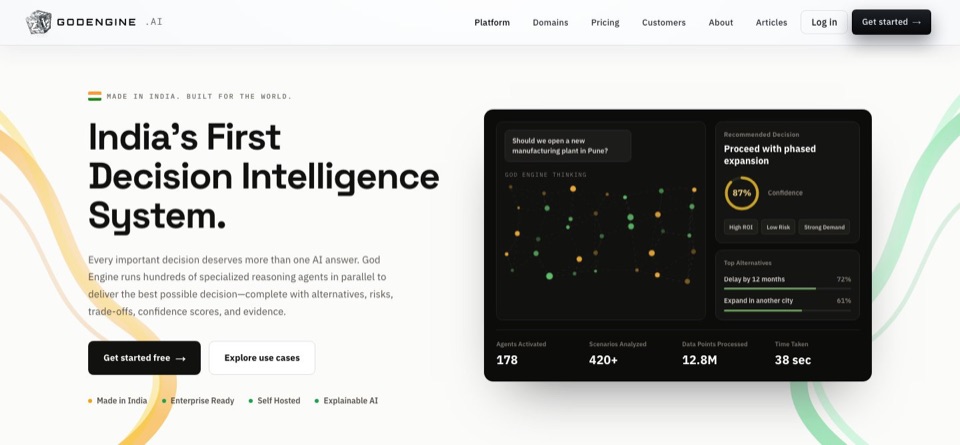
An AI chief of staff is a decision intelligence engine that transforms complex business questions into structured models of the world. Instead of just generating text, it maps causal links, explores multiple plausible scenarios, and provides auditable reasoning to help leaders make high-stakes decisions.
What is an AI Chief of Staff?
Most people think of AI as a way to write emails or summarize meetings. But for a business owner, a summary isn't a strategy. You don't need a tool that tells you what happened; you need a tool that helps you decide what to do next.
An AI chief of staff functions as a decision intelligence engine. It treats your business questions as small models of the world. When you ask a question, it doesn't just search for a pattern in its training data; it attempts to understand the underlying mechanics of your specific situation.
It focuses on three critical dimensions of any business move:
- What is true now: Identifying the current facts, entities, and data points.
- What causes what: Mapping the causal links between actions and outcomes.
- What it costs to be wrong: Identifying the risks and the uncertainty inherent in the decision.
Unlike a standard chatbot that offers a single, confident answer, this system explores multiple plausible futures. It understands that in business, there is rarely one "correct" answer, only a series of bets made under uncertainty.
The Risk of Fluent AI
Large language models are incredibly good at being fluent. They can write prose that sounds authoritative, professional, and certain. In a casual setting, this is a feature. In a high-stakes boardroom, fluency is a significant risk.
When an AI provides a single, polished paragraph as an answer, it creates an illusion of certainty. It hides the complexity of the decision behind a wall of smooth text. If a chatbot tells you, "You should expand to Mumbai next quarter," it has skipped the most important part: the reasoning, the risks, and the alternative paths.
A single chat reply hides the messy reality of business. It doesn't show you the trade-offs or the variables that could go wrong. This lack of transparency leads to blind trust, which is dangerous when millions of rupees or months of labor are on the line.
This is why GodEngine was built for the opposite of fluency. It is designed to show you the model, not just the answer. By visualizing the logic, the engine prevents the user from falling into the trap of accepting a "confident" but shallow response.
How the Intelligence Works
The engine operates through what is called a "resolve pipeline." This is not a single step of "prompt and response," but a structured sequence of reasoning that you can watch in real-time. The pipeline uses a "plan, act, verify" loop to ensure that the reasoning remains sound throughout the process.
The process follows these distinct stages:
- Break it down: The engine takes your question and extracts the essential entities, facts, and cause-and-effect links. It turns a sentence into a structure.
- Gather sources: It collects supporting sources and keeps them strictly attached to the facts they support. This ensures that every claim is grounded in evidence.
- Build a knowledge graph: It places these entities and links into a knowledge graph. This is a visual map of how different parts of your business or market interact. You can click through this graph to see the underlying logic.
- Build scenarios: It uses the graph to construct several plausible futures, testing each one to see what would have to be true for that scenario to occur.
Because the pipeline streams its results via server-sent events, you don't have to wait for a "wall of text" to appear after a long pause. You see the reasoning happen as it is being constructed, from the first second of the analysis.
Scenarios Instead of Single Answers
Real decisions are bets made under uncertainty. If you are a founder deciding whether to invest in a new product line or double down on your current marketing, there is no "correct" answer hidden in a database. There are only different paths with different probabilities.
A true AI chief of staff provides several futures instead of one answer. It looks at the variables and says, "If condition X happens, this is your outcome. However, if condition Y occurs, your current strategy will likely fail."
The engine probes each scenario to see what has to be true and what would break it. This is a core component of simulation-based decision making. It allows an operator to think like a high-level executive by weighing different outcomes against each other rather than looking for a single "yes" or "no."
For example, consider a small business owner in India deciding on a logistics strategy:
- Scenario A: You invest in your own delivery fleet. This requires high upfront capital but gives you total control over customer experience.
- Scenario B: You partner with a third-party delivery service. This has lower upfront costs but leaves your delivery quality in someone else's hands.
The engine doesn't just pick one; it maps the causal links of both—how capital expenditure affects cash flow, how delivery speed impacts repeat customers, and what happens to your margins if fuel prices rise.
Reasoning You Can Audit
Trust is earned through transparency, not through the confidence of a voice or the fluency of a text. In high-stakes work, you must be able to audit the logic used to reach a conclusion. If an AI makes a recommendation, you need to know exactly why it believes that recommendation is valid.
Every claim in a GodEngine report points back to a specific entity, a link in the knowledge graph, or a cited source. This creates a trail of evidence. If a step in the reasoning looks wrong to you, you can identify exactly which step caused the error. You can see if the model misunderstood a causal link or if it relied on a faulty piece of information.
Furthermore, the engine includes a "numbers check." This is a specialized component that compares figures in the generated answers against computed facts. While this feature is still a work in progress and can have misses, it is designed to show its working. The goal is to provide a way to verify accuracy rather than asking for blind trust.
Who Needs an AI Chief of Staff?
This tool is not for writing social media posts or summarizing long articles. It is for people who have to explain their decisions to others—investors, boards, or their own teams. It is for those who need to move from "guessing" to "modeling."
The primary users include:
- Founders: Those making high-stakes choices between different markets, deciding on key hires, setting pricing models, or preparing for a fundraising round.
- Finance and Business Analysts: Professionals who need to produce defensible, scenario-based write-ups rather than just a single, static number.
- Researchers: Those mapping the complex causal drivers behind specific economic or social trends.
- Operators: Managers overseeing complex organizational changes that impact multiple departments and teams simultaneously.
Whether you are looking at strategic AI applications for your enterprise or personal decision support, the common thread is the need for defensible logic.
Privacy for Strategic Decisions
Strategic questions are inherently sensitive. A question like "Should we acquire our competitor in Bangalore?" contains data that you would never want to paste into a public, consumer-grade chatbot. Privacy is not just a feature; it is a requirement for professional use.
The architecture of GodEngine is designed with data sovereignty in mind. We recognize that a decision engine you cannot trust with your data is of no use to a professional. To address this, the system is designed so that different stages of the resolve pipeline can be routed to different models.
Specifically, you can route stages of the pipeline to a self-hosted, private model running on your own GPU servers. This ensures that your most sensitive strategic data never leaves your controlled environment. While the ability to route every stage to a self-hosted model is currently a work in progress, it is a primary development priority.
| Feature | Standard Chatbot | AI Chief of Staff (GodEngine) |
|---|---|---|
| Output Style | Fluent, conversational prose | Structured, auditable reports |
| Logic Format | Single "best" answer | Multiple probed scenarios |
| Transparency | Black box (hidden reasoning) | Open knowledge graph & citations |
| Data Privacy | Public cloud/training risk | Option for self-hosted/private models |
Frequently Asked Questions
- How is an AI chief of staff different from a chatbot?
- A chatbot provides a fluent answer to a question, whereas an AI chief of staff builds a model of the world, maps causal links, and probes multiple scenarios to help you decide.
- Can I trust the numbers the AI provides?
- GodEngine includes a numbers check that compares answers against computed facts. It shows its working so you can audit the logic rather than relying on blind trust.
- What kind of decisions can it help with?
- It is designed for high-stakes decisions, such as choosing between markets, evaluating hires, or weighing complex operational changes.
- How does the AI show its reasoning?
- It uses a streaming resolve pipeline that shows you the reasoning process in real-time, displaying the knowledge graph and sources as they are identified.
- Is my data private when using this tool?
- GodEngine is designed to allow routing to self-hosted, private models, ensuring that sensitive strategic data does not have to be sent to outside providers.

Questions people ask
How is an AI chief of staff different from a chatbot?
A chatbot provides a fluent answer to a question, whereas an AI chief of staff builds a model of the world, maps causal links, and probes multiple scenarios to help you decide.
Can I trust the numbers the AI provides?
GodEngine includes a numbers check that compares answers against computed facts. It shows its working so you can audit the logic rather than relying on blind trust.
What kind of decisions can it help with?
It is designed for high-stakes decisions, such as choosing between markets, evaluating hires, or weighing complex operational changes.
How does the AI show its reasoning?
It uses a streaming resolve pipeline that shows you the reasoning process in real-time, displaying the knowledge graph and sources as they are identified.
Is my data private when using this tool?
GodEngine is designed to allow routing to self-hosted, private models, ensuring that sensitive strategic data does not have to be sent to outside providers.