
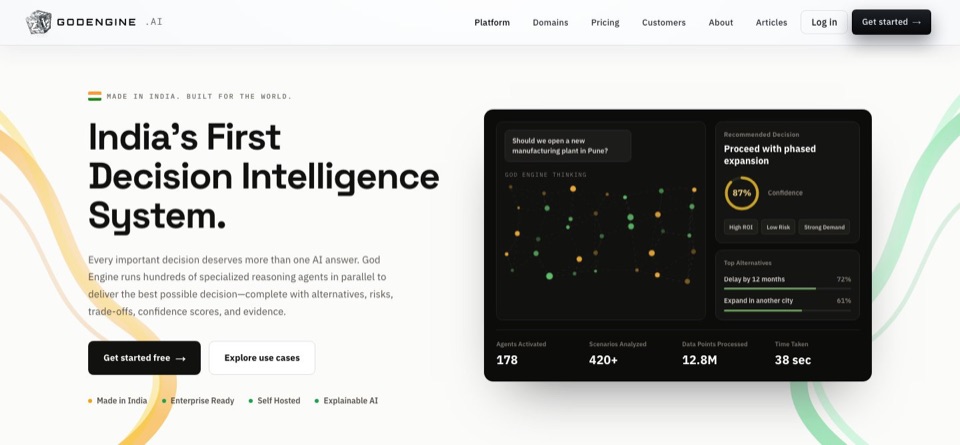
AI forecasting in decision intelligence moves beyond simple predictions to map the actual causes and effects behind potential outcomes. It helps you understand not just what might happen, but what must be true for a specific scenario to occur.
What is AI Forecasting in Decision Intelligence?
Traditional forecasting often provides a single number or a fluent answer that masks uncertainty. A standard tool might tell a shop owner in Mumbai, "Your sales will likely grow by 10% next month." While that sounds helpful, it hides the risks and the "why" behind the number.
True AI forecasting for decision-makers involves building models of the world that map facts, causes, and effects. Instead of a single guess, it builds a structured map of how different variables interact. It is about moving from "what will happen" to "what must be true for this outcome to occur."
For example, if you are deciding whether to expand a manufacturing unit, you don't just want a prediction of revenue. You want to know the causal chain: if raw material costs rise by 5%, how does that impact your ability to fulfill orders, and what specific market conditions must exist for your new unit to break even within twelve months?
From Fluency to Causal Reasoning
Large language models are excellent at producing fluent prose, but fluency can look like certainty even when wrong. This is a major risk in high-stakes business environments. A model can write a very convincing paragraph about why a new product launch will succeed, even if the underlying logic is flawed.
Effective forecasting requires a knowledge graph of entities and causal links rather than just text. It is not enough to predict the next word in a sentence; a decision engine must understand the relationship between entities—like suppliers, logistics, competitors, and consumer trends.
GodEngine treats every decision as a small model of the world, showing the underlying graph instead of hiding it behind a chat interface. By visualizing the connections, you can see if the AI is making a leap in logic or if it has a solid link between a cause and an effect.
Building and Probing Scenarios
Real decisions are bets placed under uncertainty. No business owner has perfect information, so any single-point forecast is essentially a gamble. Instead of one answer, AI forecasting should generate multiple plausible scenarios.
Consider a small logistics company deciding whether to invest in an electric vehicle fleet. A robust forecasting engine won't just give one "best case." It will generate several futures:
- Scenario A: High electricity costs but low maintenance expenses.
- Scenario B: Rapid government subsidies for green transport.
- Scenario C: A sudden spike in diesel prices making EVs significantly more profitable.
Each scenario must be "probed" to identify what would break the outcome and what the specific risks are. Probing means testing the limits of the scenario—asking, "At what price point does this investment become a loss?" This allows you to understand the boundaries of your decision.
Auditable Reasoning vs. Black Box Predictions
High-stakes decisions require reasoning you can audit, not just a number you must trust. When an AI gives a recommendation, you need to know if it is hallucinating or if it is basing its logic on real-world data. A "black box" that simply outputs a result is dangerous for professional use.
Every claim in a decision report should point back to a specific entity, a link in the graph, or a source. If the engine claims that "demand for organic spices is rising in urban centers," you should be able to click that claim and see the specific data points or reports that support it.
To ensure the math holds up, a "figure check" is used. This process compares numbers in answers against computed facts to ensure accuracy. While this feature is still being refined and can have known misses, it is designed to show its working so that you can verify the logic yourself rather than relying on blind trust.
Who Needs Advanced AI Forecasting?
Advanced forecasting is not for simple tasks like writing emails; it is for complex, high-stakes choices where you will have to explain your reasoning to others. This makes it essential for several types of professionals:
- Founders: Deciding between market entries, hires, pricing models, or fundraising rounds.
- Finance and Business Analysts: Needing defensible, structured write-ups rather than single data points.
- Operators: Weighing organizational changes that impact multiple teams simultaneously, such as restructuring a supply chain.
- Researchers: Mapping the specific causes behind a macro trend or a geopolitical event. For more on this, see our analysis of AI for Geopolitics Analysis.
The Engine Behind the Forecast
The engine does not just "think"; it follows a structured pipeline to ensure the output is grounded in reality. This process uses a resolve pipeline: extracting facts, building the graph, gathering sources, and probing scenarios.
The architecture follows a "plan, act, verify" loop. This loop is a core part of the agentic architecture that ensures the model's output is grounded in facts rather than just generating plausible-sounding text. This is a significant departure from standard LLM usage.
To make the process transparent, the pipeline uses server-sent events. This means you can watch the reasoning happen in real-time. Instead of staring at a loading spinner for a minute, you see the engine extracting entities, building the graph, and gathering sources as it works. This transparency allows you to see exactly where the engine is focusing its "attention."
Privacy and Private Model Routing
Strategic questions often contain sensitive data that cannot be shared with public chatbots. If a CEO is asking about a potential merger or a secret pricing strategy, privacy is the highest priority. Data security is a requirement for any forecasting tool used in professional decision-making.
GodEngine is designed so that every stage of the pipeline can be routed to a self-hosted open model running on our own GPU server instead of an outside provider. This helps keep sensitive reasoning away from public training sets.
It is important to note that this capability is currently partly built and still in progress. We are working on extending the ability to route every single stage of the pipeline to these private models to ensure maximum security for our users.
Frequently Asked Questions
- How is AI forecasting different from a standard chatbot?
- A chatbot provides a fluent answer that can hide uncertainty. AI forecasting for decision intelligence builds a causal model of the world to show the reasoning and the risks behind different scenarios.
- Can I trust the numbers generated by AI forecasting?
- GodEngine uses a 'figure check' to compare answers against computed facts. It shows its working and provides citations so you can audit the reasoning rather than relying on blind trust.
- What are 'probed scenarios'?
- Probed scenarios are plausible futures that the engine tests to see what must be true for them to happen and what specific factors would cause them to fail.
- What kind of decisions is this for?
- It is for high-stakes decisions where you have to explain your reasoning to others, such as market expansion, hiring, or pricing strategy.
- Is my data safe when using AI for forecasting?
- GodEngine is designed so that stages of the pipeline can be routed to a self-hosted open model running on our own GPU server to increase privacy. Note that the ability to route every stage is currently partly built.

Questions people ask
How is AI forecasting different from a standard chatbot?
A chatbot provides a fluent answer that can hide uncertainty. AI forecasting for decision intelligence builds a causal model of the world to show the reasoning and the risks behind different scenarios.
Can I trust the numbers generated by AI forecasting?
GodEngine uses a 'figure check' to compare answers against computed facts. It shows its working and provides citations so you can audit the reasoning rather than relying on blind trust.
What are 'probed scenarios'?
Probed scenarios are plausible futures that the engine tests to see what must be true for them to happen and what specific factors would cause them to fail.
What kind of decisions is this for?
It is for high-stakes decisions where you have to explain your reasoning to others, such as market expansion, hiring, or pricing strategy.
Is my data safe when using AI for forecasting?
For high-stakes work, the architecture allows routing data to self-hosted, private models on your own GPU servers to ensure privacy.