
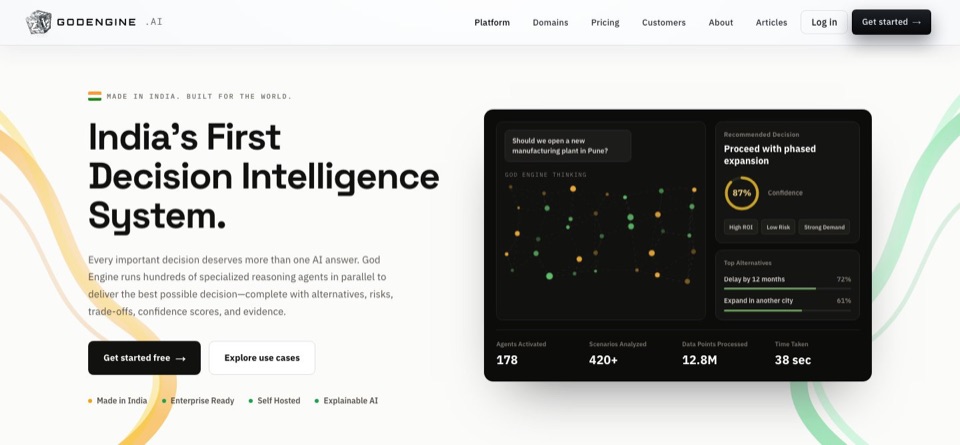
An AI strategist uses decision intelligence to move beyond simple chat interfaces. Instead of providing a single, fluent answer, they build structured models of the world to show you the causal links, risks, and reasoning behind complex choices.
What an AI Strategist Does Differently
Most people use AI to generate text. An AI strategist uses AI to generate structure. When you ask a standard chatbot a question, you get a paragraph of text that sounds confident but often hides the messy reality of the situation. A strategist focuses on the mechanics of the decision itself.
- Moves beyond fluent prose to structured reasoning. It is not enough for an answer to sound good; it must be logically sound and traceable.
- Replaces single-answer chat with scenario-based probing. Rather than saying "Yes" or "No," it explores different versions of the future.
- Focuses on "what it costs to be wrong" rather than just what is likely. It weighs the downside of a bad decision, not just the probability of a good one.
- Provides an auditable trail of facts, causes, and effects. You can see exactly how the engine connected point A to point B.
The Risk of Fluency Over Certainty
Large language models are excellent at producing fluent answers. In high-stakes work, this fluency is a trap. Because the prose sounds certain, users often mistake linguistic confidence for factual accuracy. This is a dangerous way to make business decisions.
A single chat reply hides the moving parts of a decision. It fails to show you what is true right now, what causes what, and what could happen next. For example, if a shop owner asks if they should expand, a chatbot might give a generic "Yes" based on market trends. It won't show the specific causal chain of how rent increases might interact with local foot traffic changes.
Decision intelligence solves this by putting structure around the model. By using simulation-based decision making, you move from guessing to probing. You stop asking "What is the answer?" and start asking "What must be true for this to work?"
How Decision Intelligence Works
The engine operates through a "resolve pipeline." This is a sequence of steps where each stage is treated as a small model of the world. You don't just wait for a finished response; you watch the reasoning happen in real-time through streaming data.
The Core Engine Components
The process follows a specific logic to ensure the output is more than just a guess:
- The Resolve Pipeline: Every question is treated as a complex problem to be broken down. Each stage of the analysis streams its result as soon as it finishes.
- Knowledge Graph: The engine extracts entities, facts, and cause-and-effect links from your question. It places these into a clickable graph so you can see the connections between different pieces of information.
- Scenario Probing: The engine builds plausible futures. It probes these scenarios to see what would have to be true for them to happen, and more importantly, what would cause them to break.
- Streaming Reasoning: Instead of a "loading" icon followed by a wall of text, you see the work as it happens. This transparency allows you to spot errors in the reasoning before the final report is even finished.
Who Needs an AI Strategist?
This tool is not for writing emails or summarizing meeting notes. It is for people who have to explain their decisions to others—whether that is a board of directors, a bank, or a co-founder.
| Role | Use Case |
|---|---|
| Founders | Deciding between entering new markets, making key hires, setting pricing, or deciding when to seek a new round of funding. |
| Finance & Analysts | Creating defensible business cases and multi-variable scenarios rather than just providing a single projected number. |
| Researchers | Mapping the complex web of causes behind a specific global trend or a sudden economic event. |
| Operators | Weighing organizational changes that impact multiple departments and teams simultaneously. |
Whether you are a small business owner in Mumbai deciding whether to open a second outlet in Vasai or a tech founder navigating a pivot, the goal is the same: moving from intuition to documented, causal reasoning.
Auditable Reasoning and Data Privacy
Trust in AI is often broken because the "black box" problem makes it impossible to know why an AI said what it said. An AI strategist aims to turn that black box into a glass box.
Verifying the Output
Every claim in a generated report points back to a specific entity, a link in the knowledge graph, or a cited source. We also use a "figure check" which compares numbers in the final answers against computed facts. While this feature is currently being improved and still has known misses, it is designed to show its working so you can audit the logic yourself rather than simply trusting the output.
Protecting Strategic Data
Strategic questions often contain sensitive information that you would never want to paste into a public chatbot. Privacy is a core part of the architecture. The pipeline is designed so that every stage can be routed to a self-hosted, private model running on a private GPU server. This means your most sensitive business logic stays within your own controlled environment.
GodEngine: The Decision Intelligence Engine
GodEngine is the first of five platforms being developed to bridge the gap between raw AI power and professional-grade decision making. It is currently available as an early release on the Web and Android, accessible by invitation.
| Capability | Status |
|---|---|
| Streaming decision reports | Built |
| Cause-and-effect breakdown and knowledge graph | Built |
| Scenario building and probing | Built |
| Email and Google sign-in, Web and Android apps | Built |
| Deeper simulation modes with many simulated agents | Working (being sped up) |
| Time-series forecasting (TimesFM) in everyday answers | Partly built |
| Routing to self-hosted private models | Partly built |
Frequently Asked Questions
- How is an AI strategist different from a standard LLM chatbot?
- While chatbots provide fluent answers, an AI strategist uses decision intelligence to build a model of the world, showing you the causal links and scenarios instead of just a single response.
- Can I trust the numbers an AI strategist provides?
- GodEngine uses a figure check to compare numbers against computed facts and shows its working so you can audit the reasoning rather than just trusting the output.
- What is 'scenario probing' in decision intelligence?
- It is the process of building plausible future scenarios and testing them to see what has to be true for them to happen or what would cause them to break.
- Is my strategic data safe when using these tools?
- To protect sensitive information, the architecture allows routing the pipeline to self-hosted open models on private GPU servers instead of external providers.
- What kind of decisions can I use this for?
- It is designed for high-stakes decisions where you must explain your reasoning to others, such as market entry, hiring, or complex organizational changes.

Questions people ask
How is an AI strategist different from a standard LLM chatbot?
While chatbots provide fluent answers, an AI strategist uses decision intelligence to build a model of the world, showing you the causal links and scenarios instead of just a single response.
Can I trust the numbers an AI strategist provides?
GodEngine uses a figure check to compare numbers against computed facts and shows its working so you can audit the reasoning rather than just trusting the output.
What is 'scenario probing' in decision intelligence?
It is the process of building plausible future scenarios and testing them to see what has to be true for them to happen or what would cause them to break.
Is my strategic data safe when using these tools?
To protect sensitive information, the architecture allows routing the pipeline to self-hosted open models on private GPU servers instead of external providers.
What kind of decisions can I use this for?
It is designed for high-stakes decisions where you must explain your reasoning to others, such as market entry, hiring, or complex organizational changes.