
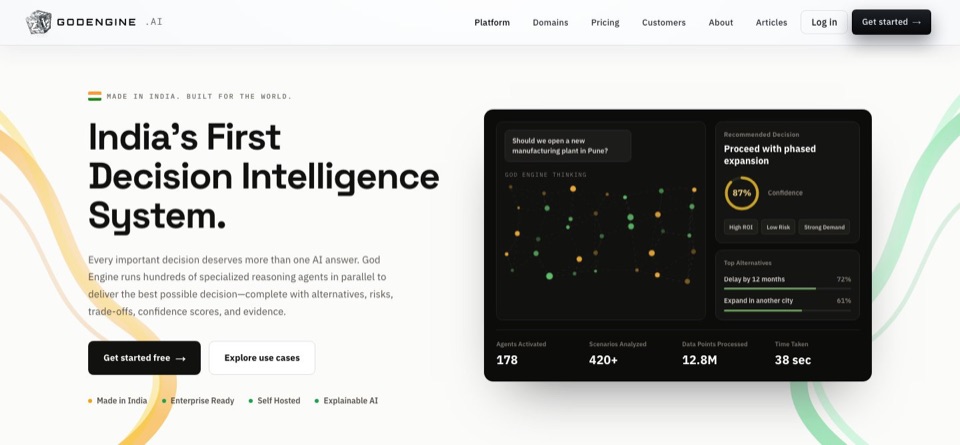
Most AI tools provide fluent answers that hide uncertainty. True decision intelligence builds a model of the world to show you the reasoning behind every choice.
The Risk of Fluent Answers
Large language models are excellent at producing fluent prose. They can write a convincing paragraph in seconds, making it easy to feel like you are talking to an expert who knows exactly what they are talking about.
In high-stakes work, this fluency often looks like certainty, which is a massive risk. When an AI gives you a single, confident answer to a complex business problem, it hides the moving parts of a decision. It doesn't show you the assumptions it made or the data it might have missed.
A single chat reply is a black box. It provides a conclusion without showing the work. If the AI is wrong, you might not realize it until the consequences hit your bottom line. GodEngine was built to do the opposite of a standard chatbot. Instead of just giving you a sentence, it gives you a structure.
How an AI 'Thinks' Through a Decision
When you ask a question in a standard chatbot, it predicts the next likely word. When you ask a question in GodEngine, the engine treats every question as a small model of the world.
The engine uses a "resolve pipeline" to break your question down. It doesn't just look for keywords; it looks for the underlying logic. This process involves several distinct stages:
- Extraction: It pulls entities, facts, and cause-and-effect links out of your question.
- Graph Building: It builds a knowledge graph that you can click through to see the structure of the problem.
- Source Attachment: It collects supporting sources and keeps them attached to the facts they support.
The process is transparent. Because the pipeline uses streaming results, you don't sit staring at a loading icon for a minute. You watch the reasoning happen in real-time. As the engine identifies a fact or a link, it appears on your screen via streaming results. This means a 50-second analysis shows progress from the very first second.
This transparency is vital for builders and owners. Whether you are using the web version or the Android app, you are seeing the same engine and the same graph. If you see a connection on your phone, it is the actual structure the engine built.
Scenarios Instead of Single Answers
Real decisions are not about finding the "one right answer." Real decisions are bets made under uncertainty. If you are a business owner in Mumbai deciding whether to expand your retail footprint, you aren't looking for a "yes" or "no." You are looking for the implications of different paths.
The engine builds a set of plausible scenarios and probes each one. It doesn't just say "this might happen." It asks deeper questions:
- What has to be true for this scenario to happen?
- What would break this scenario?
- What are the likely outcomes of this specific path?
Instead of receiving a single chat bubble, you receive a structured report on multiple potential futures. This allows you to weigh the cost of being wrong. For example, if you are deciding between opening a second outlet in Vasai this year or investing in delivery first, the engine probes the causal links between location, delivery costs, and local demand.
This is the core of decision intelligence: moving from "what is the answer?" to "what are the possibilities?"
Reasoning You Can Audit
The biggest problem with modern AI is the "hallucination"—the tendency to state falsehoods with total confidence. GodEngine fights this by making every claim auditable. Every claim in a GodEngine report points back to an entity, a link in the graph, or a specific source.
If a step in the reasoning looks wrong to you, you can trace it back. You can see exactly which step led the engine to a specific conclusion. This turns the AI from a "magic box" into a junior analyst that you can supervise.
| Feature | Standard Chatbot | GodEngine |
|---|---|---|
| Output Format | Fluent prose/text | Structured report with citations |
| Logic | Hidden/Black box | Visible knowledge graph |
| Verification | User must trust the text | "Numbers check" against computed facts |
| Complexity | Single answer | Multiple probed scenarios |
We also include a "numbers check." This feature compares figures in an answer against computed facts to reduce errors. While it is switched on and still has known misses, the engine shows its working so you can audit the logic rather than simply trusting the output.
Who Needs Decision Intelligence?
Decision intelligence is for people who have to explain their choices to others—whether that is to a board of directors, a bank, or a co-founder. It is for those who cannot afford to be "mostly right."
Common users include:
- Founders: Deciding between entering new markets, making key hires, adjusting pricing models, or deciding when to seek a new raise.
- Finance and Business Analysts: Those who need defensible write-ups and scenario models instead of just a single, isolated number.
- Researchers: Mapping the complex causes behind a specific trend or a sudden market event.
- Operators: Weighing operational changes that impact multiple teams and departments simultaneously.
If you find yourself asking questions that involve "if this, then that" logic, you are moving out of the realm of simple chat and into the realm of AI chief of staff level reasoning.
Privacy and Access
Strategic questions often involve sensitive data—profit margins, hiring plans, or expansion targets. You would not paste your company's most private secrets into a public chatbot, and neither should you have to with a decision engine.
GodEngine is designed with privacy as a core engineering requirement. We are building the capability to route every stage of the pipeline to a self-hosted, private model running on our own GPU servers. This means your data doesn't have to live in a third-party's training set. While this routing to private models is currently partly built, it is a top priority for our development roadmap.
Currently, GodEngine is available in an early release phase. It is open by invitation on both the Web and Android platforms. We are focusing on building a robust foundation before opening to the general public.
How to get started:
- Ask for access: You can request to join the current user group via our website.
- Submit a decision: You can reach out to the founder directly with a specific decision you would like to see the engine reason through. This helps us refine the engine's ability to handle real-world complexity.
As we grow, we are expanding our capabilities. This includes deeper simulation modes with many simulated agents and time-series forecasting (using TimesFM) integrated into everyday answers. We are building the tools for the future of geopolitical and business analysis.
Frequently Asked Questions
- How is this different from a standard chatbot?
- Chatbots provide fluent, conversational answers that can hide uncertainty. Decision intelligence builds a causal model and probes scenarios to show the reasoning behind the answer.
- Can I trust the numbers the AI provides?
- GodEngine includes a numbers check that compares figures against computed facts. It shows its working so you can audit the logic rather than simply trusting the output.
- What kind of questions should I ask?
- Ask complex decision questions, such as "Should we open a second outlet in Vasai this year, or invest in delivery first?" to see the engine break down causes and effects.
- Is my data private when using the engine?
- GodEngine is designed so that stages of the pipeline can be routed to self-hosted open models on private GPU servers to protect sensitive strategic data.
- How do I get access to GodEngine?
- GodEngine is currently open by invitation. You can ask for access or contact the founder with a specific decision you would like to see the engine reason through.

Questions people ask
How is this different from a standard chatbot?
Chatbots provide fluent, conversational answers that can hide uncertainty. Decision intelligence builds a causal model and probes scenarios to show the reasoning behind the answer.
Can I trust the numbers the AI provides?
GodEngine includes a numbers check that compares figures against computed facts. It shows its working so you can audit the logic rather than simply trusting the output.
What kind of questions should I ask?
Ask complex decision questions, such as 'Should we open a second outlet in Vasai this year, or invest in delivery first?' to see the engine break down causes and effects.
Is my data private when using the engine?
GodEngine is designed so that stages of the pipeline can be routed to self-hosted open models on private GPU servers to protect sensitive strategic data.
How do I get access to GodEngine?
GodEngine is currently open by invitation. You can ask for access or contact the founder with a specific decision you would like to see the engine reason through.