
What is Strategic AI?
Strategic AI refers to the application of decision intelligence to high-stakes business and organizational choices. Rather than simply generating text, it models the world by mapping facts, causes, and effects to provide structured, auditable reasoning.
When a business owner asks a standard AI a question, they often get a paragraph of text that sounds authoritative but lacks a structural foundation. Strategic AI approaches a question differently. It treats a decision as a small model of the world. It identifies the entities involved, the facts that govern them, and the causal links that connect them.
For example, a retail owner in Mumbai might ask, "Should I expand my clothing boutique to a second location in Vasai this year, or should I invest more in my delivery fleet first?" A standard chatbot might give a pros-and-cons list. A strategic approach using decision intelligence would map the causal link between "delivery speed" and "customer retention," and "rent in Vasai" against "projected footfall," creating a structured model of that specific business dilemma.
- It is the application of decision intelligence to high-stakes business and organizational choices.
- Unlike standard LLMs that prioritize fluency, strategic AI prioritizes structure and auditability.
- It treats a decision question as a small model of the world, mapping facts, causes, and effects.
The Risk of Fluency over Certainty
Large language models are excellent at producing fluent answers. In a high-stakes work environment, this fluency is a double-edged sword: it can create a false sense of certainty. When an AI writes a well-structured, confident-sounding response, it is easy to forget that the prose might be masking a lack of actual reasoning.
A single chat reply often hides the moving parts of a decision. It obscures the truth of the data, the causal relationships between variables, the potential outcomes of different paths, and—most importantly—the cost of being wrong. When you rely on a single answer, you lose the ability to see the "why" behind the conclusion.
Strategic AI is built to show the model, not just hide the reasoning behind prose. It moves away from the "black box" approach and toward a transparent structure where the logic is visible and verifiable.
How a Decision Intelligence Engine Works
To move from a chatbot to a decision engine, the system must go through a rigorous process of decomposition and verification. Using the GodEngine implementation as a reference, we can see how this works through a specific pipeline.
The Resolve Pipeline
The process begins with a resolve pipeline. Instead of generating a response all at once, the engine breaks down a question into its core components. It extracts the entities, the known facts, and the cause-and-effect links inherent in the query.
Building the Knowledge Graph
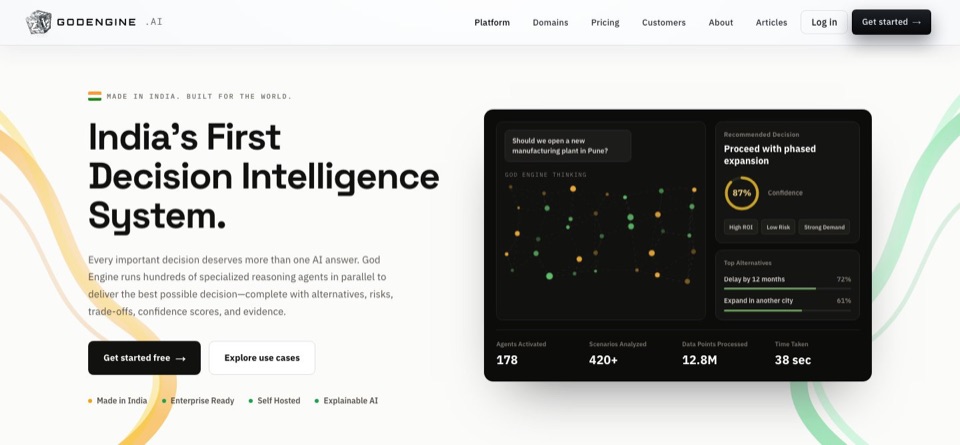
Once the components are extracted, the engine builds a knowledge graph. This is a visual and logical map of these links that users can click through to understand the logic. You aren't just reading a summary; you are navigating the logic of the decision.
Gathering and Attaching Sources
A decision is only as good as its data. The engine gathers supporting sources and attaches them directly to the facts they support. This ensures that every piece of information used to build the scenario is grounded in reality.
| Stage | Action | Output |
|---|---|---|
| Breakdown | Extract entities and causal links | A structured list of "what causes what" |
| Graphing | Map links in a knowledge graph | A clickable map of logic and entities |
| Sourcing | Collect and attach evidence | Facts linked directly to supporting sources |
Probing Scenarios instead of Single Answers
Real decisions are not about finding the "one right answer." In the real world, decisions are bets placed under conditions of uncertainty. Because of this, strategic AI focuses on simulation-based decision making and scenario probing.
Instead of providing a single, static answer, the engine builds a set of plausible futures. It then probes each scenario to determine two critical things:
- What must be true for this scenario to happen? (The necessary conditions).
- What would break this scenario? (The points of failure).
This allows operators to see the range of likely outcomes. For a logistics company, this might mean seeing a "high fuel cost" scenario versus a "rapid urban expansion" scenario, allowing them to prepare for various versions of the future rather than betting everything on a single prediction.
Reasoning You Can Audit
In high-stakes environments, "because the AI said so" is not a valid justification. You need reasoning you can audit. Strategic AI provides a trail of evidence for every step of its thought process.
Every claim in a strategic report points back to an entity, a link in the graph, or a specific source. If a step in the reasoning looks wrong, you can identify exactly which step led to the conclusion. This transparency allows you to correct the model's logic before it influences a major business move.
Furthermore, GodEngine includes a specific figure check. This feature compares numbers in answers against computed facts. While this is a work in progress and can have known misses, the engine is designed to show its working rather than asking for blind trust. It is a tool for verification, not a replacement for human oversight.
Who Needs Strategic AI?
Strategic AI is designed for individuals who will have to explain their decisions to others—whether that is a board of directors, investors, or a team of employees. It is built for those who deal with complexity and uncertainty daily.
- Founders: Making critical choices between different markets, hiring key executives, setting pricing models, or deciding when to pursue a new raise.
- Finance and Business Analysts: Moving beyond single-number forecasts to create defensible write-ups and complex scenarios for leadership.
- Researchers: Mapping the underlying causal drivers behind global trends or specific market events.
- Operators: Weighing organizational changes that impact multiple departments and require coordinated execution.
If your decision involves moving parts like causality and the cost of being wrong, you are in the realm of strategic AI.
Privacy for Sensitive Strategic Questions
Strategic questions often contain data that is too sensitive for public chatbots. A company's upcoming merger plans, detailed payroll structures, or proprietary manufacturing costs cannot be uploaded to a public model without significant risk.
The architecture of a decision intelligence engine like GodEngine is designed with this sensitivity in mind. The system is built so that different stages of the pipeline can be routed to different models. Specifically, sensitive stages can be routed to self-hosted, private models running on dedicated GPU servers.
While the ability to route every stage to a self-hosted private model is currently a work in progress, it is a primary priority for development. The goal is to ensure that decision-making intelligence does not compromise proprietary data. A decision engine you cannot trust with your data is of little use to a professional organization.

Questions people ask
How is strategic AI different from a standard chatbot?
Standard chatbots focus on generating fluent, conversational text. Strategic AI focuses on building a structured model of the world, mapping causal links, and providing auditable reasoning for decisions.
Can I trust the numbers provided by strategic AI?
The engine uses a numbers check to compare answers against computed facts. While it is a work in progress, it shows its working and citations so you can verify the logic rather than relying on blind trust.
What makes a decision 'strategic' in an AI context?
A strategic decision involves moving parts like causality, uncertainty, and the cost of being wrong. Strategic AI addresses these by probing scenarios and showing the 'why' behind an outcome.
How does the engine handle complex, multi-step reasoning?
It uses a resolve pipeline that streams results stage-by-stage via server-sent events, allowing you to watch the reasoning and graph-building happen in real-time.
Is my data safe when using a decision intelligence engine?
Strategic AI is designed so that sensitive stages of the pipeline can be routed to self-hosted, private models to ensure data remains within your controlled environment.