
The Chaos of Disconnected Documents
AI document management for small business involves moving away from scattered files in emails and WhatsApp towards a single, intelligent source of truth. By using an AI-native foundation, businesses can automate the creation and retrieval of critical documents like GST bills and price lists.
For many small and medium enterprises (SMEs), daily operations feel like a constant search for information. You might find your sales leads living in a spreadsheet, customer conversations scattered across WhatsApp, HR details tucked away in a separate app, and vital invoices buried in a long email thread.
When your business documents live in these disconnected silos, you face three major hurdles:
- Information Silos: Because nothing "talks" to anything else, AI tools can only see one small piece of the puzzle at a time. They cannot connect a WhatsApp message to an invoice in your email.
- Manual Tracking: Without a central system, you spend hours manually updating files, which leads to lost context and constant data duplication.
- Zero Visibility: When files are scattered, it becomes nearly impossible to answer a simple question like, "Who changed this price last week?"
An AI-Native Foundation for Your Files
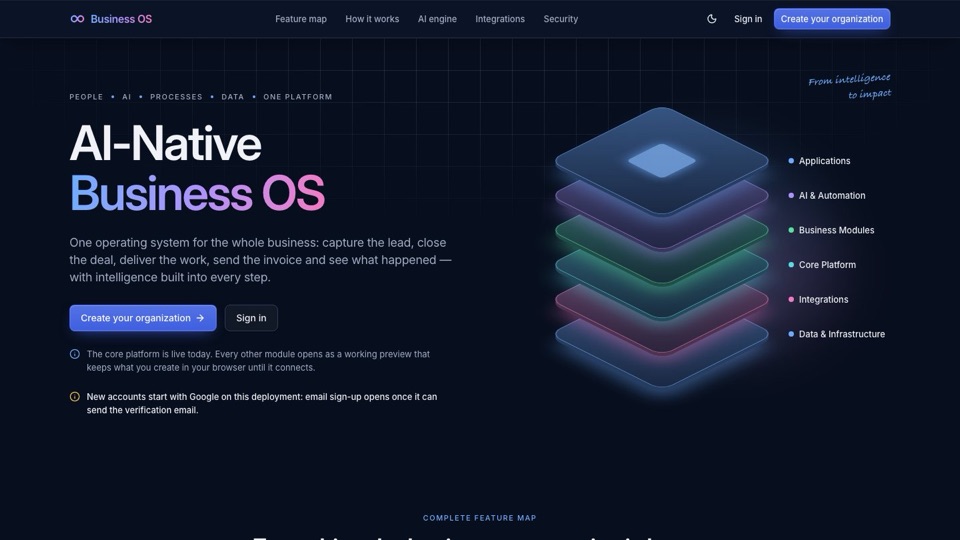
Most business tools are built by "bolting" different products together. This creates "seams" where security holes can appear and data gets duplicated. BusinessOS takes a different approach by building a master architecture first.
Instead of a bolt-on feature, document management is part of a single, secure file store. This foundation is currently live in alpha, providing the essential building blocks for a modern business operating system.
Core Features of the Foundation:
- Secure Sign-in: Use passkeys, two-factor authentication, or Google/Microsoft sign-in to protect your workspace.
- Organisational Structure: Set up departments, teams, and workspaces with clear roles and permissions.
- Versioned Uploads: Keep track of document history with previews, comments, and timelines to keep your team aligned.
- Centralized Search: Find what you need instantly across all your files and notifications.
By establishing this business operating system software foundation first, every future module—from CRM to HR—will share the same identity, the same permissions, and the same single source of truth.
From Raw Data to Finished Work
Standard document management is just storage. AI-native management is about action. This is where the gap between a "chat answer" and "finished work" is closed.
While the BusinessOS foundation provides the secure storage, tools like AskShiva act as the engine that turns requests into completed tasks. AskShiva is an AI assistant designed to handle the specific complexities of running a business in India.
| The Request | The AI Action | The Finished Work |
|---|---|---|
| "Make a GST bill for Sharma Traders, ₹18,400." | Calculates tax lines and drafts the document. | A downloadable, professional GST invoice. |
| "Make a price list from last month's sheet." | Reads your existing spreadsheet data. | A clean, printable, and shareable page. |
| "Send this on WhatsApp in Marathi." | Translates the message and prepares the file. | A ready-to-send message in the local language. |
This capability allows you to move beyond simply "searching" for a file to actually "generating" your business output through voice or text commands.
Enterprise-Grade Security for Small Business
Security shouldn't be a luxury reserved for giant corporations. In an AI-driven world, knowing exactly how your data is handled is critical. BusinessOS uses high-level technical safeguards to ensure your business secrets stay private.
How We Protect Your Data
We use PostgreSQL row-level security (RLS). This means data isolation is enforced at the database level. Even if a user is part of the same system, they can only see the specific rows of data they are authorized to see.
- Identity Protection: Secure access via passkeys and two-factor authentication.
- Strict Permissions: A single permission engine controls who can see or hide specific fields and records.
- The Audit Log: An append-only, searchable, and exportable log tracks exactly who did what and when. Because it is "append-only," records cannot be deleted or tampered with, providing a perfect history for your business.
AI Agents That Work Like Employees
The future of document management isn't just a human using a tool; it is an AI agent working alongside you. In a truly "AI-native" system, agents are treated as "first-class users."
This means an AI agent has its own identity and its own set of permissions. It doesn't just "hack" into your files; it signs in, follows your business rules, and its actions are recorded in your audit log just like a human employee's actions.
Imagine an agent that can:
- Follow up on overdue invoices automatically.
- Qualify inbound leads by reading customer details.
- Act within your specific approval workflows.
This architecture ensures that as you scale, your AI assistants act reliably and safely within the boundaries you set. This is the core philosophy behind the AI operating system for business.
Built for the Indian Business Context
Most AI tools are built for Western markets, treating Indian business practices as "edge cases." We believe they should be the main case. Business in India runs on a specific rhythm of WhatsApp, UPI, and multi-language communication.
Our approach focuses on the tools you actually use every day:
- GST-Ready: Generating GST invoices with correct tax lines is a primary capability, not an afterthought.
- Language Fluidity: The ability to translate and prepare messages in Marathi, Hindi, and other Indian languages allows you to communicate perfectly with customers across the country.
- Workflow Integration: The system is designed to bridge the gap between a digital document and a WhatsApp message or a UPI payment.
The Path to a Complete AI Operating System
BusinessOS is being built layer by layer. We are starting with the foundation to ensure that every module added later is secure, connected, and intelligent from day one.
Current Status vs. Future Roadmap
| Module | Status | What it covers |
|---|---|---|
| Foundation | Live in Alpha | Identity, permissions, files, search, and audit logs. |
| CRM | Next (Not built yet) | Contacts, deals, pipelines, and quotes. |
| Work & Communication | Specified | Tasks, projects, and messages. |
| HR | Specified | People, teams, leave, and payroll. |
| Operations & Documents | Specified | Processes, approvals, and documents. |
| AI Agents | Specified | Agents working across every module. |
| App Builder | Specified | Drag-and-drop internal business apps. |
As we move from the foundation toward a full AI-native CRM and beyond, our goal is to provide a single platform that manages every aspect of your business operations.
Frequently Asked Questions
- How is AI document management different from a standard folder system?
- Standard folders are just storage. AI-native management uses a single source of truth where agents can read, write, and act on documents like GST bills or price lists within your specific business permissions.
- Is my business data secure in an AI-native system?
- Yes. BusinessOS uses PostgreSQL row-level security and an append-only audit log to ensure data isolation and a complete record of every action taken by humans or agents.
- Can AI help with Indian tax documents?
- Yes, AskShiva is designed to handle Indian business documents, such as generating GST bills with the correct tax lines, as first-class outputs.
- Will AI agents be able to access my sensitive files?
- AI agents are governed by the same permission engine as your employees, meaning they can only access the files and data they are explicitly authorized to see.
- Can I use voice to manage my documents?
- Yes, AskShiva allows you to speak in the browser to request tasks, such as creating a document or translating a message, which the AI then turns into finished work.
Questions people ask
How is AI document management different from a standard folder system?
Standard folders are just storage. AI-native management uses a single source of truth where agents can read, write, and act on documents like GST bills or price lists within your specific business permissions.
Is my business data secure in an AI-native system?
Yes. BusinessOS uses PostgreSQL row-level security and an append-only audit log to ensure data isolation and a complete record of every action taken by humans or agents.
Can AI help with Indian tax documents?
Yes, AskShiva is designed to handle Indian business documents, such as generating GST bills with the correct tax lines, as first-class outputs.
Will AI agents be able to access my sensitive files?
AI agents are governed by the same permission engine as your employees, meaning they can only access the files and data they are explicitly authorized to see.
Can I use voice to manage my documents?
Yes, AskShiva allows you to speak in the browser to request tasks, such as creating a document or translating a message, which the AI then turns into finished work.