
The Problem with Fragmented Business Tools
BusinessOS is building an AI-native foundation to unify your business operations. While our core foundation is live in alpha, we are developing integrated modules for CRM, HR, and Operations to replace the messy mix of spreadsheets and chat apps used by most SMEs.
If you run a business in India, you know the chaos of a "fragmented stack." A typical small business owner might manage leads in a messy Excel sheet, talk to customers on WhatsApp, track staff attendance in a separate HR app, and send invoices through a fourth different tool. Documents end up lost in various email threads.
This fragmentation creates several critical issues for growing companies:
- Data Silos: Because these tools don't talk to each other, nothing is synced. A change in a customer's phone number in your contact list doesn't update in your billing app.
- Zero Visibility: When data is scattered, it is impossible to see a complete view of your business. You cannot easily track who changed a specific price or when a lead was last contacted.
- AI Limitations: Modern AI tools are only as good as the data they can see. If your data is split across five apps, an AI can only see one small piece at a time, making it useless for complex business tasks.
A Single Foundation for Everything
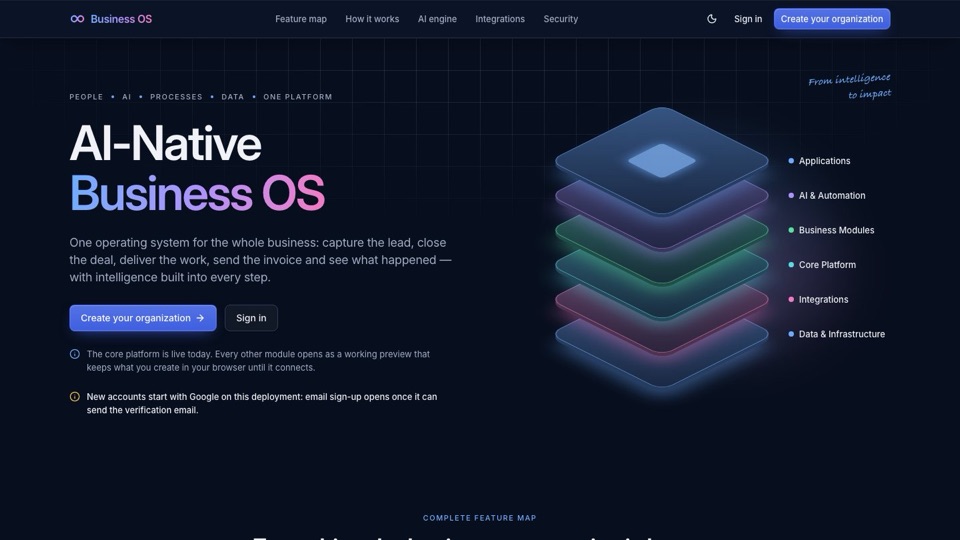
Most "all-in-one" business tools are built by bolting different products together. This creates "seams" where security holes appear and data gets duplicated. BusinessOS takes a different approach. We start with a master architecture—a single foundation—and build specialized modules on top of it.
Our foundation is currently live in early release. It provides the essential "nervous system" for your company, including secure sign-in, team management, and a unified permission engine. Instead of having different logins and different rules for every app, everything in BusinessOS shares one identity and one source of truth.
By using a business operating system software approach, we ensure that as you add more modules, they all work together perfectly from day one. Our database is the single source of truth for your entire organization.
Integrated Modules for Growth
We are building our modules to cover every major pillar of your business. We distinguish between what is currently being built and what has been fully specified for development.
| Module | What it covers | Current Status |
|---|---|---|
| CRM and Sales | Contacts, deals, pipelines, and quotes. | Next; not built yet. |
| Work and Communication | Tasks, projects, and messages. | Specified. |
| HR | People, teams, leave, and payroll. | Specified. |
| Operations and Documents | Processes, approvals, and document management. | Specified. |
Note: While the foundation is live, the specific modules above are currently in development or specified for upcoming release.
Enterprise-Grade Security and Isolation
Security isn't an afterthought; it is baked into the database level. For a multi-tenant system, we use PostgreSQL row-level security (RLS). This ensures that your data is strictly isolated at the most fundamental level, preventing one organization from ever seeing another's information.
We provide professional-grade access controls, including:
- Secure Authentication: Use passkeys, two-factor authentication (2FA), or SSO (Google/Microsoft) to keep your data safe.
- Granular Permissions: A central permission engine allows you to define exactly what users can see and do. You can hide specific fields or restrict access to certain departments.
- The Audit Log: We maintain an append-only, searchable, and exportable log. This records every single action taken by a user or an AI agent, providing a clear history of "who did what and when."
Real AI Agents, Not Just Chatbots
When we say BusinessOS is AI-native, we don't mean a simple chat box sitting in the corner of your screen. We mean that AI agents are "first-class users" of your system.
In a traditional setup, an AI is just a tool you talk to. In BusinessOS, an AI agent has its own identity and its own set of permissions, just like a human employee. This is the core of an AI operating system for business.
Because agents operate within your existing permission structures, they can actually get work done. For example, an agent could be authorized to follow up on overdue invoices or qualify inbound leads. Because they are part of the system, every action they take is recorded in the same audit log as your human staff, ensuring total accountability.
Built for Reliability and Scale
We use a modern, high-performance technology stack to ensure your business data is handled with precision. Our architecture is designed to bridge the gap between getting an AI answer and actually getting the job done.
- The Core: A TypeScript monorepo using Next.js for the web app and NestJS for the API.
- The Database: PostgreSQL 18, utilizing
pgvectorto power advanced AI search and retrieval capabilities. - Reliability: An event-driven architecture using an "outbox" pattern. This ensures that if a change triggers a background job, that job is never lost.
- Speed: We use Valkey for high-speed queuing and caching to keep the interface snappy.
By building on this robust stack, we provide the stability required for serious business operations while maintaining the flexibility to integrate the latest AI advancements.
Frequently Asked Questions
- Why not just use separate apps for CRM and HR?
- Separate apps create "seams" that lead to security holes and duplicate data. BusinessOS uses one foundation so everything shares the same identity and truth.
- How does the AI work within the platform?
- AI is "agentic," meaning agents are treated like employees with their own permissions and identities, rather than just a chat box in the corner.
- Is my data secure in a multi-tenant system?
- Yes. We use PostgreSQL row-level security and automated tests to ensure strict data isolation between different organisations.
- Can I see a history of changes made by my team?
- Yes, our append-only audit log provides a searchable, exportable record of who did what and when.
- What is the current state of the platform?
- The BusinessOS foundation is live in alpha with secure sign-in and team management. The CRM module is currently in development (Next; not built yet), while HR and Operations modules have been specified and are on the roadmap.
Questions people ask
Why not just use separate apps for CRM and HR?
Separate apps create 'seams' that lead to security holes and duplicate data. BusinessOS uses one foundation so everything shares the same identity and truth.
How does the AI work within the platform?
AI is 'agentic,' meaning agents are treated like employees with their own permissions and identities, rather than just a chat box in the corner.
Is my data secure in a multi-tenant system?
Yes. We use PostgreSQL row-level security and automated tests to ensure strict data isolation between different organisations.
Can I see a history of changes made by my team?
Yes, our append-only audit log provides a searchable, exportable record of who did what and when.
What is the current state of the platform?
The foundation is live in alpha with secure sign-in and team management. CRM, HR, and Operations modules are currently on the roadmap.