
What is an AI Operating System for Business?
An AI operating system is a unified digital foundation that manages identity, permissions, files, and data for an entire company. Unlike traditional software that simply connects different apps, an AI OS ensures every module shares one single source of truth.
Think of it as the central nervous system for your company. In a standard setup, your software is a collection of separate tools that barely talk to each other. In an AI-native operating system, every part of your business—from sales to HR—operates under the same security rules and uses the same database.
This creates a single environment where both human employees and AI agents work together. Because the AI has access to the same "truth" as your staff, it can actually understand the context of your business rather than just guessing based on a single spreadsheet or a chat log.
- Unified Foundation: Manages identity, permissions, files, and data for the whole company.
- Single Source of Truth: All modules share the same data, preventing the "duplicate info" problem.
- Unified Security: AI agents and humans operate under the exact same permission rules.
Why Your Current Stack is Fragmented
Most small and medium enterprises (SMEs) suffer from "app sprawl." You might use a spreadsheet to track leads, WhatsApp to talk to customers, a separate app for HR, and another tool for invoices. When your data is scattered like this, your business becomes a series of silos.
This fragmentation creates three major problems for growing businesses:
- Security Holes: When you add a new tool, you have to set up new users and new permissions. It is easy to accidentally give someone access to data they shouldn't see.
- Duplicate Data: You end up updating a customer's phone number in three different places. Eventually, someone uses the wrong one, and your records become unreliable.
- Blind AI: This is the biggest hurdle for the modern era. If you try to use AI tools on top of fragmented systems, the AI can only see one small piece of your business at a time. It can't see the invoice, the customer's WhatsApp history, and the HR payroll all at once.
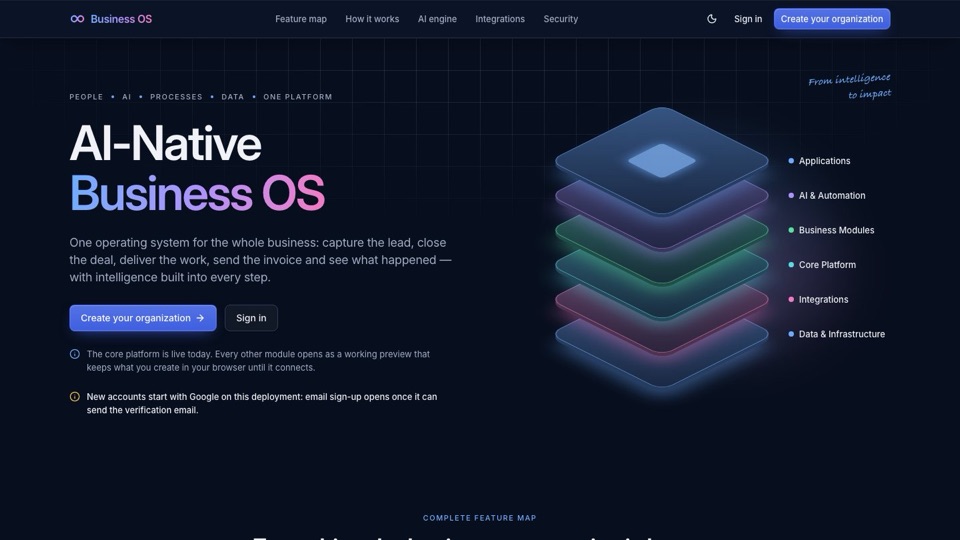
The BusinessOS Architecture: One Foundation
BusinessOS is built differently. Instead of bolting products together, we build a master architecture first. We believe that if you don't get the foundation right, the features on top will always be broken. This is why we focus on a single, robust core before building specific business modules.
Our architecture is designed to be the "single source of truth" for your entire organization. Every module we build—whether it is for sales or human resources—plugs directly into this core. This means they all share the same identity system, the same file store, and the same search engine.
| Feature | Traditional Software Stack | BusinessOS Architecture |
|---|---|---|
| Data Management | Disconnected silos and duplicates | One unified database (Single Source of Truth) |
| Permissions | Managed separately in every app | One central permission engine |
| Search | Searching through each app individually | Unified search across all modules and files |
| Security | Varying security standards | Strict database-level isolation (RLS) |
To ensure absolute privacy, we use PostgreSQL row-level security (RLS) with a signed tenant context. This ensures that your data is strictly isolated from other organizations using the platform. We even run automated tests to check this isolation for every single table in our database.
What "AI-Native" Really Means
Many companies claim to be "AI-powered," but that usually just means they stuck a chat box in the corner of an old piece of software. That isn't AI-native; that is just an interface change. A truly AI-native system is built from the ground up to treat AI as a core part of the workflow.
In BusinessOS, we treat AI agents as "first-class users." This is a fundamental shift in how software works. It means an AI agent is not just a tool you use; it is a participant in your business with its own identity and its own specific permissions.
When an AI agent performs a task—like following up on an unpaid invoice or qualifying a new lead—it follows the same rules as a human employee. It can only see the data it is allowed to see, and it can only perform actions it is authorized to do. Most importantly, every single action the agent takes is recorded in our append-only audit log, exactly like a human action would be. This creates a clear, searchable trail of everything happening in your business.
This approach is what allows for advanced workflows, such as those being developed by AskShiva, where AI can move from simply answering questions to actually completing multi-step tasks across your entire business.
Modules Built on the Foundation
We are building BusinessOS layer by layer. We start with the foundation to ensure it is rock-solid, and then we add the modules that run your business. Here is our current status and what is coming next:
Current Status: The Foundation (Live in Alpha)
The core infrastructure is already live and available for testing. This includes:
- Identity & Access: Secure sign-in, organizations, teams, and a robust permission engine.
- Data & Files: A unified file store with versioned uploads, previews, and signed links.
- Search & Notifications: A single search engine for all files and data, plus real-time in-app and email notifications.
- Audit: An append-only audit log that records every action for compliance and security.
The Roadmap: Business Modules
As the foundation matures, we are building out the specific tools you need to run your operations. These are currently in the roadmap and are not yet built:
- CRM and Sales: Managing contacts, deals, pipelines, and quotes. If you are looking for an best AI CRM for 2026, this is our primary focus.
- Work and Communication: Managing tasks, projects, and messaging.
- HR: Managing people, teams, leave requests, and payroll.
- Operations and Automation: Managing business processes, approvals, and advanced AI agents.
- App Builder: A drag-and-drop tool to create your own internal business apps.
If you are an Indian business owner looking for a specialized AI CRM in India, our roadmap is designed to address the specific needs of your local market, including GST and localized workflows.
Enterprise-Grade Security and Audit
Security cannot be an afterthought. Because we are building a foundation for entire companies, we implement enterprise-grade protections from day one. We don't just protect your data; we make sure you can prove it is protected.
Our security stack includes:
- Advanced Authentication: Secure sign-in using passkeys, two-factor authentication (2FA), and Single Sign-On (SSO) for larger teams.
- Strict Isolation: We use PostgreSQL row-level security to ensure that one company can never see another company's data, even at the database level.
- The Audit Trail: Our audit log is "append-only." This means once a record is written, it cannot be changed or deleted. It records who did what and when. This log is fully searchable and can be exported via CSV for your own compliance reviews.
By combining these layers, we provide a level of transparency and security that is often missing in the "bolted-together" software stacks used by most businesses today. We are building a business operating system software that grows with you, from your first employee to your thousandth.
Frequently Asked Questions
- How is an AI operating system different from standard business software?
- Standard software often bolts separate apps together, creating data silos. An AI operating system provides a single foundation where all modules share the same identity, permissions, and data source.
- Can AI agents work alongside my employees?
- Yes. In an AI-native system, agents have their own identities and follow the same permission and approval rules as humans, ensuring they stay within their assigned roles.
- How does BusinessOS handle data privacy between different companies?
- BusinessOS uses PostgreSQL row-level security (RLS) with a signed tenant context to enforce strict data isolation between organisations.
- What is included in the BusinessOS foundation today?
- The live alpha includes secure sign-in (passkeys, 2FA, Google/Microsoft sign-in), organisation and team management, a permission engine, files, search, and an append-only audit log.
- Is the CRM module available now?
- The CRM module, covering contacts, deals, and pipelines, is currently on the roadmap and is not yet built.
Questions people ask
How is an AI operating system different from standard business software?
Standard software often bolts separate apps together, creating data silos. An AI operating system provides a single foundation where all modules share the same identity, permissions, and data source.
Can AI agents work alongside my employees?
Yes. In an AI-native system, agents have their own identities and follow the same permission and approval rules as humans, ensuring they stay within their assigned roles.
How does BusinessOS handle data privacy between different companies?
BusinessOS uses PostgreSQL row-level security (RLS) with a signed tenant context to enforce strict data isolation between organisations.
What is included in the BusinessOS foundation today?
The live alpha includes secure sign-in (passkeys, 2FA, Google/Microsoft), organisation and team management, a permission engine, files, search, and an append-only audit log.
Is the CRM module available now?
The CRM module, covering contacts, deals, and pipelines, is currently on the roadmap and is not yet built.