
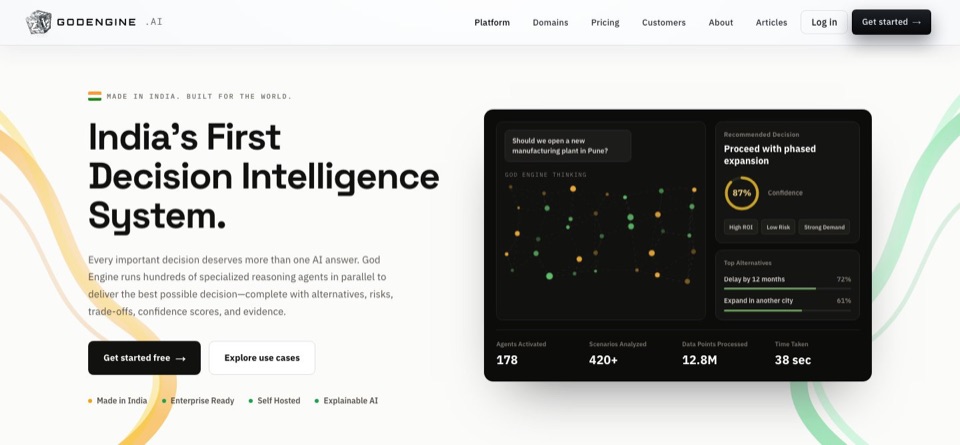
A Decision Engine, Not Just a Chatbot
GodEngine is a decision intelligence engine that builds causal models and scenarios to help founders make high-stakes bets. Unlike chatbots that provide fluent but unverified prose, it extracts facts and causal links to show you the reasoning behind every outcome.
Most AI tools today are designed to answer questions. They are built to be conversational, which means they excel at producing fluent, confident-sounding text. For a founder, this fluency is a trap. A chatbot might give you a very convincing argument for expanding your business, but it often hides uncertainty behind a wall of smooth prose. It gives you an answer, but it doesn't give you a model of the world.
GodEngine is built for the opposite. We believe that high-stakes decisions require structure, not just conversation. When you face a choice that could define your company's next year, you don't need a paragraph of text; you need to see the moving parts. You need to know what is true right now, what causes what, what could happen next, and—most importantly—what it costs to be wrong.
Instead of a single chat reply, GodEngine treats every question as a small model of the world. It builds a structured decision intelligence framework that maps out the entities, the facts, and the causal links involved in your problem. This allows you to move from "guessing" to "reasoning."
| Feature | Standard Chatbots | GodEngine |
|---|---|---|
| Output Style | Fluent, conversational prose | Structured reports and causal graphs |
| Certainty | Hides uncertainty in text | Probes multiple plausible futures |
| Verification | Hard to audit logic | Every claim is linked to a source |
| Core Goal | Answering a question | Helping you decide |
How the Resolve Pipeline Works
We don't make you wait for a wall of text to generate. GodEngine uses a "resolve pipeline" that streams results using server-sent events. This means as soon as the engine finishes a stage of reasoning, you see it on your screen. You watch the engine think in real-time.
The process follows a logical flow designed to mimic how a high-level consultant or a strategic operator would approach a problem:
- Ask: You type a complex, multi-layered decision. For example, a founder in Mumbai might ask: "Should we open a second outlet in Vasai this year, or invest in our delivery infrastructure first?"
- Break it down: The engine doesn't just look for keywords. It pulls the entities, facts, and cause-and-effect links out of your question. It places these into a clickable knowledge graph. You can see how "opening a second outlet" is linked to "increased rent" and "higher delivery demand."
- Gather sources: The engine collects supporting sources. Crucially, every fact is attached to a source. This makes the reasoning auditable. If the engine claims that Vasai has a high density of target customers, you can see exactly where that information came from.
- Build scenarios: This is where ai reasoning becomes practical. The engine builds a set of plausible scenarios and probes each one. It asks: What has to be true for the Vasai expansion to be profitable? What breaks this plan? What does this lead to in six months?
- Write the report: Finally, you receive a structured report. This isn't just a summary; it is a breakdown of your options, the likely outcomes, the risks, and the reasoning behind them, all backed by citations.
Built for High-Stakes Leadership
Founders are constantly making bets under uncertainty. When you are choosing between different markets, deciding on a key hire, setting pricing, or deciding whether to pursue a new funding round, a single "correct" answer doesn't exist. There are only different versions of the future.
GodEngine is designed for leaders who have to explain their decisions to others—whether that is a board of directors, a co-founder, or a lead investor. You cannot simply say, "The AI told me to do it." You need a defensible rationale. GodEngine gives you that explanation along with the answer.
The Reality of Uncertainty
Real decisions are not binary. They are probabilistic. Most tools try to give you one answer. GodEngine gives you several futures. By seeing what must be true for a specific outcome to occur, you can identify the "critical assumptions" that could sink your strategy if they prove false.
This approach moves you away from ai decision making that feels like magic and toward a system that feels like a tool. You can see every step, every link, and every calculation. If a step looks wrong, you can trace it back to the specific entity or source that caused the error.
Private Models for Sensitive Strategy
Strategic questions are often deeply personal to a business. You might be weighing a merger, a pivot, or a massive layoff. These are things you cannot—and should not—paste into a public chatbot where the data might be used to train general models.
We understand that a decision engine you cannot trust with your data is of limited use. Therefore, privacy is a core priority in our architecture. We have designed the pipeline so that different stages can be routed to different models.
Specifically, we are building the capability to route pipeline stages to self-hosted, open models running on private GPU servers. This means your most sensitive strategic reasoning can happen in a controlled environment, away from third-party providers. While this routing is currently being expanded, the goal is to provide a secure environment for your most critical business thinking.
Web and Android Access
Business happens everywhere—at a desk in a high-rise or on the move between meetings. To support this, GodEngine is available on both Web and Android platforms.
We ensure that the experience is consistent across devices. The engine is a single backend; the web and mobile clients simply render the same events. The knowledge graph you build and explore on your desktop is the exact same graph you can pull up on your phone while you are on the move. Because we use server-sent events, you can watch the reasoning and the graph build itself in real-time, no matter which device you are using.
Current Capabilities and Future Work
We believe in being transparent about where our technology stands. We would rather tell you exactly what we have built than oversell a vision. Here is the current state of the GodEngine pipeline:
| Capability | Status |
|---|---|
| Streaming decision reports | Built |
| Cause-and-effect breakdown and knowledge graph | Built |
| Scenario building and probing | Built |
| Web and Android apps (with Email/Google sign-in) | Built |
| Deeper simulation modes with many simulated agents | Working (being sped up) |
| Time-series forecasting (TimesFM) in everyday answers | Partly built |
| Routing every stage to a self-hosted private model | Partly built |
Our roadmap is focused on making the engine more autonomous and more private. We are working on deeper simulation modes that allow you to test your decisions against many simulated agents, and we are integrating time-series forecasting to provide more robust data-driven answers.
Frequently Asked Questions
- How is GodEngine different from ChatGPT?
- While chatbots provide fluent prose that can hide uncertainty, GodEngine builds a structured model of causes and effects, providing scenarios and citations instead of just a single answer.
- Can I trust the numbers in the report?
- GodEngine includes a numbers check that compares answers against computed facts. It shows its working so you can audit the logic rather than relying on blind trust.
- What kind of decisions can I use it for?
- It is designed for high-stakes decisions like choosing between market expansions, hiring, pricing strategies, or deciding whether to pursue a new funding round.
- Is my data private when using GodEngine?
- The architecture allows stages of the pipeline to be routed to self-hosted open models on private GPU servers, protecting sensitive strategic data.
- How do I get access to GodEngine?
- GodEngine is currently open by invitation. You can ask for access or write to me with a decision you want the engine to reason through. You can find more about our approach in our decision engine documentation.

Questions people ask
How is GodEngine different from ChatGPT?
While chatbots provide fluent prose that can hide uncertainty, GodEngine builds a structured model of causes and effects, providing scenarios and citations instead of just a single answer.
Can I trust the numbers in the report?
GodEngine includes a numbers check that compares answers against computed facts. It shows its working so you can audit the logic rather than relying on blind trust.
What kind of decisions can I use it for?
It is designed for high-stakes decisions like choosing between market expansions, hiring, pricing strategies, or deciding whether to pursue a new funding round.
Is my data private when using GodEngine?
The architecture allows stages of the pipeline to be routed to self-hosted open models on private GPU servers, protecting sensitive strategic data.
How do I get access to GodEngine?
GodEngine is currently open by invitation. You can ask for access or write to Divyaprakash Jha with a decision you want the engine to reason through.