
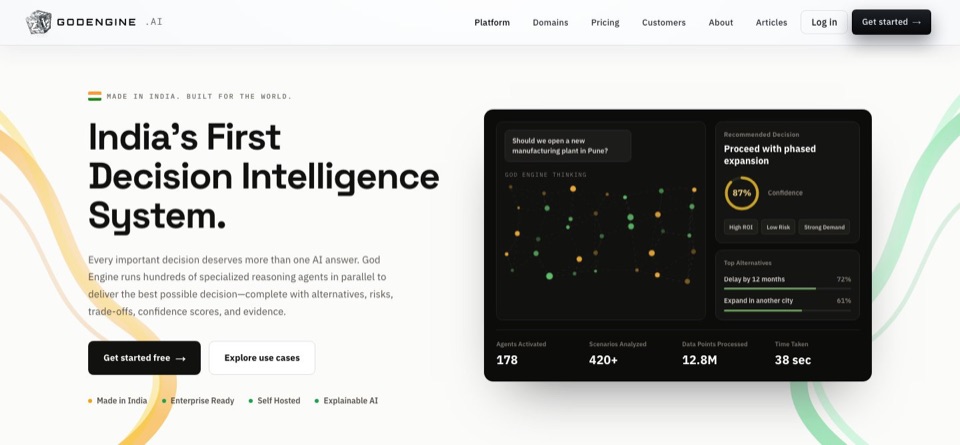
What are Decision Intelligence Tools?
Decision intelligence tools are specialized AI systems designed to model the complex causal relationships behind a choice rather than just generating conversational text. They move beyond simple chat replies to address the moving parts of a decision: current truths, causal links, potential outcomes, and the cost of being wrong.
If you have ever used a standard AI chatbot, you know the experience: you ask a question, and it provides a fluent, confident-sounding paragraph. For low-stakes tasks like writing an email or summarizing a recipe, this is perfect. But for high-stakes business choices, fluency can be a trap. A chatbot might tell you, "You should expand your retail store to a new city," but it won't show you the structural logic or the specific variables that make that advice sound. It offers a single answer, often masking the uncertainty inherent in the real world.
True decision intelligence tools function differently. They focus on helping you decide rather than just answering a question. Instead of a wall of text, they provide structured reasoning you can audit. They treat a decision as a problem of logic and causality, mapping out how one action might trigger a series of events. This approach is central to decision intelligence, which seeks to bring mathematical and structural rigor to the way humans make choices.
Consider a small business owner in Mumbai running a boutique clothing brand. If they ask a standard chatbot, "Should I open a second outlet in Vasai this year, or invest in delivery first?", the chatbot might give a generic pros-and-cons list. A decision intelligence tool, however, would attempt to model the "moving parts" of that specific choice. It would look at the relationship between local foot traffic in Vasai, the current cost of delivery logistics, and how an investment in one impacts the capital available for the other.
Key Differences in Approach
- Beyond Fluency: While LLMs focus on sounding human, decision intelligence focuses on being correct and verifiable.
- Causal Modeling: They identify the "why" behind a suggestion by mapping cause-and-effect links.
- Scenario Probing: They don't just give one answer; they explore multiple possible futures to see which ones are most robust.
The GodEngine Approach to Decision Intelligence
GodEngine is built on the premise that every question you ask is actually a small model of the world. When you input a decision, the engine doesn't just search for a pattern in its training data; it begins a process of construction and verification through a "resolve pipeline."
This pipeline is designed to show you the work as it happens. Instead of waiting for a single, massive response, the engine streams its reasoning in real-time via server-sent events. This transparency is vital for building trust in AI reasoning. You can watch the engine move through several distinct stages of thought.
First, the engine extracts entities, facts, and cause-and-effect links from your question. It places these into a clickable knowledge graph. This isn't just a list; it is a map of how different parts of your business or situation interact. If you are a founder weighing a hire, the graph might link "Salary Cost" to "Team Velocity" and "Runway Duration."
Once the graph is built, the engine moves into scenario building. It builds and probes multiple plausible scenarios to see what breaks them. It asks: "What has to be true for this expansion to work?" and "What specific event would cause this plan to fail?" By probing these scenarios, the engine helps you move from simple guessing to strategic reasoning.
| Stage | Action | Output |
|---|---|---|
| Extraction | Identifies entities and causal links | A clickable knowledge graph |
| Gathering | Collects supporting evidence | Facts attached to specific sources |
| Simulation | Probes multiple plausible futures | Scenario outcomes and "breaking points" |
| Reporting | Synthesizes findings | A structured, cited decision report |
Why Structure Beats Fluency
In high-stakes work, fluency in LLMs can look like certainty, which is a significant risk. A model can sound incredibly convincing while being factually wrong or logically disconnected. This is why "black box" AI is difficult to use in a boardroom or a financial planning session.
Decision intelligence puts structure around the model so you can check the logic. In a GodEngine report, every claim points back to an entity, a link in the graph, or a specific source. If the engine claims that "increased delivery speed will boost customer retention," you can click that claim to see the specific data point or causal link that justifies it. This makes the reasoning auditable.
Furthermore, GodEngine includes a "numbers check." This feature compares figures in the final report against computed facts to reduce errors. While it is an evolving feature and may have known misses, the system is designed to show its working rather than asking for blind trust. This is a core part of AI decision-making: the ability to verify the math behind the words.
Who Needs Decision Intelligence?
Decision intelligence is not for everyone; it is for those who have to explain their choices to others. If you are making a choice that involves significant capital, reputation, or long-term direction, you need more than a chatbot.
Common Use Cases
- Founders: Weighing critical pivots, such as choosing between entering a new market, making a key hire, adjusting pricing models, or deciding when to pursue a fundraising round.
- Finance and Business Analysts: Moving beyond single-number forecasts to create defensible, multi-scenario models that account for various market conditions.
- Researchers: Mapping the complex causal drivers behind specific trends, economic shifts, or social events.
- Operators: Managing complex organizational changes that impact multiple teams simultaneously, where a change in one department creates a ripple effect in another.
Privacy and Private Model Routing
One of the biggest barriers to using AI in business is data privacy. Strategic questions often contain sensitive information—revenue figures, upcoming product specs, or personnel details—that should not be pasted into public chatbots where they might be used for training or stored insecurely.
GodEngine is designed with this risk in mind. The architecture allows for "Private Model Routing." This means that instead of sending every part of your query to a public provider, you can route specific, sensitive stages of the reasoning pipeline to self-hosted open models running on your own private GPU servers.
The goal is to provide a decision engine you can actually trust with proprietary data. By allowing users to keep the most sensitive "thinking" steps within their own controlled infrastructure, GodEngine bridges the gap between the power of large-scale reasoning and the necessity of corporate privacy.
Current Capabilities and Roadmap
We believe in being transparent about what is ready to use today and what we are currently building. GodEngine is an evolving platform, and our roadmap reflects our commitment to moving from simple text to deep simulation.
What is Built
- Streaming Decision Reports: Real-time, step-by-step reasoning delivery.
- Knowledge Graphs: Cause-and-effect breakdowns that you can interact with.
- Scenario Probing: The ability to test "what if" situations.
- Cross-Platform Access: Fully functional web and Android apps with Google and email sign-in.
What is in Progress
- Deeper Simulation Modes: We are working on modes that involve multiple simulated agents interacting to test complex outcomes.
- Time-Series Forecasting: We are partly building integration for models like TimesFM to provide more robust temporal data in everyday answers.
- Private Model Routing: While the foundation is there, extending seamless routing to self-hosted private models is a top priority.
How to Access GodEngine
GodEngine is currently available by invitation only. We are focused on refining the engine and the experience for our early users before a wider release.
If you are interested in using the engine for your own strategic decisions, there are two ways to get involved:
- Ask for Access: You can visit our website to request an invitation.
- Write to the Founder: You can reach out directly with a specific decision you would like to see the engine reason through. This helps us understand the real-world problems we should be solving.
You can access the engine via the Web or the Android app. As we move toward a full release, we will continue to expand the capabilities of both platforms to ensure you have a consistent experience whether you are at your desk or on the move.

Questions people ask
How is decision intelligence different from a standard AI chatbot?
Chatbots focus on producing fluent, conversational text which can mask errors. Decision intelligence tools focus on structured reasoning, causal links, and verifiable scenarios.
Can I trust the numbers an AI provides?
GodEngine includes a numbers check that compares answers against computed facts to verify accuracy, though it is still an evolving feature.
What are 'scenarios' in decision intelligence?
Scenarios are plausible future outcomes that the engine probes to see what must be true for them to happen and what would cause them to break.
Is my data safe when using these tools?
GodEngine is designed to allow routing of data to self-hosted, private models to ensure sensitive strategic questions remain private.
How do I know if the AI's reasoning is correct?
You can audit the reasoning because every claim is linked to a specific entity in a knowledge graph or a cited source.