
What is a Decision Intelligence Platform?
Decision intelligence platforms are specialized AI systems designed to move beyond simple conversation to structured reasoning. Instead of just generating text, they build models of the world by mapping entities, facts, and causal links to help you make high-stakes choices.
Most people are used to interacting with standard Large Language Models (LLMs). You ask a question, and the AI provides a fluent, conversational answer. While this is impressive for writing emails or summarizing text, it often falls short when you need to make a real business move.
A true decision intelligence platform treats your question as a problem to be solved through modeling. It doesn't just guess the next word in a sentence; it attempts to map out the underlying logic of your situation. It identifies the "who," the "what," and the "why" behind a specific scenario.
For example, if a small boutique owner in Mumbai is wondering whether to expand their physical storefront or increase their budget for Instagram advertising, a chatbot might give a generic list of pros and cons. A decision intelligence platform, however, will attempt to structure those variables. It looks at the entities (the storefront, the ad budget, the customer base), the facts (current footfall, ad conversion rates), and the causal links (how much more ad spend leads to how much more footfall).
The ultimate goal is to move from "chatting" to "deciding." By showing you the underlying logic, these platforms allow you to see the mechanics of a choice rather than just reading a polished paragraph.
The Risk of Fluency in High-Stakes Decisions
There is a hidden danger in modern AI: fluency looks like certainty. Large language models are incredibly good at producing text that sounds authoritative, professional, and confident. For a student writing an essay, this is a feature. For a business owner making a million-rupee investment, this is a massive risk.
When an AI provides a single, smooth chat reply, it often hides the "moving parts" of the reasoning. It doesn't show you:
- What information is actually true right now.
- What specific event causes another event to happen.
- The cost of being wrong if the AI's logic is flawed.
In high-stakes environments, you cannot rely on "vibes" or the tone of the prose. You need to know if the AI is hallucinating a connection or if it is following a logical chain. This is where ai reasoning becomes critical. Decision intelligence puts a structure around the model so you can audit the logic. Instead of trusting the prose, you are verifying the architecture of the thought process.
| Feature | Standard AI Chatbot | Decision Intelligence Platform |
|---|---|---|
| Primary Goal | Fluent conversation | Structured decision support |
| Output Style | Conversational prose | Auditable reasoning & models |
| Logic Visibility | Hidden/Black box | Explicit causal links |
| Risk Profile | High (due to hidden hallucinations) | Lower (due to auditable steps) |
How Decision Intelligence Works
Moving from a chatbot to a decision engine requires a fundamental change in how the software processes information. It requires a "pipeline" rather than a single step of generation.
The Resolve Pipeline
One of the most important technical aspects is the resolve pipeline. Instead of waiting for a long response to appear all at once, the pipeline streams results in real-time. This means you can watch the reasoning happen stage by stage. If a 50-second analysis is running, you see progress from the very first second, rather than staring at a blinking cursor.
Knowledge Graphs
The engine doesn't just read text; it extracts entities and cause-and-effect links to build a clickable map of facts. This is known as a knowledge graph. When the system identifies a fact, it attaches it to a specific entity, allowing you to see how different parts of your business or your problem are connected.
Scenario Probing
Instead of providing one "correct" answer, a decision intelligence platform builds and probes multiple plausible futures. It asks: "What would have to be true for this outcome to happen?" and "What specific event would break this plan?" This is essential for strategic reasoning, as it prepares you for uncertainty.
Citations and Verification
To prevent the "black box" problem, every claim made in a report is linked back to a specific entity, a link in the knowledge graph, or a source. You don't have to take the AI's word for it; you can click through to see where the information originated.
Key Capabilities for Operators
For those who use these tools in professional settings, certain capabilities are non-negotiable. These are the tools that turn an AI from a toy into an operator's asset.
- Scenario Building: The platform provides several possible futures and clearly outlines the conditions required for each to occur. This allows you to plan for "best-case" and "worst-case" scenarios with mathematical clarity.
- Fact Verification: One of the most vital features is a "numbers check." This compares the figures mentioned in the AI's answers against computed facts. While it is a work in progress and has known misses, it is designed to show its working so you don't have to rely on blind trust.
- Streaming Reasoning: By using server-sent events, the platform ensures that the user is always aware of the current state of the analysis, making the complex process of ai decision making feel transparent and interactive.
Who Should Use These Platforms?
Decision intelligence is not for everyone. It is designed for people who have to explain their choices to stakeholders, boards, or employees. If you need to justify a major move, you need a defensible reasoning chain.
Common users include:
- Founders: When deciding between entering new markets, making key hires, changing pricing models, or deciding when to start a fundraising round.
- Finance and Business Analysts: Those who need structured, defensible write-ups and scenario maps rather than just a single, isolated number.
- Researchers: Individuals mapping the complex causal drivers behind specific global trends or localized market events.
- Operators: Managers weighing complex changes that impact multiple teams simultaneously, such as a logistics shift that affects both warehouse staff and delivery drivers.
Data Privacy in Decision Intelligence
Strategic questions are often highly sensitive. A founder asking about a potential acquisition or a company planning a restructuring cannot simply paste that data into a public chatbot. Doing so risks leaking proprietary strategy into the training data of a public model.
Advanced decision intelligence platforms address this through architectural flexibility. A key goal for modern engines is the ability to route different stages of the reasoning pipeline to self-hosted, private models running on dedicated GPU servers. This ensures that your most sensitive "reasoning" stays within your controlled environment.
The ability to run models privately is not just a luxury; it is essential for building the trust required to use an AI as a core part of a business's decision-making engine.
GodEngine: A Practical Implementation
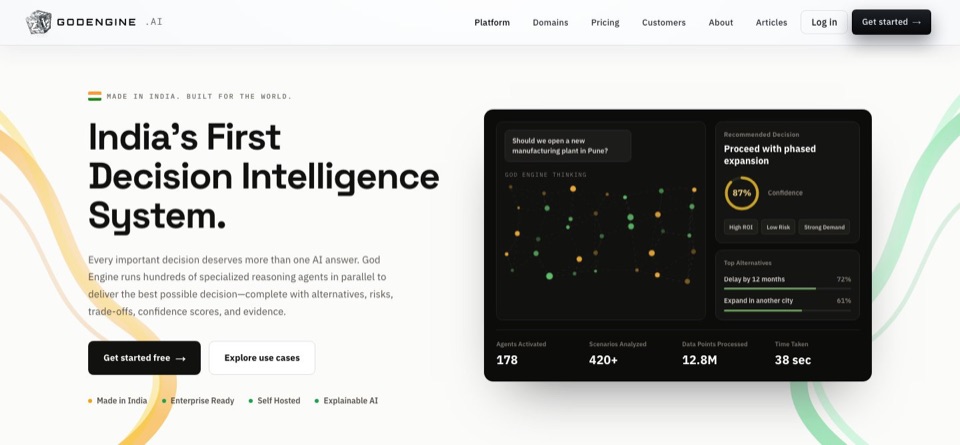
GodEngine is a decision intelligence engine currently available on the web and as an Android app. It is designed to take a decision question, extract facts and causal links, build scenarios, and stream a full report back to the user.
The platform is currently open by invitation. This approach ensures that the team can maintain quality and control while the product matures. The core engine is the first of five planned platforms from the team.
Current capabilities include:
- Streaming decision reports.
- Cause-and-effect breakdowns via a knowledge graph.
- Scenario building and probing.
- Web and Android app availability.
As the platform evolves, the team is working on deeper simulation modes involving multiple simulated agents and integrated time-series forecasting. Users can request access or reach out with specific decision problems they would like to see the engine reason through.
Frequently Asked Questions
- How is decision intelligence different from a standard AI chatbot?
- Chatbots focus on generating fluent, conversational answers. Decision intelligence platforms focus on building models of cause and effect, probing scenarios, and providing auditable reasoning.
- Can I trust the numbers an AI provides for business decisions?
- Standard AI can hallucinate. Decision intelligence platforms use a 'numbers check' to compare answers against computed facts and provide citations for every claim.
- Why are scenarios important for decision making?
- Real decisions are bets made under uncertainty. Scenario probing shows you multiple possible futures and what would have to be true for each to happen.
- How do I know if an AI's reasoning is correct?
- A proper decision intelligence platform allows you to audit the reasoning by showing the knowledge graph, the entities involved, and the specific sources used.
- Is my data safe when using these platforms?
- For high-stakes decisions, it is vital to use platforms that allow you to route data to self-hosted, private models rather than public providers.

Questions people ask
How is decision intelligence different from a standard AI chatbot?
Chatbots focus on generating fluent, conversational answers. Decision intelligence platforms focus on building models of cause and effect, probing scenarios, and providing auditable reasoning.
Can I trust the numbers an AI provides for business decisions?
Standard AI can hallucinate. Decision intelligence platforms use a 'numbers check' to compare answers against computed facts and provide citations for every claim.
Why are scenarios important for decision making?
Real decisions are bets made under uncertainty. Scenario probing shows you multiple possible futures and what would have to be true for each to happen.
How do I know if an AI's reasoning is correct?
A proper decision intelligence platform allows you to audit the reasoning by showing the knowledge graph, the entities involved, and the specific sources used.
Is my data safe when using these platforms?
For high-stakes decisions, it is vital to use platforms that allow you to route data to self-hosted, private models rather than public providers.