
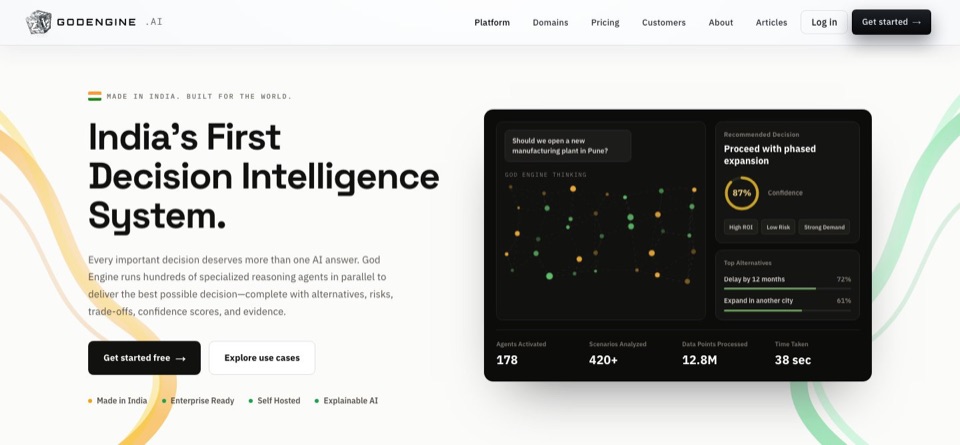
Defining Decision Intelligence
Decision intelligence is the process of applying structured reasoning and causal modeling to complex questions. Instead of just generating text, it builds a model of the world to show you the risks, dependencies, and potential outcomes of your choices.
Most people think of AI as a way to get a quick answer to a question. But in business, answers are rarely enough. If a shop owner in Mumbai is deciding whether to expand their storefront or invest in a new delivery fleet, they don't just need a "yes" or "no." They need to understand the mechanics of that choice.
Decision intelligence moves beyond "answently" prose—those fluent, conversational replies that sound confident but lack depth. It addresses the actual moving parts of a real-world decision:
- What is true now: The current facts and data points.
- Cause-and-effect links: How one change (like a price hike) triggers another (like a drop in volume).
- What could happen next: The various paths the business might take.
- The cost of being wrong: The specific risks and downsides of a chosen path.
Essentially, it treats every question as a small model of the world rather than just a prompt for a text response. It is about strategic reasoning applied to data.
Why Not Just Use a Chatbot?
Large language models (LLMs) are excellent at producing fluent answers. They can write a beautiful paragraph about market trends or competitive analysis. However, for builders and business owners, this fluency is a double-edged sword.
In high-stakes work, fluency can look like certainty. A chatbot might give you a very confident-sounding recommendation to expand into a new city, but it won't tell you exactly why it thinks that will work or what specific event would prove it wrong. It hides the complexity of the real world behind a single, polished reply.
Decision intelligence is built for the opposite of a chatbot. It acknowledges that real decisions are bets made under uncertainty. Instead of a single answer, it provides scenarios. It doesn't just tell you what might happen; it shows you the different versions of the future you are choosing between.
| Feature | Standard Chatbot (LLM) | Decision Intelligence |
|---|---|---|
| Primary Goal | Fluency and conversation | Structured reasoning and outcomes |
| Output Style | A single, confident answer | Multiple plausible scenarios |
| Handling Uncertainty | Often glosses over it | Probes and tests it |
| Complexity | Hidden behind prose | Exposed through models |
How the Decision Pipeline Works
The power of a decision engine lies in its "resolve pipeline." This is a sequence of steps that transforms a raw question into a structured, actionable report. Unlike traditional AI that waits to give you a wall of text, a modern pipeline streams its results so you can watch the reasoning happen in real-time.
The process follows these core stages:
- Break it down: The engine takes your question and pulls out the entities, facts, and cause-and-effect links. It places these into a knowledge graph—a map of how things relate to one another.
- Gather sources: It collects supporting information and attaches those sources directly to the facts they support. This ensures that every piece of data is anchored to reality.
- Build and probe scenarios: The engine builds multiple plausible scenarios. It then "probes" them, asking: "What has to be true for this scenario to happen?" and "What would break this scenario?"
- Write the report: The final output is a structured report. It lays out your options, the likely outcomes, the risks involved, and the specific reasoning used to reach those conclusions.
This is more than just AI reasoning; it is a structured investigation into the mechanics of a decision.
Reasoning You Can Audit
One of the biggest risks in using AI for business is the "black box" problem—you get an answer, but you have no idea how the machine arrived there. Decision intelligence is designed to be transparent. It provides reasoning you can actually audit.
Every claim made in a decision intelligence report points back to something specific: an entity in the graph, a link between two facts, or a specific external source. If a step in the reasoning looks wrong to you, you don't have to guess why the machine said it. You can see exactly which step failed or why the engine believed a certain link was true.
This transparency moves you from a state of "blind trust" to a state of "verification." You aren't just taking the machine's word for it; you are reviewing its logic.
Who Needs Decision Intelligence?
Decision intelligence is built for anyone who has to explain a high-stakes decision to someone else—whether that is a board of directors, a co-founder, or a bank manager.
Common Use Cases:
- Founders: Deciding between different markets, choosing between key hires, setting pricing models, or deciding when to pursue a new fundraising round.
- Finance and Business Analysts: Those who need to provide defensible write-ups and multiple scenarios rather than just a single, static number.
- Researchers: Individuals trying to map the causal drivers behind a specific market trend or a sudden economic event.
- Operators: Managers weighing organizational changes that might impact multiple different teams and departments simultaneously.
Privacy and Data Security
Strategic decisions often involve highly sensitive data—proprietary margins, upcoming product specs, or private hiring plans. You cannot simply paste this information into a public chatbot without significant risk.
A professional decision intelligence architecture is designed with privacy as a requirement, not an afterthought. The goal is to allow different stages of the reasoning pipeline to be routed to self-hosted, private models running on dedicated GPU servers. This ensures that your most sensitive strategic questions stay within your own controlled environment.
While the ability to route every stage to a private model is currently a work in progress, it is a core priority. A decision engine is only useful if you can trust it with your most valuable information.

Questions people ask
How is decision intelligence different from AI reasoning?
While AI reasoning focuses on the logic of a model, decision intelligence applies that reasoning to a structured model of the world, including causal links and scenario probing.
Can decision intelligence help with uncertainty?
Yes. Instead of providing one 'correct' answer, it builds and probes multiple plausible scenarios to show different possible futures.
How do you verify if a decision intelligence report is accurate?
You can audit the reasoning by following the citations and links in the knowledge graph back to the original sources and facts.
Is decision intelligence only for large corporations?
No. It is designed for anyone who has to explain a high-stakes decision to others, including founders, analysts, and researchers.
What is the main risk of using standard LLMs for decisions?
The main risk is that LLMs are designed for fluency; they can produce very confident-sounding prose that is factually incorrect or lacks causal depth.