
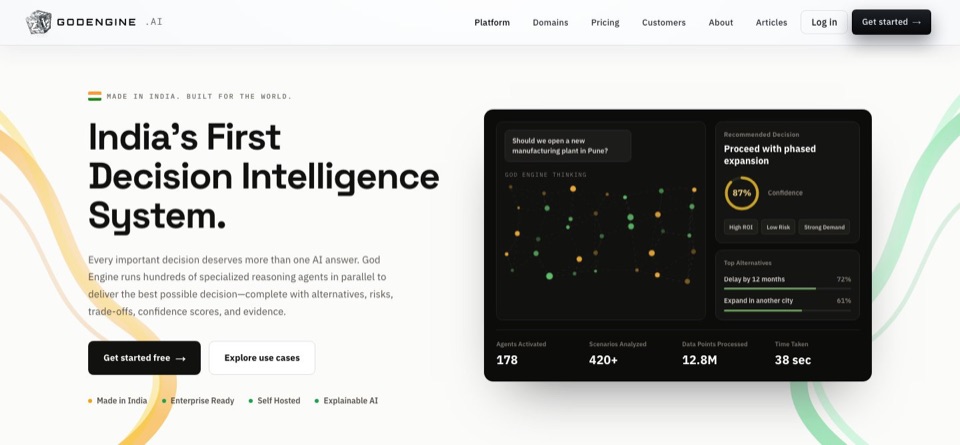
A decision engine is a system that models the world to help you make high-stakes choices. Instead of just generating text, it extracts facts and causal links to build a structured map of possibilities, risks, and outcomes.
What is a Decision Engine?
Most people are used to interacting with chatbots. When you ask a chatbot a question, it uses language patterns to predict the next most likely word, resulting in a fluent, confident-sounding answer. This is great for writing emails or summarizing articles, but it is dangerous for business strategy.
A decision engine operates differently. It does not treat your question as a prompt for a conversation; it treats your question as a problem to be modeled. It looks at the entities involved—such as your business, your competitors, or your local market—and attempts to understand how they interact.
- Beyond Fluency: Unlike a chatbot that provides a single fluent answer, a decision engine treats a question as a model of the world.
- Knowledge Mapping: It extracts entities, facts, and cause-and-effect links to build a clickable knowledge graph.
- Structured Output: It provides structured reports showing options, likely outcomes, and risks rather than just text.
If you ask a chatbot, "Should I expand my cafe to a second location in Vasai?" it might give you a list of pros and cons. A decision engine will attempt to map out the actual causal links: how much foot traffic in Vasai affects your revenue, how a second rent payment impacts your cash flow, and what specific conditions must be met for that expansion to be successful.
How the Engine Works
The engine operates through a specialized process called a resolve pipeline. This is not a single step where you send a prompt and wait; it is a multi-stage journey of reasoning.
The Resolve Pipeline
The process begins when you type a decision question. The engine does not jump straight to an answer. Instead, it performs the following steps:
- Breakdown: The engine pulls the entities, facts, and cause-and-effect links out of your question. It places these into a knowledge graph that you can actually click through to inspect.
- Gathering: It collects supporting sources and keeps them attached to the specific facts they support, ensuring the reasoning is grounded.
- Scenario Building: It builds a set of plausible scenarios and probes them. It asks: "What has to be true for this scenario to work?" and "What breaks this logic?"
- Reporting: Finally, it writes a structured report that lays out the options, the likely outcomes, and the risks.
One of the most important technical features is how the information is delivered. The pipeline uses server-sent events to stream results. This means you do not sit staring at a loading spinner for 50 seconds; you watch the reasoning happen in real-time, seeing each stage of the breakdown as it finishes.
Reasoning You Can Audit
In high-stakes business environments, "sounding right" is not the same as "being right." Large language models are excellent at producing fluent answers, but this creates a specific risk: fluency often looks like certainty. This can lead to a false sense of security when making expensive decisions.
A decision engine is built to combat this by putting structure around the model. It is designed for ai reasoning that is transparent rather than opaque. Instead of a wall of text that you have to take on faith, you get a system you can audit.
| Feature | Standard Chatbot | Decision Engine |
|---|---|---|
| Primary Goal | Fluent conversation | Logical modeling |
| Verification | Hard to verify "hallucinations" | Every claim points to a source or link |
| Output Type | Unstructured prose | Structured reports and graphs |
| Reliability | Based on probability | Based on causal links and figure checks |
To ensure accuracy, the engine includes a "figure check." This feature compares numbers used in the answers against computed facts. While the system is still evolving and has known misses, it is designed to show its working so you can audit the logic rather than relying on blind trust. This is a core part of ai decision making where the goal is to move from "guessing" to "calculating."
Scenarios Instead of Single Answers
Real decisions are rarely about finding the one "correct" answer. In the real world, decisions are bets made under conditions of uncertainty. A good operator knows that there is no single path, only a series of possible futures.
A decision engine embraces this by providing several possible futures. Instead of saying "You should do X," it identifies what would have to be true for different outcomes to occur. This is a fundamental aspect of scenario planning ai.
For example, if you are a founder deciding whether to raise a new round of funding or bootstrap your growth, the engine won't just pick a side. It will show you:
- Scenario A: Rapid growth through funding. (Requires: high market demand, quick hiring cycles).
- Scenario B: Sustainable growth through bootstrapping. (Requires: high margins, low burn rate).
By seeing these paths, you can weigh the cost of being wrong. You can look at each scenario and ask, "If I choose Path A and the market shifts, can I survive the pivot?" This allows for much more sophisticated strategic reasoning.
Who Should Use a Decision Engine?
Decision engines are built for people who have to explain their choices to others—whether that is to a board of directors, a bank, or a co-founder. If your decision has moving parts that affect multiple teams, you need a way to map those parts.
Target Users
- Founders: When deciding between entering new markets, making key hires, adjusting pricing models, or choosing between funding rounds.
- Finance and Business Analysts: When you need to produce defensible, structured write-ups and scenarios rather than just a single projected number.
- Operators and Researchers: When you are trying to map the causal links behind complex trends or significant organizational changes.
Privacy and Private Models
Strategic questions are sensitive. A business owner would never paste their most private, unannounced merger plans into a public chatbot. We understand that strategic questions require data security that public tools cannot guarantee.
The architecture of our engine is designed with privacy as a priority. We recognize that a decision engine you cannot trust with your data is not much use at all. To solve this, we have designed the pipeline so that different stages can be routed to different models.
Specifically, the architecture allows stages of the pipeline to be routed to self-hosted, open models on private GPU servers. This means you can use the power of a decision engine without ever sending your most sensitive information to an outside provider. This is a critical distinction for companies moving toward decision intelligence in a secure, enterprise-grade way.
Current Capabilities and Future Work
We believe in being transparent about what is built and what is still in development. We would rather tell you exactly where the product stands than oversell it.
Current Capabilities (Built)
- Streaming Reports: Real-time, end-to-end streaming of decision reports.
- Causal Mapping: Cause-and-effect breakdown and interactive knowledge graphs.
- Scenario Probing: The ability to build and probe multiple plausible futures.
- Cross-Platform: Available on both Web and Android (early release by invitation).
In Development (Partly Built / Working)
- Deeper Simulations: We are working on simulation modes that involve many simulated agents acting within a scenario.
- Time-Series Forecasting: Integrating tools like TimesFM to include time-series forecasting in everyday answers.
- Private Routing: Completing the ability to route every stage of the pipeline to a self-hosted private model.

Questions people ask
How is a decision engine different from a chatbot?
A chatbot provides fluent text answers that can hide uncertainty. A decision engine builds a causal model of the world, showing you the facts, the links between them, and the different scenarios that could play out.
Can I trust the numbers provided by the engine?
The engine includes a 'figure check' that compares numbers in answers against computed facts. It shows its working so you can audit the logic rather than relying on blind trust.
How does the engine handle complex, multi-step reasoning?
It uses a resolve pipeline that breaks questions down into entities and causal links, building a knowledge graph that you can click through to see how the engine reached its conclusion.
Is my data safe when using the engine?
The architecture is designed so that stages of the pipeline can be routed to self-hosted, private models on your own GPU servers to protect sensitive strategic data.
What kind of questions can I ask?
You can ask complex, high-stakes questions like 'Should we open a second outlet in Vasai this year, or invest in delivery first?' to see the different paths and risks.