
What is Strategic Reasoning?
Strategic reasoning is the process of breaking a complex decision down into a structured model of the world. Instead of just generating text, it maps out entities, facts, and the causal links that connect them to show you the "why" behind a potential outcome.
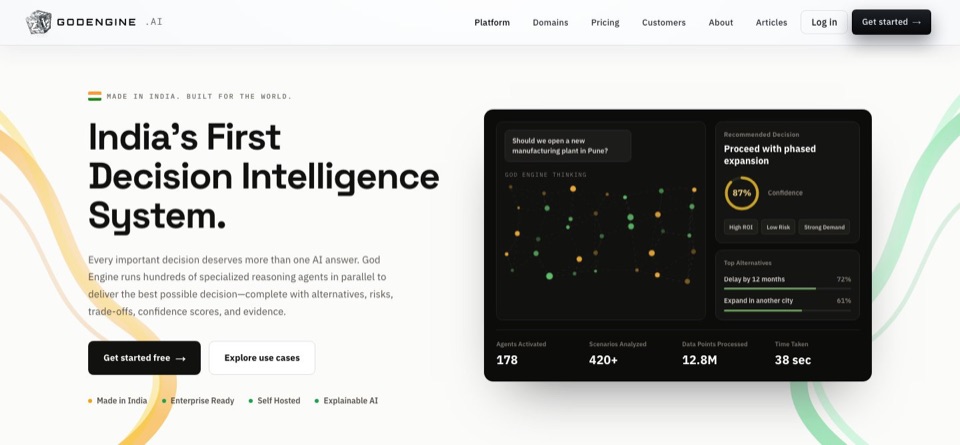
When you ask a standard AI a question, you get a paragraph. When you use strategic reasoning, you get a map. It focuses on three critical dimensions of a decision: what is true right now, what causes what to happen next, and the actual cost of being wrong if your assumptions fail.
Imagine a small business owner in Mumbai deciding whether to expand a retail shop into a larger space in Bandra. A chatbot might give a generic list of pros and cons. Strategic reasoning, however, models the relationship between rent increases, foot traffic patterns, and inventory turnover. It treats the decision as a series of interconnected moving parts rather than a simple yes-or-no question.
Reasoning vs. Fluent Prose
Large language models are incredibly good at being "fluent." They can write beautiful, persuasive, and professional-sounding prose. However, for business owners and builders, fluency is a double-edged sword. Fluency can look like certainty even when the AI is simply guessing. This is a massive risk in high-stakes decision-making.
Strategic reasoning moves away from "confident prose" and toward structured, decision intelligence. It replaces the illusion of certainty with auditable logic. Instead of providing one single "best" answer, it provides multiple plausible scenarios to account for the inherent uncertainty in the real world.
| Feature | Fluent AI (Chatbots) | Strategic Reasoning |
|---|---|---|
| Output Style | Conversational prose | Structured logic and models |
| Certainty | Often masks uncertainty with confidence | Explicitly maps uncertainty and risks |
| Verification | Difficult to trace individual claims | Every claim is linked to a source or fact |
| Structure | Linear text | Knowledge graphs and causal links |
In short, while a chatbot tells you what sounds right, a reasoning engine shows you what holds up under scrutiny.
How the Reasoning Pipeline Works
To move from a question to a strategic report, the engine follows a specific "resolve pipeline." This is not a single step, but a sequence of specialized tasks that build upon one another. This approach is central to ai reasoning systems designed for professional use.
- Extraction: The engine pulls entities (people, places, products), facts (prices, dates), and cause-and-effect links out of your question and places them into a knowledge graph.
- Gathering: It collects supporting sources and attaches them directly to the specific facts they support. This ensures you aren't just trusting a "feeling" from the model.
- Probing: This is where the heavy lifting happens. The engine builds scenarios and tests them. It asks: "What has to be true for this to work?" and "What specific event would break this plan?"
- Reporting: Finally, it lays out the options, the likely outcomes, and the risks in a structured report, complete with citations so you can verify the logic yourself.
Because this happens in a pipeline, the results are streamed. You don't sit in silence for a minute waiting for a wall of text; you watch the reasoning happen in real-time as each stage completes.
Making Reasoning Auditable
One of the biggest problems with modern AI is the "black box" problem. You get an answer, but you don't know how the AI got there. If you are making a decision that involves significant capital or staff changes, "because the AI said so" is not a valid defense for your board or your partners.
Strategic reasoning makes the logic auditable. Every claim in a strategic report points back to an entity, a link in the knowledge graph, or a specific source. If a step in the logic looks wrong to you, you can identify exactly which step caused the error. You can see if the engine misunderstood a causal link or if it relied on a faulty piece of data.
The goal is to provide an explanation you can defend to others. Whether you are an operator explaining a pivot to a founder or a manager justifying a budget to a CFO, you need an explanation you can stand behind.
Thinking in Scenarios
Real-world decisions are rarely about finding the "one right answer." Instead, real decisions are bets made under conditions of uncertainty. A business owner isn't just choosing between "Option A" and "Option B"; they are navigating a landscape of possibilities.
Strategic reasoning uses scenario planning to provide several possible futures rather than a single, rigid prediction. It identifies the specific conditions that would have to be true for a particular outcome to occur. For example, if you are considering a new pricing model, the engine won't just say "it will increase revenue." It will say, "This outcome depends on customer churn remaining below 5% and competitor response being delayed by at least six months."
This allows you to prepare for the "what if" before it happens. It helps you identify the "breaking points" of your strategy, so you know exactly when you need to change course.
Who Uses Strategic Reasoning?
This technology is built for people who have to explain their decisions to someone else. It is for those for whom a mistake is expensive and a "hallucination" is a liability.
- Founders: Deciding between entering new markets, making key hires, adjusting pricing, or pursuing a new funding round.
- Finance and Business Analysts: Requiring defensible, structured write-ups and scenarios rather than just a single number that might be wrong.
- Operators: Weighing operational changes that impact multiple teams, such as shifting from a direct-to-consumer model to a wholesale model.
- Researchers: Mapping the underlying causes behind complex trends or market events.
The GodEngine Approach to Reasoning
GodEngine is built to move from simply "answering questions" to "helping you decide." It is a decision engine designed to handle the complexity of real-world business logic through a structured resolve pipeline.
We recognize that strategic questions often contain sensitive data. A decision engine you cannot trust with your data is of little use. Therefore, GodEngine is designed with privacy in mind. While the engine currently runs on our own server, the architecture is built so that every stage of the pipeline can be routed to a self-hosted open model running on our own GPU server instead of an outside provider. This capability is partly built today and is a major priority for our development roadmap.
We believe in transparency regarding our product's capabilities. While we have built the core components—the cause-and-effect breakdown, the knowledge graph, and the scenario probing—we are actively working on deeper simulation modes with many simulated agents and more advanced time-series forecasting.
The goal is to provide a tool that doesn't just give you a result, but gives you the confidence to act on it.
Frequently Asked Questions
- How is strategic reasoning different from a standard AI chatbot?
- Chatbots often provide a single, fluent answer that can hide uncertainty. Strategic reasoning builds a model of causes and effects to show the logic and risks behind multiple possible outcomes.
- Can I verify the reasoning an AI provides?
- Yes. In a strategic reasoning engine like GodEngine, every claim is linked to a specific entity, a causal link in a graph, or a cited source so you can audit the logic.
- Why is scenario planning important for decision making?
- Because real decisions are bets made under uncertainty, scenario planning helps you understand what must be true for a specific outcome to happen and what might break your plan.
- What are the risks of relying on fluent AI answers?
- The primary risk is that fluency looks like certainty. High-stakes decisions require structured reasoning that accounts for the cost of being wrong, rather than just well-written prose.
- How does strategic reasoning handle data privacy?
- Advanced engines allow for routing the reasoning pipeline to self-hosted models running on our own GPU server instead of an outside provider. This ensures sensitive strategic questions stay more private.

Questions people ask
How is strategic reasoning different from a standard AI chatbot?
Chatbots often provide a single, fluent answer that can hide uncertainty. Strategic reasoning builds a model of causes and effects to show the logic and risks behind multiple possible outcomes.
Can I verify the reasoning an AI provides?
Yes. In a strategic reasoning engine like GodEngine, every claim is linked to a specific entity, a causal link in a graph, or a cited source so you can audit the logic.
Why is scenario planning important for decision making?
Because real decisions are bets made under uncertainty, scenario planning helps you understand what must be true for a specific outcome to happen and what might break your plan.
What are the risks of relying on fluent AI answers?
The primary risk is that fluency looks like certainty. High-stakes decisions require structured reasoning that accounts for the cost of being wrong, rather than just well-written prose.
How does strategic reasoning handle data privacy?
Advanced engines allow for routing the reasoning pipeline to self-hosted private models on your own hardware, ensuring sensitive strategic questions stay private.