
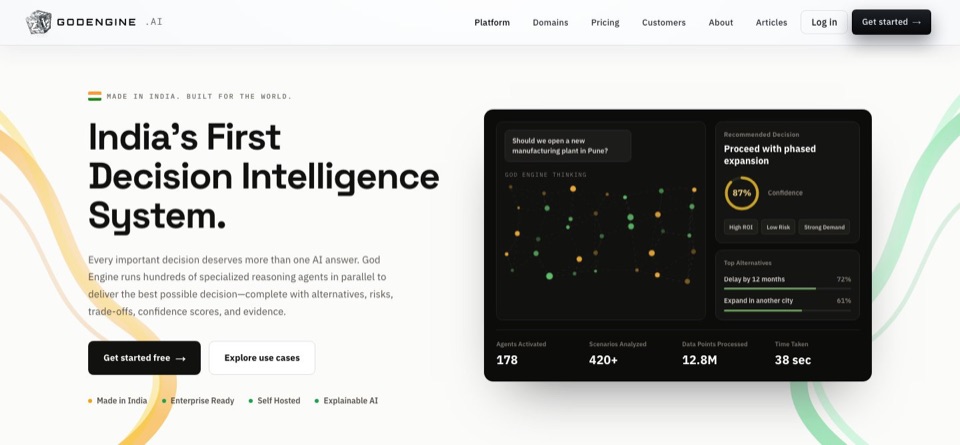
Scenario planning AI is a decision intelligence tool that moves beyond single-answer chatbots to model multiple plausible futures. Instead of giving you one confident response, it builds models of the world to show you the risks, requirements, and outcomes of different strategic paths.
What is Scenario Planning AI?
Most people use AI as a sophisticated search engine or a conversational partner. They ask a question, and the model provides a fluent, polished paragraph. For low-stakes tasks like writing an email or summarizing a recipe, this is perfect. But for high-stakes business decisions, fluency can be a trap.
Standard Large Language Models (LLMs) often provide one confident response that hides uncertainty. This creates a false sense of certainty. Scenario planning AI works differently by treating every question as a small model of the world. It doesn't just guess the answer; it maps the logic.
- Multiple Futures: Unlike standard LLMs that provide one confident response, scenario planning AI builds multiple plausible futures.
- Requirement Mapping: It identifies what must be true for a scenario to happen and what would break it.
- Bet Weighing: It helps operators weigh bets under uncertainty by showing the likely outcomes of different choices.
Think of a small business owner in Mumbai deciding whether to expand their garment factory to a new district. A chatbot might say, "Expansion is a good idea if demand is high." Scenario planning AI will map out a "High Demand" scenario and a "Supply Chain Disruption" scenario, showing exactly what needs to be true for each to occur.
How the Engine Builds Scenarios
The process happens through a "resolve pipeline." This is not a black box; it is a transparent, step-by-step reasoning process that you can watch in real-time. We call this ai reasoning because the machine is actively constructing a logical framework.
When you input a decision, the engine follows a structured path to move from a raw question to a complex, multi-faceted report:
- Break it down: The engine extracts entities, facts, and cause-and-effect links from your question and places them into a knowledge graph.
- Gather sources: It collects supporting sources and keeps them attached to the specific facts they support.
- Build scenarios: It builds a set of plausible scenarios based on those causal links.
- Probe the scenarios: The engine probes each scenario to find the requirements and the risks—asking, "What must be true for this to work?" and "What would break this scenario?"
- Stream the report: The reasoning is streamed in real-time via server-sent events, so you can watch the model build the scenarios instead of waiting for a wall of text.
This approach is central to decision intelligence. It ensures that the final report is not just a guess, but a structured output based on a mapped reality.
Why Fluency is Not Enough
In high-stakes work, "sounding right" is not the same as "being right." This is a major risk in ai decision making. LLM fluency can look like certainty, which is dangerous when millions of rupees or years of growth are on the line.
If a chatbot gives you a single, beautifully written answer, you have no way to audit the logic. You are forced to rely on blind trust. Scenario planning AI provides structure so you can check the logic instead of just trusting the prose. It moves the AI from "answering questions" to "helping you decide" by showing you the cost of being wrong.
| Feature | Standard Chatbots | Scenario Planning AI |
|---|---|---|
| Output Style | Single, fluent prose | Multiple plausible futures |
| Uncertainty | Often hidden or ignored | Explicitly mapped and probed |
| Logic Check | Difficult (requires manual audit) | Built-in (via knowledge graph) |
| Primary Goal | Answering a question | Assisting a decision |
Auditable Reasoning and Sources
A decision is only as good as the evidence behind it. If you have to explain a major pivot to your board or your partners, "the AI told me so" is not an acceptable answer. You need a defensible rationale.
GodEngine is built for auditability. Every claim in a scenario report points back to a specific entity, a link in the knowledge graph, or a source. If a step in the reasoning looks wrong, you can trace it back to see exactly which step led to that specific outcome.
This level of transparency is what separates a simple decision engine from a tool designed for professional operators.
Who Should Use Scenario Planning AI?
This tool is not for everyone. It is built for people who face "fork-in-the-road" moments where the wrong choice has a high cost. The common thread among our users is that they will eventually have to explain their decision to someone else.
- Founders: Deciding between entering new markets, making key hires, adjusting pricing models, or deciding when to take a raise.
- Finance and Business Analysts: Those who need to provide a defensible, structured write-up for stakeholders rather than just a single, isolated number.
- Operators: Leaders weighing organizational changes that affect multiple teams and departments simultaneously.
- Researchers: Professionals mapping the complex causal drivers behind a specific market trend or a global event.
Whether you are a startup founder in Bengaluru or a logistics manager in Delhi, the goal is the same: move from guessing to reasoning.
Private Models and Data Security
Strategic questions are sensitive. You would not paste your company's unreleased quarterly roadmap or your private payroll data into a public chatbot. We agree. Strategic questions require absolute privacy.
GodEngine is designed with a unique architecture to address this. We know that a decision engine you cannot trust with your data is not much use. Our design allows for the routing of different stages of the reasoning pipeline to self-hosted, open models. This means you can run the engine on your own private GPU servers rather than relying on outside providers.
While some parts of our pipeline currently run on our servers, we are actively building the ability to route every stage to your own private infrastructure. This ensures your sensitive decision data remains under your total control.
Access GodEngine
GodEngine is currently an early-release platform and is open by invitation. We are focused on building a robust, reliable engine rather than a mass-market chatbot.
You can access the engine in two ways:
- Web: The full experience via your browser.
- Android: An early-release app that brings the engine to your mobile device.
If you want to see how the engine handles your specific challenges, you can request access or write to us with a specific decision you would like to see the engine reason through. We are building the future of strategic reasoning, one decision at a time.

Questions people ask
How is scenario planning AI different from a standard chatbot?
Chatbots provide a single, fluent answer that often hides uncertainty. Scenario planning AI builds multiple plausible futures and probes them to show you the risks and requirements of each.
Can I trust the numbers provided by the AI?
GodEngine includes a numbers check that compares answers against computed facts. Because it shows its working and cites sources, you can audit the logic rather than relying on blind trust.
What kind of decisions is this AI best for?
It is built for high-stakes decisions where you must explain your reasoning to others, such as market entries, hiring, or pricing strategies.
Is my data private when using the engine?
The architecture is designed so that stages of the pipeline can be routed to self-hosted private models on your own GPU server to protect sensitive information.
How do I see the reasoning behind a scenario?
The engine uses a streaming pipeline that shows the reasoning as it happens, linking every claim back to a specific entity or source in a knowledge graph.