
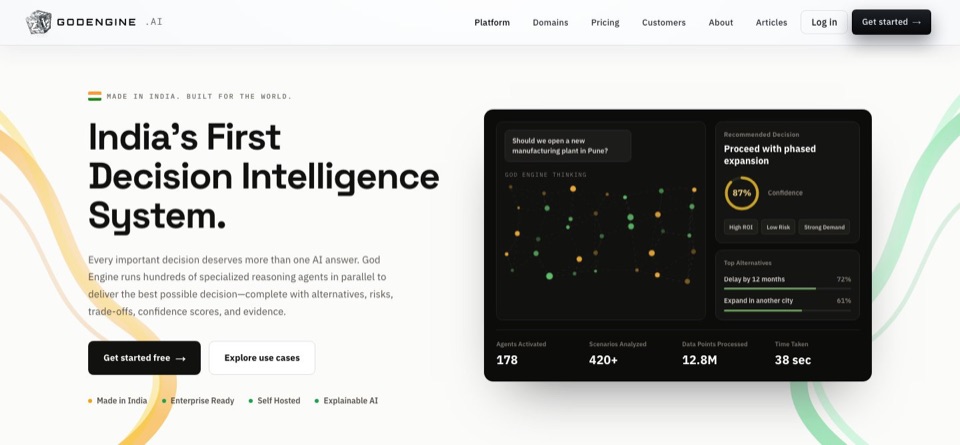
Defining AI Strategy in the Age of Agents
A real AI strategy moves beyond simple question-and-answer interactions to build models of the world. It focuses on decision intelligence by mapping current truths, causal links, and the cost of being wrong to help you make verifiable choices.
Most people think an AI strategy is just about picking the right chatbot or learning how to write better prompts. For a business owner or a builder, that is a dangerous misunderstanding. A chatbot is a linguistic tool; a strategy is a reasoning tool.
An effective AI strategy shifts your focus from generating text to building models of the world. When you ask a chatbot, "Should I expand my retail shop to a second location in Vasai?", it might give you a beautifully written paragraph. But it isn't actually thinking about your cash flow, your local competition, or the logistical cost of a new warehouse. It is just predicting the next word in a sentence.
A strategy built on decision intelligence handles the moving parts of a real decision:
- Current Truths: What are the actual facts on the ground right now?
- Future Possibilities: What are the different scenarios that could play out over the next six months?
- The Cost of Being Wrong: If this expansion fails, what is the specific downside to my core business?
By moving toward this model, you stop asking for "answers" and start asking for "reasoning." You aren't looking for a single sentence; you are looking for a map of how your business works.
The Risk of Fluency Without Certainty
Large language models (LLMs) are incredibly good at being fluent. They can write emails, summarize reports, and mimic the tone of a professional consultant. However, in high-stakes business environments, this fluency is a double-edged sword.
The primary risk is that fluency often looks like certainty. When an AI provides a confident, well-structured response, our human brains are wired to trust it. But that confidence is often just a byproduct of the model's training to predict the most likely next word. If the model is hallucinating a fact, it will hallucinate it with the same authoritative tone it uses to state a mathematical truth.
In a high-stakes setting—such as deciding whether to take a massive loan to upgrade manufacturing equipment—a "fluent" answer that contains a subtle error in logic can lead to catastrophic financial decisions. You cannot build a business on "vibes" or "confident prose."
A robust strategy requires structure around the model. You need a system where you can audit the reasoning. You need to be able to look at a conclusion and ask, "Where did this specific number come from?" If the AI cannot show its work, it is not a tool for decision-making; it is just a sophisticated autocomplete.
The Decision Intelligence Framework
To move from "chatting" to "deciding," you need a framework that treats every question as a small model of the world. This is the core of decision engine architecture.
Instead of asking for a single answer, a strategic approach uses scenarios to prepare for bets under uncertainty. Most business owners think in terms of "Will this work?" but experienced operators think in terms of "What must be true for this to work?"
A proper framework follows these steps:
- Map the Knowledge Graph: Instead of a flat text file, you map entities (like "Inventory," "Supplier," or "Vasai Outlet"), facts (current stock levels), and cause-and-effect links (if Supplier is late, then Inventory is low).
- Use a Resolve Pipeline: Rather than waiting for a wall of text, a structured pipeline breaks down a complex question into smaller, manageable components. You see the reasoning happen in real-time, step by step.
This approach allows you to use strategic reasoning to navigate uncertainty. You aren't just guessing the future; you are probing the boundaries of what is possible.
| Feature | Standard Chatbot | Decision Intelligence |
|---|---|---|
| Primary Goal | Generate fluent text | Model reality and outcomes |
| Output Type | A single "answer" | Multiple scenarios and risks |
| Logic Basis | Statistical probability | Causal links and facts |
| Trust Method | "It sounds right" | Audit the reasoning steps |
Building Verifiable Reasoning Pipelines
To build a system that a business owner can actually rely on, you must implement a "plan, act, verify" loop. This is the fundamental architecture used in advanced ai reasoning systems. It ensures that the model doesn't just wander off into a hallucination.
A verifiable model operates on three strict rules:
- The Verification Loop: The system doesn't just "write." It plans a path to the answer, acts on that plan by gathering data, and then verifies that the data actually supports the conclusion.
- Figure Checks: This is a technical necessity. A figure check compares numbers in the final answer against the raw, computed facts. If the AI calculates a total in one paragraph and then uses a different total in the next, the system flags the discrepancy.
This is why we focus on ai decision making rather than just "AI generation." In a generation task, a small error is a typo. In a decision task, a small error is a business failure.
Privacy: The Foundation of Strategic AI
Strategic questions are inherently sensitive. If a founder is asking, "Should we raise a Series A at a $50M valuation or stay bootstrapped?", that information is highly confidential. You cannot simply paste these questions into a public chatbot without risking your intellectual property and strategic advantage.
A professional AI strategy must solve for data sovereignty. This means your architecture should allow for routing different stages of the reasoning process to different models based on sensitivity.
For example, a high-level summary might be handled by a fast, public model, but the core reasoning involving your private financial spreadsheets should be routed to a self-hosted, private model running on your own GPU servers. This ensures that your most sensitive data never leaves your controlled environment.
Data security is not a "feature" to be added later; it is a prerequisite for trust. If you cannot trust the engine with your data, you will never use it to make your most important decisions.
Who Should Implement This Approach?
This level of rigor is not for everyone. If you just want to write a marketing email, a standard chatbot is fine. But if you are an operator or a leader facing high-stakes choices, you need a model that thinks, not just one that talks.
The following profiles benefit most from a decision-intelligence-led strategy:
- Founders: When you are choosing between entering new markets, making key hires, setting complex pricing structures, or deciding when to seek a raise. You need to explain these decisions to investors and boards; you need a defensible reasoning chain.
- Finance and Business Analysts: When you need to present defensible scenarios to a CFO rather than just a single, static number. You need to show how different variables interact.
- Operators: When you are weighing organizational changes—like restructuring a supply chain or changing a delivery model—that will affect multiple teams and departments simultaneously.
The common thread among these users is simple: You will have to explain the decision to someone else. A chatbot gives you an answer, but a decision engine gives you the explanation. That explanation is what makes a decision defensible.

Questions people ask
How is AI strategy different from using a chatbot?
Chatbots focus on generating fluent text, whereas an AI strategy for decision intelligence focuses on building causal models and verifiable scenarios to help you decide.
Why is reasoning more important than fluency in AI?
In high-stakes business, fluency can hide errors. Reasoning allows you to audit the steps and see exactly why the engine reached a specific conclusion.
Can AI help with scenario planning?
Yes. A proper decision engine builds multiple plausible futures, probing what must be true for each scenario to occur and what might break them.
How do I ensure my AI strategy protects sensitive data?
By using a pipeline that can be routed to self-hosted, private models on your own hardware rather than relying on public external providers.
What is the role of causality in AI decision making?
Causality involves mapping how one event leads to another, allowing the engine to build a knowledge graph of facts and effects rather than just predicting words.