
The Risk of Fluency in High-Stakes Decisions
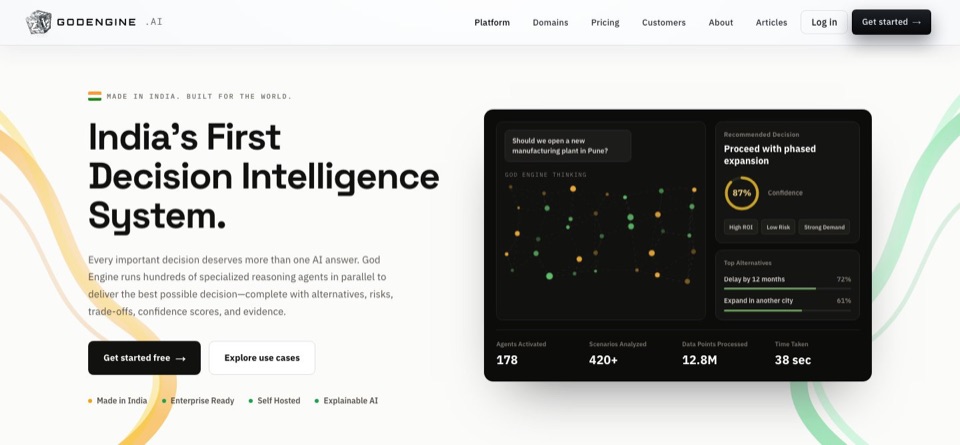
AI for board-level decisions requires moving beyond the fluent, conversational prose of standard chatbots toward auditable decision intelligence. Instead of receiving a single, confident-sounding answer, leaders need a system that builds causal models, probes multiple scenarios, and cites every source to ensure reasoning is sound.
Large language models are excellent at producing fluent answers. They can write a beautiful email or a convincing essay in seconds. However, in high-stakes business environments, this fluency is a double-edged sword. Fluency often masks uncertainty. A chatbot might give you a very confident answer about whether you should expand your manufacturing plant in Pune, but that confidence might be a mask for a lack of logic or a failure to account for supply chain variables.
In board-level decisions, a single chat reply hides the critical moving parts that actually matter to a business owner:
- What is true: The current facts, market data, and financial realities.
- What causes what: The causal links between an action (like a price drop) and an outcome (like market share gain).
- What it costs to be wrong: The downside risk if your assumptions fail.
GodEngine is built to do the exact opposite of a chatbot. While a chatbot tries to sound right, GodEngine focuses on being verifiable. It is designed to show you the model behind the answer, rather than just a wall of text. This is the essence of decision intelligence.
How Decision Intelligence Works
When you ask a question in GodEngine, the system doesn't just predict the next word in a sentence. It treats every question as a small model of the world. It uses a "resolve pipeline" where each stage of the thinking process is streamed to you in real-time. You don't just wait for a result; you watch the reasoning happen.
The process follows a structured path to ensure the output is more than just a "guess":
- Break it down: The engine extracts entities, facts, and cause-and-effect links from your question. These are placed into a clickable knowledge graph.
- Gather sources: It collects supporting sources and keeps them strictly attached to the facts they support.
- Build scenarios: It builds a set of plausible scenarios and probes them. It asks: "What has to be true for this to work?" and "What breaks this logic?"
- Write the report: It generates a structured report that lays out your options, the likely outcomes, the risks, and the reasoning behind each.
This approach moves you away from simple AI reasoning that merely predicts text, and toward a system that understands the structure of your business problem.
Reasoning You Can Audit
One of the biggest problems with standard AI is the "black box" problem. You get an answer, but you don't know how the machine got there. For a board member, "the AI said so" is not a valid justification for a multi-million rupee investment.
GodEngine provides reasoning you can actually audit. Every claim in a GodEngine report points back to a specific entity, a link in the knowledge graph, or a specific source. If a step in the reasoning looks wrong—for example, if the engine assumes a certain tax rate is applicable when it is not—you can see exactly which step caused the error. You can trace the logic back to the source and correct the path.
To combat the issue of "hallucinations" (where AI confidently states false information), GodEngine includes a figure check. This feature compares numbers in the generated answers against computed facts to ensure mathematical accuracy. While it is still a work in progress and can have known misses, it is designed to show its working so you can verify the logic rather than simply trusting the output.
| Feature | Standard Chatbots | GodEngine |
|---|---|---|
| Primary Goal | Fluency and conversation | Causal modeling and decision support |
| Logic | Hidden (Black Box) | Visible (Knowledge Graph) |
| Verification | User must manually check everything | Built-in figure checks and source citations |
| Output Format | Unstructured prose | Structured reports with scenarios |
Scenario Planning for Uncertainty
Real-world decisions are rarely about finding the "one right answer." Instead, real decisions are bets made under uncertainty. If a retail chain in Mumbai is deciding whether to expand to a new suburb, there isn't one single "correct" path. There are multiple possible futures depending on rent costs, local competition, and consumer spending power.
Instead of providing one single answer, the engine provides several plausible scenarios and the conditions required for each to occur. This aligns with how high-level operators naturally think about risk and opportunity. It helps you move from "What should I do?" to "What must be true for this plan to succeed?"
This capability is a core part of strategic reasoning. By probing these scenarios, the engine helps you identify the "breaking points" in your strategy before you commit capital.
Privacy for Strategic Questions
Strategic questions often contain highly sensitive data—merger details, upcoming pricing shifts, or specific hiring plans. Most business owners know that pasting this data into a public chatbot is a massive security risk. Data used to train public models could potentially leak or be used in ways you didn't intend.
GodEngine is designed with a different architecture. We recognize that a decision engine you cannot trust with your data is not much use. Our design allows different stages of the reasoning pipeline to be routed to self-hosted open models running on your own private GPU servers. This means your most sensitive strategic reasoning can stay entirely within your own infrastructure, ensuring your data remains under your control.
Who Should Use This Engine?
GodEngine is built for people who have to explain their decisions to others—whether that is to a board of directors, a bank, or a group of co-founders. If you cannot defend the "why" behind a decision, the decision itself is a risk.
Common use cases include:
- Founders: Deciding between entering new markets, making key hires, adjusting pricing models, or choosing between different funding rounds.
- Finance and Business Analysts: Moving beyond single-number forecasts to create defensible, scenario-based write-ups for leadership.
- Operators: Weighing organizational changes that impact multiple departments and require a view of the entire causal chain.
- Researchers: Mapping the complex causal links behind specific market trends or economic events.
Get Early Access
GodEngine is currently in an early release phase and is open by invitation only. We are focused on building a robust engine that provides real value to decision-makers rather than just adding another chatbot to the market.
You can request access or write to Divyaprakash Jha with a specific decision you would like to see the engine reason through. We are looking for users who need more than just answers—users who need intelligence they can audit.
GodEngine is available on the Web and as an Android app. The engine is the same on both, ensuring the graph you see on your phone is the exact same graph the engine built on the server.
| Current Capability | Status |
|---|---|
| Streaming decision reports | Built |
| Cause-and-effect breakdown & Knowledge Graph | Built |
| Scenario building and probing | Built |
| Web and Android apps | Built |
| Deeper simulation with multiple agents | Working (being sped up) |
| Time-series forecasting (TimesFM) | Partly built |
| Routing to self-hosted private models | Partly built |

Questions people ask
How is this different from using ChatGPT?
While chatbots provide fluent text, GodEngine builds a causal model of the world, probes scenarios, and provides an auditable reasoning chain with cited sources.
Can I trust the numbers generated by the AI?
GodEngine uses a figure check to compare answers against computed facts; it shows its working so you can verify the logic rather than just trusting the output.
Is my data secure when asking strategic questions?
Yes, the architecture allows routing to self-hosted private models on your own GPU servers to protect sensitive strategic information.
What kind of reports does the engine produce?
It produces structured reports that lay out various options, likely outcomes, risks, and the specific reasoning and sources behind each.
Does the engine provide just one answer?
No, it provides multiple plausible scenarios and explains what would have to be true for each outcome to occur, helping you manage uncertainty.