
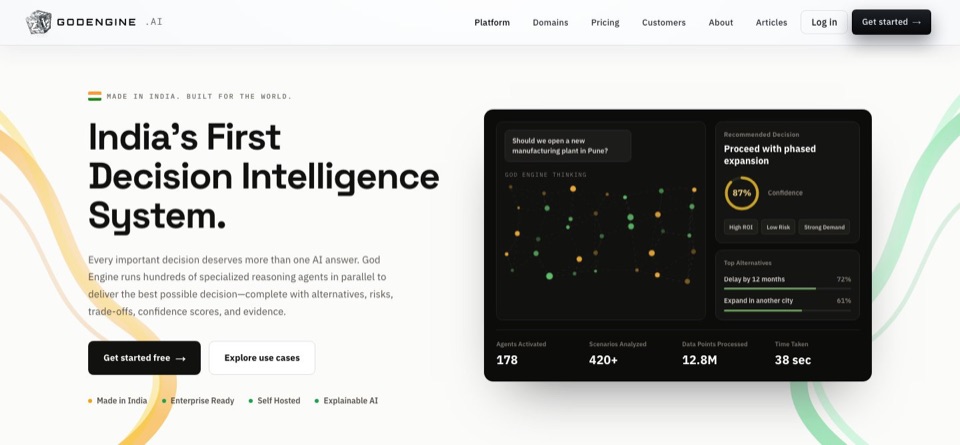
Moving from Chatbots to Decision Intelligence
Effective AI for competitive analysis must move beyond generating fluent text to building structured models of market dynamics. Instead of receiving a single, uncertain answer from a chatbot, you use decision intelligence to map out cause-and-effect relationships and probe multiple potential market scenarios.
Most current AI tools operate on a simple pattern: you ask a question, and the model generates a response. While the prose is often smooth and convincing, it hides a dangerous level of uncertainty. In a high-stakes business environment, "fluency" is not the same as "accuracy." A chatbot might tell you that a competitor is expanding, but it won't tell you the specific causal chain that makes that expansion a threat to your specific margins.
True competitive analysis requires understanding three distinct dimensions of a market:
- Current Truth: What are the established facts, pricing structures, and market shares right now?
- Causal Links: If a competitor lowers their price, what actually happens to your customer retention? What causes a shift in supply chain costs?
- Future Possibilities: Given the current trends, what are the different paths the market could take?
GodEngine treats every competitive question as a small model of the world rather than a simple text generation task. By using decision intelligence, the engine moves from "guessing the next word" to "modeling the next move."
How AI Models Your Competitive Landscape
When you pose a strategic question—such as "Should we expand our retail presence to Pune or invest more in our direct-to-consumer website this quarter?"—the engine does not just search for an answer. It initiates a complex reasoning process designed to map the logic of your decision.
The process follows a structured pipeline that breaks down the complexity of the market into digestible, verifiable parts:
- Extraction: The engine identifies the key entities (competitors, locations, products), the facts (current prices, sales data), and the cause-and-effect links (how a marketing spend affects customer acquisition) and places them into a clickable knowledge graph.
- Scenario Building: Instead of providing one "correct" answer, the engine builds a set of plausible scenarios based on your specific market question. It considers different versions of the future.
- Scenario Probing: The engine then "probes" these scenarios. It asks: What has to be true for this scenario to happen? What specific event would break the logic of this plan? This identifies the "breaking points" in your strategy.
- Real-time Streaming: You do not wait for a loading bar to finish before seeing a wall of text. The engine uses a streaming pipeline, meaning you watch the reasoning unfold in real-time as the model builds the graph and evaluates the scenarios.
This approach turns a static answer into a dynamic map. You aren't just reading a report; you are inspecting a model of your competitive environment.
Why Auditable Reasoning Matters for Strategy
The biggest risk in using Large Language Models (LLMs) for business strategy is the "fluency trap." This occurs when a model produces a response that sounds incredibly professional and certain, but is actually based on a hallucination or a logical error. In a boardroom, a confident-sounding error can lead to a multi-million rupee mistake.
To combat this, GodEngine prioritizes strategic reasoning that is fully auditable. This provides several key advantages over standard generative AI:
| Feature | Standard Chatbots | GodEngine Decision Intelligence |
|---|---|---|
| Output Type | Single, fluent text response | Structured report with multiple scenarios |
| Verification | Implicit (you must trust the text) | Explicit (every claim points to a source or link) |
| Logic | Probabilistic word prediction | Causal modeling and "figure checks" |
| Uncertainty | Often hidden behind confident prose | Explicitly mapped as risks and requirements |
Every claim made in a GodEngine report is linked. If the engine claims a competitor has increased their delivery speed, you can click that claim to see the specific entity or source it is based on. Furthermore, the engine includes a "figure check" designed to compare numbers in answers against computed facts. While this feature is still being refined and can have known misses, it is designed to show its working so that you can audit the math yourself rather than relying on blind trust.
Scenario Planning for Market Moves
In the real world, business decisions are not about finding the "right" answer; they are about making bets under conditions of uncertainty. A founder in Mumbai deciding whether to pivot their product line is not looking for a single prediction, but for a way to understand the risks of different paths.
GodEngine provides several possible futures. Instead of saying "You should do X," the engine shows you "If you do X, scenario A occurs if these three things happen. However, if these two things fail, scenario B becomes the reality."
This method allows you to analyze the cost of being wrong. By probing the limits of each scenario, the engine helps you see how different market variables interact. It moves beyond static, historical data to show the dynamic tension between your moves and your competitors' reactions.
Private Models for Sensitive Strategy
Strategic intelligence is highly sensitive. If you are analyzing a competitor's potential move or your own internal cost structures, you cannot simply paste that data into a public chatbot. Doing so risks feeding your proprietary strategy into a model used by others.
The architecture of GodEngine is built with this privacy requirement in mind. We recognize that a decision engine you cannot trust with your data is of no use to a professional operator. To solve this, the engine is designed so that different stages of the analysis pipeline can be routed to different models.
Specifically, you can route sensitive stages of the reasoning process to self-hosted, open models running on your own private GPU servers. This means your most sensitive strategic logic never has to leave your controlled environment. While the ability to route every stage to a private model is currently being expanded, the foundation is built to ensure that privacy is a core feature of the decision engine, not an afterthought.
Who Should Use AI for Competitive Analysis?
Competitive analysis through decision intelligence is built for those who must explain their reasoning to others. If your decision requires a "why" that can withstand scrutiny from a board, a partner, or a bank, this tool is for you.
- Founders: When deciding between entering new markets, adjusting pricing models, or deciding whether to make a key hire.
- Finance and Business Analysts: When you need to move beyond a single spreadsheet number to create a defensible, structured write-up of market possibilities.
- Operators: When you are weighing operational changes—like changing a logistics provider—that will impact multiple departments and teams simultaneously.
- Researchers: When you are trying to map the underlying causal drivers behind a sudden market trend or a shift in consumer behavior.
Whether you are using the web interface or the Android app, the goal remains the same: providing the explanation along with the answer.

Questions people ask
How is AI for competitive analysis different from a standard chatbot?
Chatbots provide fluent text answers that can hide errors. Decision intelligence builds a causal model of the world, showing you the reasoning and sources instead of just a conclusion.
Can I trust the numbers an AI provides for market analysis?
GodEngine uses a 'figure check' to compare numbers in answers against computed facts to reduce errors, and it shows its working so you can audit it.
How does the AI handle uncertain market scenarios?
Instead of one answer, it builds and probes multiple plausible scenarios, identifying what must be true for each outcome to occur and what might break them.
Is my competitive data safe when using AI?
GodEngine is designed so stages of the pipeline can be routed to self-hosted, private models on your own hardware to protect sensitive strategy.
How long does it take to get a competitive analysis report?
The engine uses a streaming pipeline, meaning you see the reasoning and progress from the first second of the analysis rather than waiting for a wall of text.