
The Risk of 'Fluent' AI
AI for risk analysis must move beyond simple text generation to provide structured, causal reasoning. Instead of relying on chatbots that produce confident-sounding but unverified prose, true decision intelligence uses models to map cause-and-effect relationships and probe multiple potential futures.
Large language models are excellent at producing fluent answers, but fluency often looks like certainty. This is a dangerous trap in high-stakes business environments. When an AI provides a smooth, well-written paragraph, it often hides the underlying uncertainty and the complex moving parts that actually drive a decision.
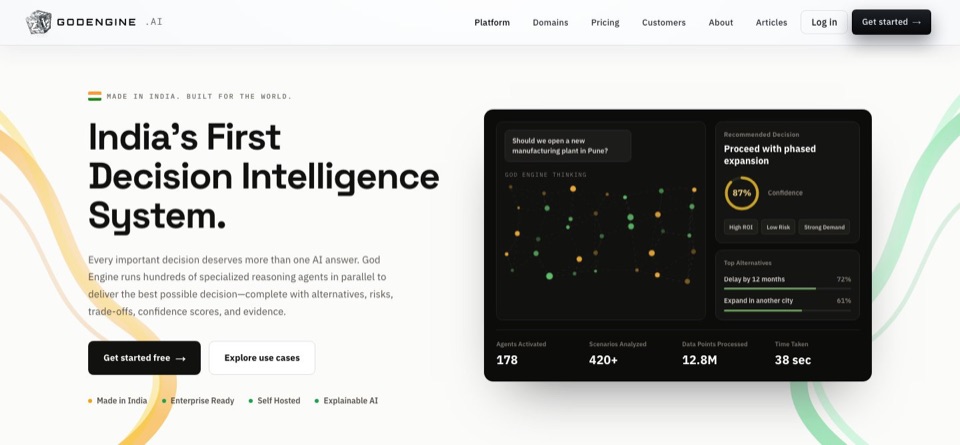
In high-stakes work, a single chat reply is not enough. If a founder asks, "Should we expand our manufacturing plant in Pune next quarter?", a chatbot might give a convincing "Yes" based on general market trends. However, that answer hides the specific risks: What if supply chain costs rise by 10%? What if local labor availability drops? A chatbot gives you a sentence; risk analysis requires knowing what is true now, what causes what, and what could happen next.
True ai reasoning requires more than just predicting the next word in a sentence. It requires a model that understands the mechanics of your specific business situation. Without this, you are not performing risk analysis; you are simply reading a very sophisticated guess.
Decision Intelligence vs. Chatbots
There is a fundamental difference between a tool that answers questions and a tool that helps you decide. Most AI tools on the market are chatbots. They are designed for conversation, which makes them great for drafting emails or summarizing text, but poor for weighing heavy business risks.
GodEngine is a decision intelligence engine, not just another chatbot. While a chatbot treats your question as a prompt to be answered with text, GodEngine treats every question as a small model of the world. It attempts to map the reality described in your question rather than just predicting a likely response.
| Feature | Standard Chatbots | Decision Intelligence |
|---|---|---|
| Output Type | Fluent, conversational prose | Structured reports and causal graphs |
| Handling Uncertainty | Often hides uncertainty behind confidence | Probes multiple plausible futures |
| Core Logic | Statistical word prediction | Causal modeling and scenario probing |
Instead of providing one single "correct" answer, a proper decision intelligence approach provides several plausible futures. This helps you manage uncertainty by showing you not just what might happen, but what would have to be true for those outcomes to occur. This is the difference between a guess and a strategy.
How GodEngine Analyzes Risk
The process of moving from a question to a risk assessment happens through a structured "resolve pipeline." This is not a black box; it is a transparent sequence of logical steps designed to build a mental model of your decision.
1. Breaking Down the Question
The engine begins by extracting facts, causes, and effects from your query. It pulls these entities out and places them into a clickable knowledge graph. For example, if you ask about opening a second outlet in Vasai versus investing in delivery, the engine identifies "Outlet in Vasai," "Delivery Investment," "Capital Outlay," and "Local Demand" as interconnected nodes.
2. Building Scenarios
Once the graph is built, the engine constructs a set of plausible scenarios. It doesn't just look at one path; it probes each one to see what breaks the logic. It asks: "What has to be true for the Vasai outlet to be profitable?" and "What happens to the delivery model if fuel prices spike?"
3. Real-Time Reasoning
Unlike traditional AI that makes you wait for a wall of text to appear all at once, GodEngine uses server-sent events to stream its reasoning in real-time. You can watch the analysis happen, seeing the engine move through the stages of the pipeline as it works. This transparency allows you to see the logic as it is being constructed.
Reasoning You Can Audit
One of the biggest hurdles in ai decision making is the "black box" problem. If an AI tells you to sell your inventory, you need to know why. You cannot make a million-rupee decision based on "because the AI said so."
GodEngine is built for auditability. Every claim made in a generated report points back to a specific entity, a link in the knowledge graph, or a specific source. If a step in the reasoning looks wrong to you, you can click through to see exactly which step the engine took and why it believed that specific causal link existed.
This level of detail is essential for anyone who has to explain their decisions to stakeholders, partners, or investors. It moves the AI from being a "magic box" to being a verifiable assistant.
Who Should Use AI for Risk Analysis
This tool is not for people looking for creative writing; it is for people who have to live with the consequences of their choices. The common thread among our users is that they will have to explain their decisions to someone else.
- Founders: When choosing between entering new markets, making key hires, adjusting pricing models, or deciding whether to take a new round of funding.
- Finance and Business Analysts: When you need to provide a defensible, structured write-up for a board meeting, rather than just a single, isolated number.
- Operators: When you are weighing operational changes that impact multiple teams simultaneously, such as changing a logistics provider or a warehouse layout.
- Researchers: When you are trying to map the complex causes behind a specific market trend or a sudden economic event.
Private Models and Data Security
Strategic questions are sensitive. A business owner would never paste their five-year expansion plan or their exact margin data into a public chatbot, because that data could be used to train future models. We agree.
Privacy is a core priority for building trust. GodEngine is designed so that different stages of the reasoning pipeline can be routed to self-hosted, private models. Instead of sending your data to an outside provider, the engine can run on our own GPU servers using open models. This ensures that your most sensitive strategic questions remain within a controlled environment.
The ability to run models privately is not just a feature; it is a requirement for any professional-grade strategic reasoning tool. We are continuing to build out the infrastructure to make private routing a seamless part of the user experience.
Current Capabilities and Future Work
We believe in being transparent about what is ready to use and what we are still building. We are focused on building a complete engine for decision intelligence, not just a collection of features.
| Capability | Status |
|---|---|
| Streaming decision reports | Built |
| Cause-and-effect breakdown and knowledge graphs | Built |
| Scenario building and probing | Built |
| Web and Android apps (same engine) | Built |
| Deeper simulation modes (multiple simulated agents) | Working / Being sped up |
| Time-series forecasting (TimesFM) in everyday answers | Partly built |
| Routing every stage to self-hosted private models | Partly built |

Questions people ask
How is AI risk analysis different from using ChatGPT?
Chatbots provide fluent, conversational answers that can hide uncertainty and hallucinations. Decision intelligence builds a causal model of the world to show you the reasoning and the risks behind the answer.
Can I trust the numbers an AI provides for risk assessment?
GodEngine includes a 'numbers check' that compares answers against computed facts. While it is still being refined, it shows its working so you can audit the logic rather than just trusting the prose.
How does the AI handle uncertainty in scenarios?
Instead of giving one 'correct' answer, the engine builds several plausible scenarios and probes them to see what would have to be true for each outcome to occur.
Is my data safe when using AI for strategic decisions?
GodEngine is designed so stages can be routed to self-hosted, private models on dedicated GPU servers, ensuring your strategic questions don't have to be shared with outside providers.
What makes a decision 'auditable' in AI?
Auditable reasoning means every claim in a report is linked back to a specific source, entity, or causal link in a knowledge graph, allowing you to verify the logic.