
The Risk of Fluency in Strategy
AI for strategic planning must move beyond simple conversation to structured decision intelligence. Instead of relying on fluent chat replies that mask uncertainty, you need a system that builds models of the world to help you navigate complex choices.
Large Language Models (LLMs) are incredibly good at producing fluent, natural-sounding answers. In a casual setting, this is a feature. In high-stakes strategic work, this fluency creates a significant risk: it looks like certainty. When an AI provides a polished paragraph about your market entry, it is easy to mistake its linguistic confidence for factual accuracy or logical soundness.
A single chat reply is a "black box" that hides the moving parts of a real decision. It fails to show you:
- What is actually true based on your data.
- What causes what (the causal links between your actions and outcomes).
- The cost of being wrong if your assumptions fail.
Strategic planning is not about finding one "correct" answer from a chatbot. It is about exploring multiple possible futures. If you are a business owner deciding whether to expand a retail chain from Mumbai to Pune, a single "yes" or "no" from an AI is useless. You need to know what conditions would make that move a success and what conditions would make it a disaster.
A Decision Intelligence Engine
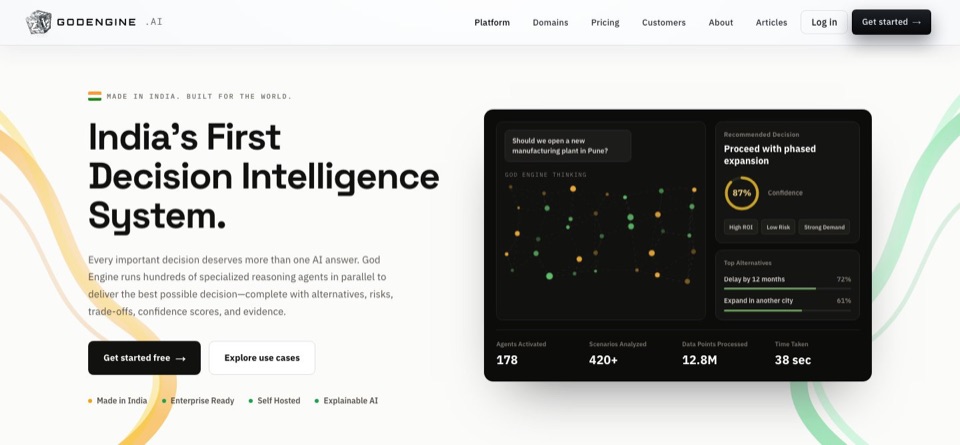
GodEngine is built on the principle of decision intelligence. We believe that strategic questions should not be answered with walls of text, but with structured models. We treat every strategic question as a small, contained model of the world.
Instead of giving you a single, potentially hallucinated answer, GodEngine provides several plausible scenarios. For every scenario, the engine identifies exactly what would have to be true for that outcome to occur. This allows you to move from "guessing" to "probing."
The engine uses a specialized "resolve pipeline" to process your query. It doesn't just predict the next word; it extracts entities, facts, and cause-and-effect links, organizing them into a clickable knowledge graph. This turns a vague question into a map of logic that you can navigate and inspect.
How AI Drives Strategic Reasoning
To move from a prompt to a professional report, the engine follows a rigorous ai reasoning process. It breaks down your decision into manageable, verifiable stages.
The Resolve Pipeline
The process follows these core steps:
- Break down: The engine pulls facts and causal links from your question to build a knowledge graph. It identifies the "who," "what," and "why" behind your query.
- Gather sources: The engine collects supporting sources. Crucially, every claim made in the reasoning is attached to these sources so you can verify the data yourself.
- Build scenarios: The engine probes different paths. It asks, "If X happens, what does it lead to?" and "What would have to be true to prevent Y?"
- Write the report: Finally, it generates a structured report. This isn't just a chat response; it is a layout of options, likely outcomes, risks, and full reasoning with complete citations.
This approach moves you away from "black box" AI and toward strategic reasoning that you can actually use to defend your decisions to stakeholders.
Reasoning You Can Audit
The biggest problem with current AI is the "black box" effect—you see the answer, but you don't see the work. GodEngine is designed to be transparent. We use server-sent events to stream the reasoning process in real-time. As the engine works, you see the logic unfolding before your eyes.
This transparency serves several critical functions for builders and owners:
- Check the work: If a specific conclusion seems off, you don't have to guess why. You can look back at the graph and see exactly which link or source led the engine to that conclusion.
- Verify numbers: We have implemented a "figure check" designed to compare numbers in an answer against computed facts. While this is a work in progress and not perfect, it ensures the engine shows its working so you can audit the math rather than blindly trusting the output.
Who Should Use AI for Strategy?
GodEngine is designed for people who have to explain their decisions to others—whether that is a board of directors, a bank, or a co-founder.
| User Type | Primary Use Case |
|---|---|
| Founders | Deciding between entering new markets, making key hires, setting pricing, or deciding whether to take a funding round. |
| Finance & Analysts | Creating defensible write-ups and multiple scenarios rather than providing a single, static number. |
| Operators | Weighing operational changes that impact multiple departments or teams simultaneously. |
| Researchers | Mapping the complex causal drivers behind a specific market trend or a sudden economic event. |
Privacy for Sensitive Strategic Data
Strategic planning involves high-stakes data. You cannot simply paste your company's unreleased quarterly projections or sensitive hiring plans into a public chatbot without massive risk. Most AI tools are built to collect data; GodEngine is built to protect it.
Our architecture is designed for privacy. We have built the engine so that every stage of the pipeline can be routed to a self-hosted open model running on our own private GPU servers. This means your sensitive decision data does not have to be sent to an outside provider. This capability is currently being built and is a top priority for us, ensuring that a decision engine is only useful if it is a secure one.
Get Early Access to GodEngine
GodEngine is currently available by invitation only. We are focused on refining the engine and its ability to handle complex, real-world reasoning before a wide release.
If you want to test the engine, you can:
- Ask for access through our website.
- Write to the founder with a specific decision you want the engine to reason through.
The engine is available on the web and via an Android app. We are building a suite of tools for decision intelligence, and GodEngine is the first of five planned platforms.

Questions people ask
How is AI for strategic planning different from a chatbot?
Chatbots provide fluent, conversational answers that can hide errors. GodEngine provides structured reasoning, causal links, and verifiable sources to show you the model behind the answer.
Can I trust the numbers provided by the AI?
GodEngine uses a figure check to compare numbers against computed facts. While it is a work in progress, the engine shows its working so you can audit the logic rather than just trusting the output.
What are 'scenarios' in the context of decision intelligence?
Scenarios are different plausible futures. The engine probes them to identify what must be true for a scenario to happen and what would cause it to fail.
Is my strategic data private?
GodEngine is designed so that stages of the pipeline can be routed to self-hosted private models on our own GPU servers, rather than using outside providers.
How does the engine show its reasoning?
The engine uses a resolve pipeline that streams results as they happen, showing the knowledge graph and causal links being built in real-time.