
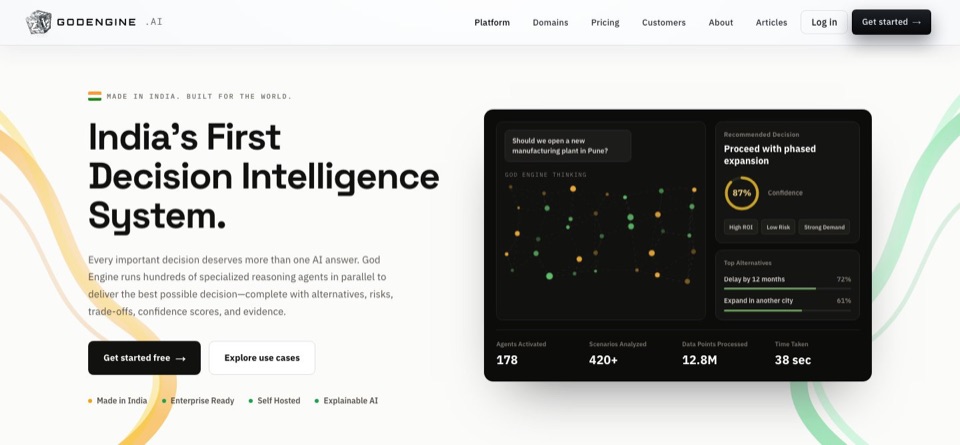
An AI scenario planning tool builds models of the world to help you navigate uncertainty. Instead of just providing a single answer, GodEngine generates multiple plausible futures and probes the risks, causes, and outcomes of your choices to support high-stakes decision-making.
What is an AI Scenario Planning Tool?
When you ask a standard chatbot a question, you get a block of text. That text is often fluent and confident, which creates a dangerous illusion of certainty. In high-stakes business environments, fluency is not the same as accuracy. This is the "fluency trap"—the risk that a model's ability to write well masks the fact that its reasoning is flawed.
GodEngine is a decision intelligence engine designed to solve this. It does not just "chat"; it treats every question as a small model of the world. When you present a complex problem, the engine doesn't just guess the answer. It maps out the moving parts: what is true right now, what causes what, what could happen next, and what it will cost if you are wrong.
The difference in approach
- Beyond Prose: Traditional LLMs provide fluent prose that can hide uncertainty. GodEngine provides structure so you can see the uncertainty.
- Modeling the World: GodEngine acts as a decision intelligence engine by treating questions as models of the world rather than just text completion tasks.
- Multiple Futures: Instead of one answer, it generates multiple plausible scenarios and probes what must be true for each to occur.
- Causal Mapping: It visualizes the causal links and entities behind every outcome, showing you the "why" behind the "what."
How the Engine Probes the Future
GodEngine uses a "resolve pipeline" to move from a question to a structured report. Unlike other tools where you wait for a long response to appear all at once, GodEngine uses server-sent events to stream its reasoning. You watch the analysis happen in real-time, seeing the engine think through each step.
| Stage | What the Engine Does | The Output |
|---|---|---|
| Break down | Extracts entities, facts, and cause-and-effect links from your question. | A clickable knowledge graph. |
| Gather sources | Collects and attaches supporting evidence to every extracted fact. | A verifiable web of information. |
| Build and probe | Generates plausible scenarios and tests them to see what breaks them. | A set of "what-if" futures. |
| Write report | Synthesizes everything into a structured document. | A final, cited decision report. |
For example, if a small business owner in Mumbai asks, "Should we open a second outlet in Vasai this year, or invest in delivery first?", the engine won't just give a recommendation. It will map out the entities (the Vasai location, the delivery fleet, the current staff), the facts (current revenue, local competition), and the causal links (how delivery investment impacts profit margins vs. how a second outlet impacts overhead).
Reasoning You Can Audit
In high-stakes work, "trust me" is not a valid strategy. You need to be able to justify your decisions to partners, investors, or boards. GodEngine is built for strategic reasoning that is transparent and auditable.
Avoid the Fluency Trap
A confident-sounding AI can lead you down a path of incorrect assumptions. GodEngine avoids this by putting structure around the model. Every claim in a GodEngine report points back to an entity, a link in the knowledge graph, or a specific source. If a step in the reasoning looks wrong, you can click through to see exactly which step the engine took and why it believed that specific link was true.
The Numbers Check
Numbers are the backbone of business decisions, but AI is notorious for "hallucinating" math. GodEngine includes a "numbers check" that compares figures in the generated answers against computed facts. While this feature is still being refined and has known misses, it is designed to show its working so you can audit the math rather than simply taking it on faith.
Built for Complex Decision Making
GodEngine is designed for people who have to explain their decisions to someone else. Whether you are a founder or a researcher, the tool provides the explanation along with the answer.
- Founders: Use it to weigh heavy choices like choosing between entering new markets, making key hires, adjusting pricing models, or deciding when to take a raise.
- Finance & Analysts: Move beyond single-point estimates. Create defensible write-ups that present multiple scenarios instead of just one number.
- Researchers: Map the underlying causes behind complex trends or specific global events to see how one variable triggers another.
- Operators: Weigh organizational changes that impact multiple departments simultaneously, helping you understand the ripple effects of your choices.
Privacy and Private Models
Strategic questions often involve sensitive data—intellectual property, upcoming hires, or unannounced financial shifts. You cannot use a tool for high-stakes strategy if you are worried about your data being used to train public models.
GodEngine is designed with a privacy-first architecture. We recognize that a decision engine you cannot trust with your data is of little use. Our design allows every stage of the reasoning pipeline to be routed to a self-hosted, open model running on our own private GPU servers. This ensures that your most sensitive strategic queries do not have to pass through public, third-party providers.
While the ability to route every stage to private models is currently partly built, it is a primary development priority for the platform.
Access and Platform
GodEngine is currently in an early release phase and is available on both the Web and Android. The engine is the same on both platforms, meaning the knowledge graph you build on your desktop is the same one you can probe on your phone while on the move.
Current Status
- Streaming decision reports: Built
- Cause-and-effect knowledge graph: Built
- Scenario building and probing: Built
- Web and Android apps: Built
- Deeper simulation modes (multi-agent): Working (in progress)
- Time-series forecasting: Partly built
- Private model routing: Partly built
GodEngine is the first of five platforms being built by this company. Our next project, AskShiva, will be an assistant designed to remember your context and act on your behalf.
| Question | Answer |
|---|---|
| How is this different from a standard AI chatbot? | Chatbots provide a single, fluent answer that can hide uncertainty. GodEngine builds a causal model of the world and provides multiple scenarios with cited sources. |
| Can I trust the numbers the AI provides? | GodEngine includes a numbers check that compares answers against computed facts, and it shows its working so you can audit the reasoning. |
| What kind of scenarios does the tool create? | It builds plausible futures by identifying what must be true, what could break a scenario, and the potential costs of being wrong. |
| Is my data secure when using GodEngine? | The architecture allows stages of the pipeline to be routed to self-hosted private models on our own GPU servers to protect sensitive data. |
| How do I get access to GodEngine? | GodEngine is currently open by invitation. You can ask for access or write to us with a decision you want the engine to reason through. |

Questions people ask
How is this different from a standard AI chatbot?
Chatbots provide a single, fluent answer that can hide uncertainty. GodEngine builds a causal model of the world and provides multiple scenarios with cited sources.
Can I trust the numbers the AI provides?
GodEngine includes a numbers check that compares answers against computed facts, and it shows its working so you can audit the reasoning.
What kind of scenarios does the tool create?
It builds plausible futures by identifying what must be true, what could break a scenario, and the potential costs of being wrong.
Is my data secure when using GodEngine?
The architecture allows stages of the pipeline to be routed to self-hosted private models on our own GPU servers to protect sensitive data.
How do I get access to GodEngine?
GodEngine is currently open by invitation. You can ask for access or write to Divyaprakash Jha with a decision you want the engine to reason through.