
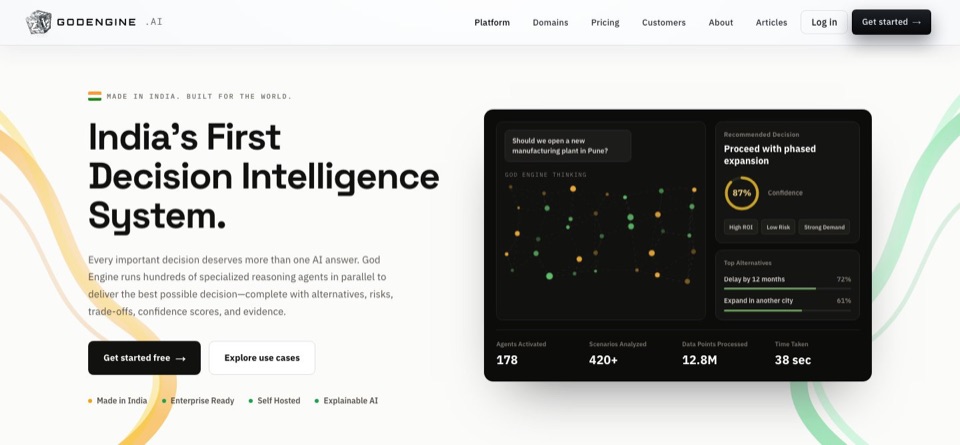
GodEngine is a decision intelligence engine that builds causal models and scenarios to audit your strategy. Unlike chatbots that provide fluent but unverified prose, it maps the relationships between facts, causes, and effects to show you the logic behind a choice.
Why Chatbots Fail at Strategy
When you ask a standard AI chatbot for business advice, you get a wall of text. It is polite, it is grammatically perfect, and it sounds incredibly confident. This is exactly where the danger lies for business owners and builders.
Large language models are designed to predict the next likely word in a sentence. This makes them excellent at producing fluent prose, but fluency is not the same as truth. In high-stakes work, a chatbot can hallucinate a logical-sounding argument that is fundamentally disconnected from your actual business constraints. It provides an answer, but it hides the "moving parts."
A real strategic decision involves several layers of uncertainty that a single chat reply ignores:
- What is actually true: The current state of your cash flow, market size, or inventory.
- What causes what: If you increase your marketing spend in Mumbai, does it actually drive sales in Pune, or is it just wasted noise?
High-stakes work requires strategic reasoning that is auditable. You cannot build a five-year roadmap on a "feeling" or a conversational response that lacks a structural foundation.
A Decision Intelligence Engine
GodEngine is not just another interface for a language model. It is a decision engine designed to treat every question as a small model of the world rather than a prompt for a text response. Instead of just generating text, it performs a process of extraction and mapping.
When you input a complex question, the engine begins a "resolve pipeline." It doesn't just think; it builds. It extracts the entities, the facts, and the cause-and-effect links from your query and places them into a clickable knowledge graph. This graph shows you how different parts of your business or market are linked.
The result is a structured report. Instead of a chat bubble, you get a breakdown that shows the reasoning, the identified risks, and the likely outcomes for different paths. It moves you from "chatting" to decision intelligence.
Scenarios Instead of Single Answers
Most people use AI to ask, "What should I do?" This is the wrong question. The right question is, "What are the different ways this could play out?"
Real decisions are bets made under conditions of uncertainty. GodEngine approaches this by building and probing multiple plausible scenarios. It doesn't just give you one "best" answer; it explores several futures. It identifies what would have to be true for a specific scenario to occur and, more importantly, it identifies what would break that scenario.
For example, if you are deciding whether to expand your manufacturing to a new state, the engine won't just say "Yes" or "No." It will build scenarios:
- Scenario A (High Demand): If local logistics costs remain low and demand hits X, the outcome is Y.
- Scenario B (Supply Chain Disruption): If raw material prices rise by 10%, the current plan becomes unprofitable.
This allows operators to see the boundaries of their decisions, helping them prepare for multiple futures rather than relying on a single, potentially biased, prediction.
Reasoning You Can Audit
The biggest problem with AI reasoning is the "black box" problem. You see the output, but you don't see the work. GodEngine is built to be transparent through its streaming architecture.
The pipeline uses server-sent events, meaning as the engine works, you see the results in real-time. You watch the reasoning happen. If a step in the logic looks suspicious, you can trace it back. Every claim in a GodEngine report points back to a specific entity, a link in the knowledge graph, or a cited source. You aren't being asked to trust the machine; you are being given the tools to verify it.
To further ensure accuracy, the engine uses a "figure check." This is a process that compares numbers provided in the answers against computed facts. While this feature is currently switched on and still has known misses, the engine's design philosophy is to show its working so you can spot errors rather than blindly accepting a number.
| Feature | Standard Chatbot | GodEngine |
|---|---|---|
| Output Format | Fluent prose/paragraphs | Structured reports & Knowledge graphs |
| Logic | Hidden/Black box | Auditable causal links |
| Numbers | Probabilistic text generation | Computed facts with figure checks |
| Uncertainty | Often hidden by confident tone | Explicitly modeled via scenarios |
Who Should Use This Instead of a Consultant?
Consultants are expensive and often provide a single, polished narrative. GodEngine is for those who need to do the heavy lifting of strategic thinking themselves, but with the structural support of a machine. It is built for people who will have to explain their decisions to others.
Common users include:
- Founders: When you are deciding between entering a new market, making a key hire, changing your pricing model, or taking a new round of funding.
- Finance and Business Analysts: When you need to move beyond a single spreadsheet number to create a defensible write-up with multiple scenarios.
- Researchers: When you are trying to map the complex causes behind a specific market trend or a sudden economic event.
- Operators: When you are weighing a change—like a new logistics partner—that will impact multiple teams and departments simultaneously.
Private Models for Sensitive Strategy
Strategic decisions involve "crown jewel" data: your margins, your upcoming hires, your expansion plans, and your specific customer data. You cannot simply paste this into a public chatbot without significant risk.
We recognize that a decision engine you cannot trust with your data is not much use. To address this, GodEngine is designed with a modular architecture. Our goal is to allow every stage of the reasoning pipeline to be routed to a self-hosted, private open model running on our own GPU servers, rather than an outside provider.
Current Capabilities and Roadmap
We believe in being transparent about what is ready to use today and what we are building for tomorrow. We are moving from simple text responses toward deep, agentic simulations.
What is Built
- Streaming decision reports that show progress in real-time.
- Cause-and-effect breakdown and knowledge graph visualization.
- Scenario building and probing capabilities.
- Web and Android applications (the same engine runs on both).
- Email and Google sign-in for easy access.
What is in Progress
Our roadmap involves moving from static scenarios to dynamic environments. This includes:
- Deeper Simulation Modes: Using many simulated agents to test how a decision plays out in a complex ecosystem.
- Time-Series Forecasting: Integrating tools like TimesFM to bring advanced forecasting into everyday answers (this is currently partly built).
- Full Private Routing: Completing the ability to route all pipeline stages to self-hosted, private models.
GodEngine is currently open by invitation. You can request access via our website or write to the founder directly with a specific decision you would like to see the engine reason through.

Questions people ask
How is this different from using ChatGPT for strategy?
ChatGPT provides fluent, conversational answers that can hide uncertainty. GodEngine builds a causal model of the world, showing you the links, sources, and scenarios behind a decision so you can audit the logic.
Can I trust the numbers provided by the engine?
GodEngine uses a figure check to compare answers against computed facts. Because it shows its working and cites its sources, you can verify the reasoning rather than relying on blind trust.
Is my strategic data kept private?
Yes, the architecture allows stages of the pipeline to be routed to self-hosted, private models on our own GPU servers, making it safer for sensitive strategic questions than public chatbots.
What kind of questions can I ask?
You can ask complex decision questions, such as 'Should we open a second outlet in Vasai this year, or invest in delivery first?' The engine will break down the entities and causal links involved.
How do I get access to GodEngine?
GodEngine is currently open by invitation. You can ask for access via the website or write to the founder with a decision you would like to see the engine reason through.