
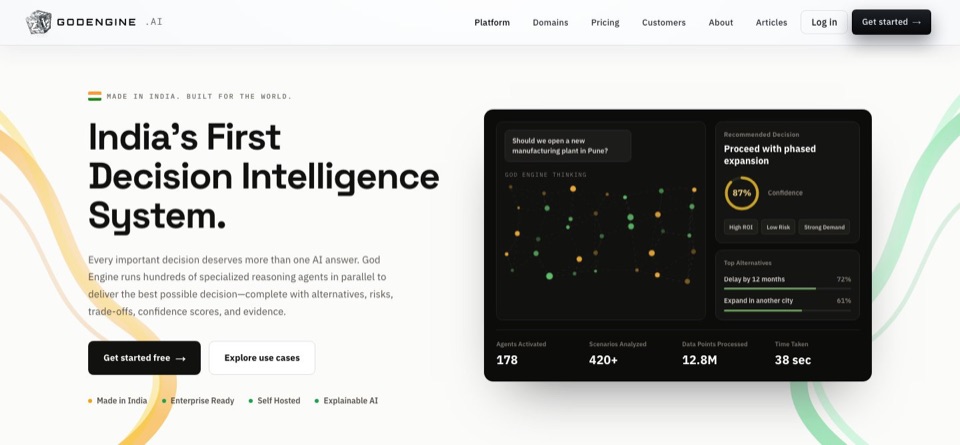
The Risk of Fluent Answers
AI helps strategic decision making by moving beyond simple text generation to build structured models of cause and effect. Instead of just providing a conversational response, it maps out different scenarios and the risks associated with each choice.
Large language models are excellent at producing fluent, confident prose. For a business owner, this can be a trap. When you ask a chatbot a complex question about your business, it will likely give you a very polished, very certain-sounding answer.
In high-stakes work, this fluency can be mistaken for certainty. A single chat reply often hides the complexity of moving parts. If you ask, "Should I expand my garment factory to a new district?", a chatbot might give you a list of pros and cons that sounds authoritative but lacks a deep understanding of how your specific variables interact.
Strategic decisions require knowing what is true, what causes what, and what it costs to be wrong. A simple text response doesn't show you the "why" or the "what if." It gives you a conclusion without the underlying logic, making it difficult to defend that conclusion to a partner or a bank.
From Chatbots to Decision Intelligence
To make better decisions, we need to move from simple conversation to decision intelligence. While a chatbot is designed to talk, a decision engine is designed to model.
Decision intelligence puts structure around models so you can check them. It treats every question as a small model of the world. Instead of providing one single, definitive answer, it provides several plausible futures. This is crucial because real-world business is rarely about finding the "one right answer"; it is about choosing the best path among many possibilities.
The goal of this approach is to provide an explanation you can defend to others. If a founder is deciding whether to change their pricing model, they don't just need a "yes" or "no." They need a structured breakdown that shows how a price increase might affect customer retention and total revenue.
| Feature | Standard Chatbot | Decision Intelligence |
|---|---|---|
| Output Style | Fluent, conversational prose | Structured models and scenarios |
| Logic | Hidden within the text | Visible via causal links |
| Certainty | Often mimics certainty (fluency) | Explores uncertainty and risks |
| Verification | Hard to audit the "thought" process | Fully auditable reasoning |
Mapping Causes and Effects
At the heart of strategic reasoning is understanding how one event triggers another. This is where ai reasoning becomes a practical tool for builders and owners.
The engine extracts entities, facts, and cause-and-effect links from a question. For example, if a logistics company asks about adding more delivery vehicles, the engine identifies the entities (vehicles, drivers, fuel costs, delivery speed) and the links between them (more vehicles → higher upfront cost → faster delivery → higher customer satisfaction).
These links are placed into a clickable knowledge graph. This allows you to see the underlying logic behind a recommendation. Instead of reading a paragraph of text, you can visually navigate the structured map of reality that the AI has constructed. It moves the AI from being a writer to being a cartographer of your business logic.
Probing Scenarios Under Uncertainty
Real decisions are bets made under uncertainty. You never know if a new product will launch successfully or if a competitor will drop their prices tomorrow. Because of this, you cannot rely on a single prediction.
AI helps by building a set of plausible scenarios. It doesn't just guess; it probes each scenario. The system asks:
- What must be true for this scenario to happen?
- What specific event would break this scenario?
- What does this scenario lead to in the long term?
This mimics how experienced operators think about the future. An experienced shop owner in a busy market doesn't just hope for more foot traffic; they think, "If I move my stock to the front, will it increase sales, or will it just create a bottleneck that slows down my existing customers?" The AI performs this same mental simulation across multiple possible futures.
Reasoning You Can Audit
One of the biggest hurdles in using AI for high-stakes decisions is the "black box" problem. If an AI tells you to sell a specific asset, you need to know why. You cannot simply take its word for it. This is why strategic reasoning must be auditable.
Every claim in a report points back to an entity, a graph link, or a source. If a step in the reasoning looks wrong, you can identify exactly why the engine believed it. You can trace the logic back to the specific fact or the specific causal link that led to that conclusion.
It shows its working rather than asking for blind trust. For example, a "figure check" compares numbers in answers against computed facts. This transparency is what allows a business owner to move from "guessing with AI" to "deciding with AI."
Watching the Reasoning Happen
When you ask a complex strategic question, the answer shouldn't just appear instantly as a finished block of text. That's not how thinking works, and it's not how you should interact with a decision engine.
The process uses a "resolve pipeline" where each stage streams its result. You can watch the reasoning happen in real-time. You might see the engine first identifying the entities, then building the graph, then probing the scenarios, and finally drafting the report. This uses server-sent events to show progress from the first second.
Watching the pipeline allows you to see the "thought process" as it unfolds. If you see the engine misidentifying a key variable early in the process, you can catch the error before it reaches the final report. It turns the AI from a magic box into a collaborative partner.
Who Needs AI-Driven Strategic Decisions
Strategic decision-making isn't just for massive corporations; it is for anyone whose next move carries significant weight. The common thread is that you will have to explain the decision to someone else—a co-founder, a bank, or a board of directors.
Those who benefit include:
- Founders: When choosing between different markets, deciding on a new hire, setting pricing, or deciding when to take a raise or a funding round.
- Finance and Business Analysts: When you need to provide more than just a single number, but rather a defensible write-up with multiple scenarios for your leadership team.
- Researchers: When you are trying to map the complex causes behind a specific market trend or a sudden change in consumer behavior.
- Operators: When you are weighing a change in process or structure that will impact multiple teams and departments simultaneously.

Questions people ask
How is AI for decision making different from a standard chatbot?
Standard chatbots provide fluent text answers that can hide errors. Decision intelligence provides structured models, causal links, and scenarios that you can audit.
Can I trust the numbers an AI provides for strategic decisions?
GodEngine uses a figure check to compare numbers against computed facts. It shows its working so you can verify the logic rather than relying on blind trust.
What are scenario-based AI decisions?
Instead of giving one answer, the AI builds several plausible futures and probes them to see what would have to be true for each to occur.
How does AI help with risk assessment?
AI helps by identifying what could break a specific scenario and calculating the potential consequences of being wrong.
Is my data safe when using AI for strategic questions?
For sensitive strategic questions, it is vital to use models that can be routed to self-hosted private servers to ensure data privacy.