
Why Founders Need More Than a Chatbot
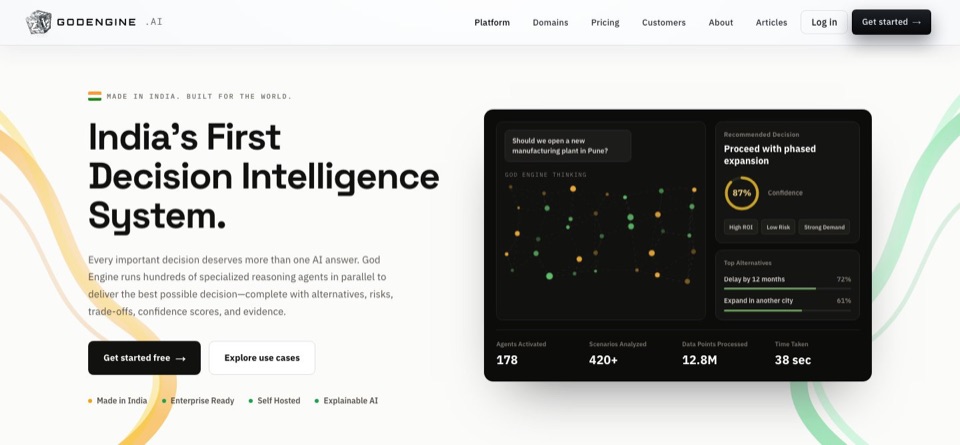
GodEngine is a decision intelligence engine that builds causal models and scenarios to help founders navigate high-stakes strategic choices. Unlike standard AI that provides a single answer, it extracts facts, causes, and effects to build a structured, auditable knowledge graph of your decision.
Most AI tools are designed for conversation. They are excellent at producing fluent prose, but in high-stakes business environments, fluency can be dangerous. When an AI gives you a confident, well-written paragraph, it often hides the underlying uncertainty. It gives you a conclusion without showing you the logic, the risks, or the assumptions that led there.
For a founder, a "confident" answer is rarely enough. If you are deciding whether to expand your manufacturing plant in Pune or increase your marketing spend in Mumbai, you don't just need a recommendation. You need to know why the AI thinks one path is better, what data points it is relying on, and what specific conditions would make that decision a mistake.
GodEngine is a decision intelligence engine designed to show you the model, not just the answer. It treats every strategic question as a small model of the world. Instead of just talking, it builds a structure of entities, facts, and causal links so you can see the mechanics of your own strategy.
| Feature | Standard Chatbots | GodEngine |
|---|---|---|
| Output Format | Fluent, conversational prose | Structured reports and causal graphs |
| Logic | Hidden "black box" reasoning | Auditable links and entities |
| Uncertainty | Often masked by confident tone | Explicitly probed via scenarios |
| Data Handling | Public model processing | Option for private, self-hosted models |
How GodEngine Reasons Through Your Strategy
The engine operates through a process called a resolve pipeline. Instead of waiting for a single, massive response to appear all at once, the pipeline streams its results to you in real-time using server-sent events. This means you can watch the reasoning happen step-by-step as the engine works through your problem.
The Reasoning Pipeline
The process follows a structured path to move from a simple question to a complex strategic map:
- Break it down: The engine analyzes your question to pull out key entities and the cause-and-effect links between them. These are placed into a clickable knowledge graph. If you ask, "Should we hire five more sales reps in Bangalore?", the engine identifies the "Sales Reps," the "Bangalore Market," and the "Revenue Growth" as connected entities.
- Gather sources: As the engine identifies facts, it collects supporting sources. These are kept attached to the specific facts they support so you can verify the information immediately.
- Build scenarios: This is where strategic reasoning becomes actionable. The engine builds a set of plausible futures and "probes" them. It asks: "What must be true for this scenario to happen?" and "What specific event would break this plan?"
- Write the report: Finally, it generates a structured report that lays out your options, the likely outcomes, the associated risks, and the reasoning behind every recommendation, complete with citations.
Reasoning You Can Audit, Not Just Trust
In high-stakes business, "trust me" is not a valid strategy. You need to be able to defend your decisions to investors, board members, or your own team. This is why GodEngine focuses on ai reasoning that is transparent rather than just "smart."
The core problem with many large language models is "fluency as certainty." Because they write so well, it is easy to mistake a grammatically perfect paragraph for a logically sound business plan. GodEngine fights this by making the underlying logic visible. Every claim in a GodEngine report points back to a specific entity, a link in the knowledge graph, or a verified source. If a piece of the logic looks wrong to you, you can drill down to see exactly which step the engine took and why it believed that specific connection existed.
The Figure Check
Accuracy is critical when dealing with numbers. GodEngine includes a "figure check" designed to compare numbers provided in an answer against computed facts. While this feature is currently switched on and still has known misses, it is designed to show its working. The goal is to provide a system where you can verify the math rather than simply asking for your blind trust.
For those interested in the technical implementation of this verification, the reasoning models architecture relies on a "plan, act, verify" loop. This loop is what allows the engine to move beyond simple text generation and into actual logical verification.
Strategic Use Cases for Operators
GodEngine is built for people who have to explain their decisions to others. Whether you are a founder or a senior analyst, the tool is designed to handle the complexity of real-world business operations.
- Resource Allocation: Deciding between competing priorities. For example: "Should we invest our remaining seed capital into product R&D or a heavy customer acquisition campaign in the next quarter?"
- Market Entry: Mapping the causal drivers behind a specific market trend. If you see a surge in demand for sustainable packaging in Southeast Asia, GodEngine can help you map the causes and the potential risks of moving into that space.
- Organizational Shifts: Weighing changes that touch multiple teams at once, such as shifting from a direct-to-consumer model to a wholesale/distributor model.
- Fundraising and Stakeholders: Creating defensible, structured write-ups. When an investor asks, "How did you arrive at this burn rate projection?", you can provide a structured report that shows the causal links and scenarios you considered.
Privacy-First Architecture for Sensitive Data
Strategic questions are often the most sensitive data a company owns.
GodEngine is designed with this reality in mind. Our architecture allows for the routing of different pipeline stages to self-hosted open models running on private GPU servers. This means your most sensitive business intelligence does not have to pass through a public provider's servers.
While the ability to route every single stage to a private model is currently a work in progress, it is a core priority for our development. We believe a decision engine is only useful if you can actually trust it with your most private strategic data.
Current Capabilities and Future Vision
We are building GodEngine in stages. We prefer to be transparent about what is ready to use today and what we are currently working on in the lab.
What is Available Now
- Streaming Decision Reports: Get structured, cited reports via the web.
- Causal Knowledge Graphs: Visual, clickable breakdowns of cause and effect.
- Scenario Building: The ability to probe multiple plausible futures.
- Multi-Platform Access: The same engine is available on both Web and Android.
What is in Development
- Deeper Simulation Modes: We are working on modes that involve multiple simulated agents to create more complex, interactive environments.
- Time-Series Forecasting: We are integrating tools like TimesFM to bring time-series forecasting into everyday answers.
- Private Model Routing: Expanding the ability to run the entire pipeline on self-hosted, private hardware.
The long-term vision for GodEngine is to become a suite of five distinct platforms. The next major release will be AskShiva, an assistant designed to remember your context and act on your behalf. Currently, GodEngine is available by invitation. You can request access or write to the founder with a specific decision you want the engine to reason through.
Frequently Asked Questions
- How is this different from ChatGPT?
- While LLMs provide fluent text, GodEngine provides a structured model of the world, showing the causal links and scenarios behind an answer so you can audit the reasoning.
- Can I use it on my phone?
- Yes, GodEngine is available on both Web and Android, ensuring the same knowledge graph is rendered across all devices.
- Is my data secure?
- GodEngine is designed to allow routing to self-hosted private models on our own GPU servers to protect sensitive strategic data.
- How do I get access?
- GodEngine is currently open by invitation. You can ask for access or write to the founder with a decision you would like to see it reason through.
- What kind of decisions is it best for?
- It is built for high-stakes decisions where you must explain your reasoning to others, such as market entry, hiring, or pricing strategy.

Questions people ask
How is this different from ChatGPT?
While LLMs provide fluent text, GodEngine provides a structured model of the world, showing the causal links and scenarios behind an answer so you can audit the reasoning.
Can I use it on my phone?
Yes, GodEngine is available on both Web and Android, ensuring the same knowledge graph is rendered across all devices.
Is my data secure?
GodEngine is designed to allow routing to self-hosted private models on our own GPU servers to protect sensitive strategic data.
How do I get access?
GodEngine is currently open by invitation. You can ask for access or write to the founder with a decision you want the engine to reason through.
What kind of decisions is it best for?
It is built for high-stakes decisions where you must explain your reasoning to others, such as market entry, hiring, or pricing strategy.