
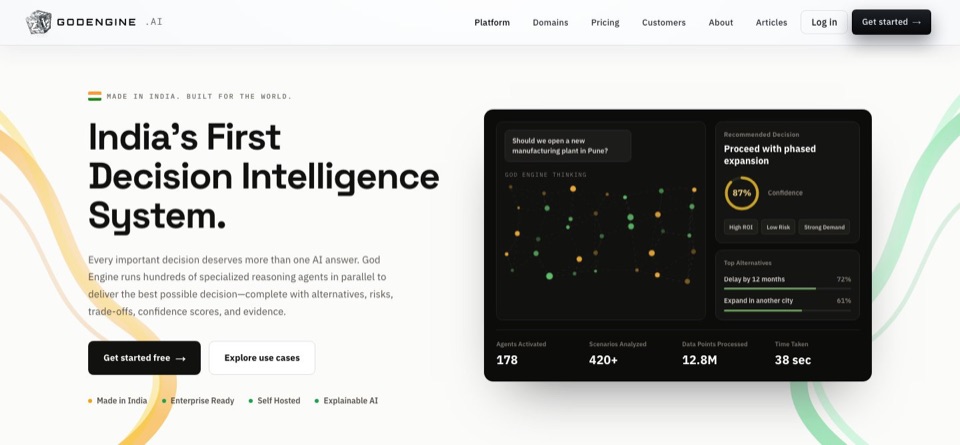
The Difference Between Answering and Deciding
AI cannot make business decisions on its own because a true decision requires understanding causality, weighing risks, and probing potential futures. While standard AI can provide fluent answers, decision intelligence provides a structured model of the world that allows you to see the reasoning behind a choice.
Most AI tools you use today—like standard chatbots—are designed to answer questions. They take a prompt and generate fluent prose. The danger in a business context is that fluency looks like certainty. If an AI gives you a confident-sounding paragraph about whether you should expand your retail shop in Mumbai or stay in your current location, it is simply predicting the next likely word in a sentence.
A real business decision is much more complex than a text response. It involves several moving parts that a simple chatbot often ignores:
- Current truths: What are your actual sales numbers and current overheads?
- Causal links: If you increase your marketing spend, what specifically causes an increase in footfall?
- Potential futures: What happens if a new competitor opens across the street next month?
- The cost of being wrong: What is the financial and operational impact if this decision fails?
True decision intelligence moves beyond "answering" by providing a structured model of these variables. It doesn't just tell you what to do; it shows you the mechanics of why a certain path might work or fail.
How AI Moves from Chat to Decision Intelligence
To move from a simple chat interface to a tool that supports high-stakes business choices, the underlying technology must change. It requires a shift from simple pattern matching to AI reasoning.
The process of turning a question into a decision-support report follows a specific pipeline:
- Extraction: The engine begins by pulling entities, facts, and cause-and-effect links out of your question. Instead of just reading the words, it maps the relationships between them.
- Knowledge Graphing: These extracted facts are placed into a knowledge graph. This is a structured map of how different parts of your business or market interact.
- Scenario Building: Instead of searching for one "correct" answer, the engine builds multiple plausible scenarios. For example, if you are deciding whether to invest in a new delivery fleet, it might model a "high demand" scenario and a "low demand" scenario.
- Scenario Probing: Each scenario is probed. The system asks: "What must be true for this scenario to happen?" and "What specific event would break this scenario?"
- Structured Reporting: The final output is not just a chat bubble. It is a structured report that lays out the options, the likely outcomes, the risks, and the reasoning used to reach them.
This approach is fundamental to strategic reasoning. It allows an operator to see the logic flow rather than just receiving a summary.
Why Reasoning Must Be Auditable
In high-stakes business environments, "trust me" is not a valid strategy. You cannot make a million-rupee decision based on a chatbot's "feeling." You must be able to audit the logic. If an AI makes a claim, you need to be able to verify it immediately.
An auditable system ensures that every claim in a decision report points back to a specific entity, a link in the knowledge graph, or a verifiable source. If the AI suggests that "competitor pricing will likely drop," you should be able to see exactly which data point or source led to that conclusion.
One critical component of this is the "figure check." This is a process where the system compares the numbers used in its written answers against the actual computed facts. This helps prevent the common AI error where a model provides a fluent sentence that is mathematically incorrect.
Decisions as Bets Under Uncertainty
Experienced business owners know that most decisions are not about finding the "right" answer, because the future is never certain. Instead, real decisions are bets made under uncertainty. You are placing a wager on one version of the future over another.
Effective AI decision making should mimic the way expert operators think. An expert doesn't just look for one outcome; they weigh different paths and their requirements. They ask, "If I take this path, what conditions must hold true for me to win?"
| Feature | Standard Chatbot | Decision Intelligence |
|---|---|---|
| Output Style | Single, fluent text response | Multiple plausible scenarios |
| Logic Model | Statistical word prediction | Causal knowledge graph |
| Uncertainty | Often hides uncertainty with confident prose | Explicitly probes what might "break" a scenario |
| Verification | Difficult to trace reasoning | Every claim is linked to a source or entity |
The Importance of Data Privacy in Decision Making
Strategic questions are often highly sensitive. If a founder is weighing whether to take a specific venture capital term sheet or which employee to promote to a leadership role, they cannot simply paste that data into a public chatbot. Doing so risks leaking proprietary strategy into the training sets of large models.
For a decision engine to be useful in a professional setting, it must respect data sovereignty. A reliable system should offer the ability to route data pipelines to self-hosted, private models. This means your most sensitive causal models and strategic questions stay within your controlled environment.
While many advanced features in modern decision engines are still being developed—such as full routing to private models or advanced time-series forecasting—the goal is clear: a decision engine you cannot trust with your data is of limited use to a business owner.
Who Should Use AI for Decision Support?
Decision intelligence is not for everyone; it is for those who have to explain their choices to others. If your decision requires a "defensible write-up" for a board of directors, a bank, or a partner, these tools are built for you.
Common use cases include:
- Founders: Deciding between entering new markets, making key hires, adjusting pricing models, or choosing between different fundraising rounds.
- Finance and Business Analysts: Moving away from single-number forecasts toward scenario-based, defensible reports that account for multiple variables.
- Operations Managers: Weighing organizational changes that impact multiple departments simultaneously, where a change in one area creates a ripple effect in another.
- Researchers: Mapping the specific, underlying causes behind a sudden trend or a market event to understand if it is a temporary spike or a structural shift.
The common thread is complexity. When a decision has too many moving parts to hold in your head at once, you need a system that can model the world for you.

Questions people ask
Can AI provide a single correct answer for a business decision?
No. Real decisions are bets under uncertainty, so effective AI provides multiple plausible scenarios and the conditions required for each to occur.
How is AI reasoning different from a standard chatbot?
Chatbots provide fluent text that can hide errors. Decision intelligence builds a knowledge graph of causes and effects so you can audit the reasoning.
Can I trust AI with sensitive strategic data?
Trust depends on privacy. A secure decision engine should allow you to route data to self-hosted private models rather than public providers.
What happens if the AI makes a mistake in its calculation?
Advanced systems use a 'figure check' to compare answers against computed facts, and they show their working so you can spot errors.
What is the benefit of scenario planning in AI?
Scenario planning shows you what has to be true for a specific outcome to happen and what might break that outcome, helping you manage risk.