
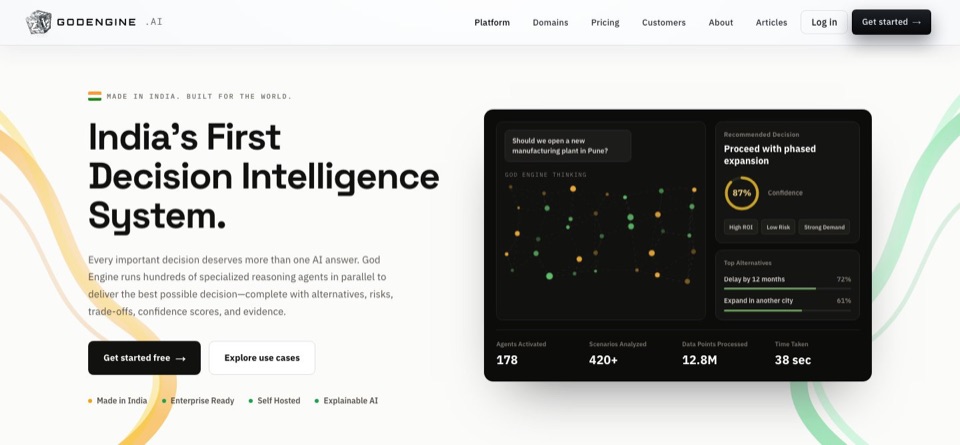
What does decision intelligence look like in practice?
Decision intelligence moves beyond simple chat replies by providing structured reasoning instead of just fluent text. It uses knowledge graphs and scenario probing to show you the underlying model of the world, allowing you to audit how a conclusion was reached.
When you ask a standard AI a question, you often get a single, confident-sounding paragraph. In high-stakes business environments, that confidence can be dangerous if the answer is wrong. Decision intelligence is designed to solve this by treating every question as a small model of the world.
In practice, this means the system does not just "guess" the next word. It performs a structured process to ensure the logic holds up. This involves several key technical and logical shifts:
- Mapping the World: It uses knowledge graphs to map out entities, facts, and the causal links between them.
- Scenario Probing: Instead of giving you one "correct" answer, it builds and probes multiple plausible scenarios to see what might happen in different futures.
- Auditability: It provides a structured report with citations, so you can verify exactly which fact or source led to a specific recommendation.
- Reasoning Pipelines: It uses a reasoning pipeline that breaks a problem down into stages, allowing you to see the logic unfold in real-time.
Practical Business Scenarios
For business owners and operators, decisions are rarely about finding a single "right" answer in a vacuum. They are about weighing competing risks and uncertain outcomes. Decision intelligence helps navigate these complexities by looking at how one change ripples through a system.
Market Expansion
Imagine a growing retail brand in India. A founder might be weighing whether to open a second outlet in a specific location like Vasai or to invest heavily in a new delivery channel. A decision engine doesn't just list pros and cons; it looks at the causal links between location, logistics, and local demand to show how each path changes the business's risk profile.
Resource Allocation
Should you hire three new sales executives this quarter, or should you invest that same capital into upgrading your CRM and automation technology? Decision intelligence helps you weigh the pros and cons of human capital versus technological investment by modeling the expected outcomes of both paths.
Strategic Pivots
When a company is at a crossroads, the stakes are high. You might be evaluating whether to focus on a completely new market, shift to a subscription-based pricing model, or initiate a new funding round. These decisions impact your runway, your culture, and your product roadmap simultaneously.
Operational Changes
A change in a supply chain policy might seem small, but it can impact the warehouse team, the sales team, and the finance department. Decision intelligence is built for operators who need to assess changes that touch multiple teams across an organization, ensuring that a fix in one area doesn't create a crisis in another.
Use Cases for Analysts and Researchers
Analysts often struggle with the "black box" problem: an AI gives a number, but the analyst cannot explain to the CFO exactly how that number was derived. Decision intelligence is built to provide a strategic reasoning framework that is defensible.
Finance & Business Analysis
Instead of relying on a single, unverified number from a chatbot, analysts can use decision engines to create defensible write-ups. These reports are based on multiple scenarios, showing not just what is likely to happen, but what would have to be true for a specific financial outcome to occur.
Trend Mapping
Researchers can use causal links to understand the specific drivers behind a market trend. Rather than just noting that "demand is rising," a decision engine helps map the cause-and-effect chain—such as how a specific regulatory change or a shift in consumer sentiment is driving that trend.
Risk Assessment
A core part of risk management is identifying the "breaking point" of a strategy. Decision intelligence allows you to probe scenarios to find out what would have to be true for a specific outcome to occur, and more importantly, what specific variables would break your current strategy.
High-Stakes Decisions for Founders
Founders operate in a state of constant uncertainty. Every decision they make is a bet on the future. Because they often have to explain their logic to investors, board members, or early employees, they need more than just an answer; they need an explanation.
Common high-stakes scenarios include:
- Opportunity Cost: Choosing between two competing market opportunities where both look promising but resources are limited.
- Fundraising Timing: Determining the optimal window to start a fundraise based on current runway, market conditions, and growth milestones.
- Complex Hiring: Evaluating hiring decisions that go beyond a simple skill gap and instead impact company culture and long-term burn rate.
For these leaders, the ability to show the "why" behind a decision is just as important as the decision itself. This is why ai decision making is shifting away from simple chat toward structured reasoning models.
Chatbots vs. Decision Intelligence
It is easy to confuse a Large Language Model (LLM) with a decision engine, but for professional work, the difference is critical. The following table outlines how these two approaches differ in a business context.
| Feature | Chatbots (LLMs) | Decision Intelligence |
|---|---|---|
| Output Style | Fluent prose that can look like certainty even when wrong. | Structured reasoning that highlights uncertainty. |
| Format | A "wall of text" response. | A streaming reasoning pipeline and structured report. |
| Depth | Provides a single answer. | Provides an explanation you can show to others. |
| Verification | Hard to audit; prone to hallucinations. | Every claim is linked to an entity or source. |
While chatbots are excellent for drafting emails or summarizing text, decision intelligence is built for the "reasoning" part of the job.
How the Intelligence is Built
Building a system that can actually "reason" requires more than just a prompt. It requires a specialized architecture. At the core of modern engines like GodEngine is a resolve pipeline designed to move from a question to a validated report.
The Resolve Pipeline
The process begins by extracting facts and cause-and-effect links from the user's question. This isn't just text processing; it is the process of turning language into a structured map of logic.
Knowledge Graphs and Scenario Probing
Once the facts are extracted, they are placed into a knowledge graph. This allows users to click through entities to see how they are connected. From there, a scenario probing engine tests different variables—asking, "What happens to our profit if our customer acquisition cost doubles?" or "What if this supplier fails to deliver?"
The Number Check
One of the most important technical features is the "number check." This feature compares numbers provided in an answer against computed facts. While this feature is currently being refined and is not yet perfect, it is a critical step in ensuring that the engine's reasoning is grounded in math rather than just linguistic probability.
Frequently Asked Questions
- How is decision intelligence different from a standard AI chatbot?
- Chatbots often provide a single, fluent answer that can hide uncertainty. Decision intelligence builds a model of the world, showing the causal links, scenarios, and sources behind a recommendation.
- Can I use decision intelligence for financial forecasting?
- Yes. It is designed for analysts who need defensible scenarios and structured reports rather than just a single number.
- What makes a decision intelligence report 'auditable'?
- Every claim in a report points back to an entity, a link in a knowledge graph, or a cited source, allowing you to see exactly why the engine reached a conclusion.
- What kind of questions can I ask a decision engine?
- You can ask complex, multi-variable questions. For example, GodEngine's interface is designed to handle questions like, "Should we open a second outlet in Vasai this year, or invest in delivery first?"
- Is my data safe when using these models?
- Data privacy is a major concern for high-stakes decisions. While many services use public APIs, advanced engines are working toward allowing users to route processing to self-hosted, private models on their own hardware.

Questions people ask
How is decision intelligence different from a standard AI chatbot?
Chatbots often provide a single, fluent answer that can hide uncertainty. Decision intelligence builds a model of the world, showing the causal links, scenarios, and sources behind a recommendation.
Can I use decision intelligence for financial forecasting?
Yes. It is designed for analysts who need defensible scenarios and structured reports rather than just a single number.
What makes a decision intelligence report 'auditable'?
Every claim in a report points back to a specific entity, a link in a knowledge graph, or a cited source, allowing you to see exactly why the engine reached a conclusion.
What kind of questions can I ask a decision engine?
You can ask complex, multi-variable questions like 'Should we open a second outlet in Vasai this year, or invest in delivery first?'
Is my data safe when using these models?
Advanced decision engines can route stages of the pipeline to self-hosted private models on your own GPU server to ensure data privacy.