
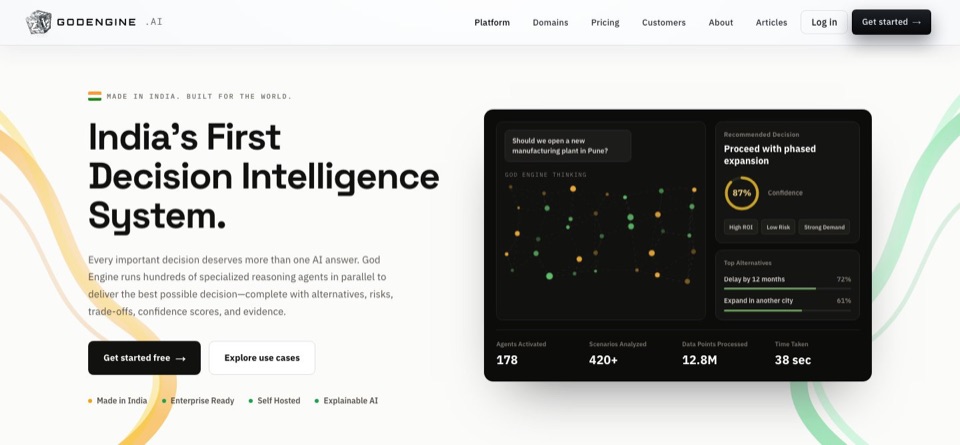
The decision intelligence market is expanding as businesses move away from simple AI chatbots toward structured reasoning and scenario planning. This shift is driven by a need for auditable, high-stakes reasoning that moves beyond mere fluency to provide actual certainty in complex environments.
Why the Market is Expanding
The transition from generative AI "chat" to decision intelligence represents a fundamental shift in how enterprises use technology. For years, businesses have experimented with large language models (LLMs) to generate text, but they have quickly discovered that fluency is not the same as accuracy or utility in a boardroom setting.
Shift from Fluency to Certainty
Large language models are excellent at producing fluent answers. However, in high-stakes work, this fluency is a risk. A chatbot can sound incredibly confident while providing a hallucination or an incorrect logical step. Decision intelligence solves this by putting structure around the model so you can check it. Instead of just receiving a paragraph of text, users require a system that provides structured reasoning to avoid the risks of perceived certainty.
The Need for Auditability
In a professional setting, "because the AI said so" is not a valid strategic justification. Markets are moving toward systems where every claim points back to a specific entity, a link in a knowledge graph, or a verified source. This ability to trace a conclusion back to its origin is what separates a toy from a professional tool. If a step in a logic chain looks wrong, an operator must be able to see exactly which step failed and why the engine believed it.
Complexity of Modern Bets
Real decisions are not single-answer questions; they are bets placed under uncertainty. Whether it is a retail owner in Mumbai deciding whether to expand to a new suburb or a tech founder deciding on a pricing model, the reality is that there are multiple plausible futures. There is a growing demand for tools that provide these multiple scenarios rather than a single, static answer.
Who is Driving Demand?
The demand for decision intelligence is not coming from a single sector, but from several distinct roles that share a common problem: the need to explain a choice to others. If you have to justify a major capital expenditure or a change in company direction, you need more than a chat window; you need a defensible reasoning chain.
- Founders: They are constantly navigating high-stakes choices regarding which markets to enter, which key hires to make, how to price a new product, or when to pursue a fundraising round.
- Finance and Business Analysts: These professionals are moving away from seeking a single number. They need defensible write-ups and complex scenario modeling that can withstand scrutiny from a CFO or a board of directors.
- Researchers: They require tools to map the causal links behind specific trends or complex global events, moving beyond correlation to understand actual cause-and-effect.
- Operators: These are the people managing day-to-day changes that impact multiple teams simultaneously. They need to see how a change in one part of the business ripples through the rest of the organization.
The Gap Between Chatbots and Decision Engines
To understand the market opportunity, one must understand the technical and functional gap between a standard chatbot and a true decision engine. While chatbots focus on generating text that sounds human, decision intelligence focuses on the underlying logic of the world.
| Feature | Standard AI Chatbots | Decision Intelligence Engines |
|---|---|---|
| Primary Goal | Fluency and text generation | Structured reasoning and choice support |
| Output Type | A single conversational response | Scenarios, causal links, and reports |
| Logic Structure | Hidden behind prose | Visible via knowledge graphs and entities |
| Verification | Often relies on user trust | Auditable via source citations and figure checks |
The Resolve Pipeline
A true decision engine utilizes what is known as a "resolve pipeline." Instead of simply predicting the next word in a sentence, the engine extracts facts, causes, and effects from a question. It then builds a model of the world to probe those facts. This is a core component of ai reasoning—the ability to break a complex problem into its constituent parts before attempting to solve it.
Visualizing the Model
True market value lies in showing the model. Rather than just providing an answer, advanced systems use knowledge graphs and causal links to show the user the "why." When a user can see the graph of entities and the connections between them, they can interact with the logic itself, rather than just reading a summary of it.
Critical Requirements for Enterprise Adoption
For decision intelligence to move from experimental use to core enterprise infrastructure, several technical hurdles must be cleared. Business owners cannot rely on tools that are "black boxes" or that pose a risk to their proprietary strategy.
Data Privacy and Sovereignty
Strategic questions often contain sensitive information that a company would never paste into a public chatbot. For an enterprise to adopt these tools, they must have the ability to route their reasoning pipelines to self-hosted, private models. This ensures that the "secret sauce" of a company's strategy remains within their own controlled environment. While this capability is still being built in many current platforms, it is a non-negotiable requirement for high-stakes adoption.
Verification and Figure Checks
Accuracy in numbers is the difference between a useful tool and a liability. A critical requirement is the "figure check"—a process where the system compares numbers in its generated answers against computed facts. Because even the best models can make errors, the system should show its working and its math rather than simply asking the user to trust its output.
Real-time Reasoning and Auditing
Decision-making is often a high-pressure process. Systems should ideally use server-sent events to stream reasoning steps in real-time. This allows a user to watch the reasoning happen as it is being built, providing immediate feedback and allowing for auditing of the process as it unfolds, rather than waiting for a single, massive wall of text to appear after a long delay.
The Future of Decision Intelligence
The evolution of this market is moving toward increasingly complex and autonomous systems. We are moving from simple support to active, agentic participation in the decision process.
Simulation and Forecasting
We expect to see the deeper integration of time-series forecasting into everyday decision workflows. Imagine a small business owner in a growing city like Bangalore being able to see how a predicted change in local transport infrastructure might impact their delivery costs six months from now. This involves moving from static data to dynamic, predictive modeling.
Agentic Architectures
The most significant shift will be the transition from simple decision support to agentic architectures. These systems follow a "plan-act-verify" loop. Instead of just suggesting a path, these agents can simulate multiple paths using many simulated agents, probing different outcomes to see which one is most robust. This is the frontier of ai decision making.
Frequently Asked Questions
- How does decision intelligence differ from standard AI chatbots?
- While chatbots focus on generating fluent text, decision intelligence focuses on structured reasoning, providing scenarios, causal links, and auditable sources to help you make a choice.
- Why is scenario planning important for decision intelligence?
- Real decisions are bets under uncertainty. Scenario planning allows you to probe multiple plausible futures to see what must be true for each outcome to occur.
- Can decision intelligence tools be used for private data?
- Yes, high-stakes decision intelligence should ideally allow for routing data to self-hosted, private models to ensure strategic information remains secure.
- What makes a decision intelligence report 'auditable'?
- An auditable report links every claim back to a specific entity in a knowledge graph or a verified source, allowing you to see exactly why the engine reached a conclusion.
- Who benefits most from decision intelligence tools?
- Founders, finance analysts, researchers, and operators who need to explain their reasoning and the risks of being wrong to other stakeholders.

Questions people ask
How does decision intelligence differ from standard AI chatbots?
While chatbots focus on generating fluent text, decision intelligence focuses on structured reasoning, providing scenarios, causal links, and auditable sources to help you make a choice.
Why is scenario planning important for decision intelligence?
Real decisions are bets under uncertainty. Scenario planning allows you to probe multiple plausible futures to see what must be true for each outcome to occur.
Can decision intelligence tools be used for private data?
Yes, high-stakes decision intelligence should ideally allow for routing data to self-hosted, private models to ensure strategic information remains secure.
What makes a decision intelligence report 'auditable'?
An auditable report links every claim back to a specific entity in a knowledge graph or a verified source, allowing you to see exactly why the engine reached a conclusion.
Who benefits most from decision intelligence tools?
Founders, finance analysts, researchers, and operators who need to explain their reasoning and the risks of being wrong to other stakeholders.