
The Flaw in Generative AI Answers
Game theory in AI decision making moves beyond simple text prediction to model complex causal relationships and probabilistic outcomes. Instead of just generating fluent prose, it treats questions as strategic models to help you weigh risks and potential futures.
Large Language Models (LLMs) are incredibly good at sounding smart. They can write a professional-sounding email or a coherent summary in seconds. However, for a business owner, fluency is not the same as accuracy. In high-stakes environments, a chatbot's ability to produce smooth, confident text can actually be a liability because it can mask deep uncertainty.
When you ask a standard chatbot a complex business question, it often provides a single, definitive answer. This "one-size-fits-all" response hides the moving parts of a real decision. It ignores the "what ifs" and the conditional logic that defines real-world strategy. For example, if a shop owner in Mumbai asks if they should expand their inventory, a chatbot might give a confident "Yes" based on general trends, without accounting for the specific local supply chain risks or the cost of capital.
High-stakes work requires more than a confident-sounding answer; it requires a model you can audit. You need to see the math, the logic, and the assumptions. Without this, you aren't making a decision; you are simply following a suggestion that might be hallucinated or oversimplified.
Modeling Decisions as Strategic Games
Real decisions are not single points of truth; they are bets placed under uncertainty. When a founder decides whether to hire a new lead engineer or spend that budget on marketing, they are navigating a landscape of probabilities. They are playing a game where the rules are not fully known, and the moves of competitors or market shifts are unpredictable.
Effective AI decision making treats a question as a small model of the world. Instead of trying to predict the next word in a sentence, the engine tries to map the causal links between different variables. It looks at how one action impacts another and what the resulting state of the world might look like.
Instead of providing one single answer, a strategic engine provides several plausible scenarios. It outlines the specific conditions required for each scenario to occur. This is the essence of strategic reasoning: understanding that "Outcome A" only happens if "Condition X" and "Condition Y" are both met.
| Feature | Standard Chatbot | Decision Intelligence Engine |
|---|---|---|
| Output Type | Fluent, conversational prose | Structured, causal reports |
| Handling Uncertainty | Often hides it behind confidence | Explicitly models multiple scenarios |
| Logic Structure | Probabilistic word prediction | Causal graphs and entity links |
| Primary Goal | Answering a question | Helping a user decide |
From Questions to Causal Graphs
To move from "chatting" to "reasoning," the system must understand the underlying structure of the problem. The process begins by extracting entities, facts, and cause-and-effect links from a question. If you ask, "Will opening a second outlet in Vasai increase my total profit if rent rises by 10%?", the engine identifies the key players: the Vasai outlet, total profit, and rent costs.
These elements are placed into a knowledge graph to map how variables interact. This is not just a list of words; it is a map of relationships. The engine understands that "Rent" is a cost that directly subtracts from "Profit." It maps the direction of the influence.
This structure allows the engine to probe what must be true for a specific outcome to happen. It can work backward from a goal.
By using these reasoning models, the AI moves away from guessing what word comes next and toward calculating what state of the world is required to reach a conclusion.
The Resolve Pipeline: How it Works
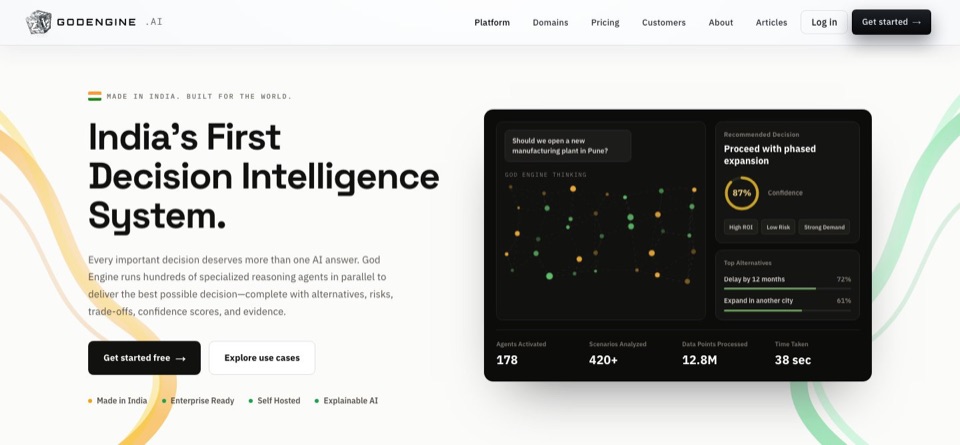
GodEngine uses a "resolve pipeline" to break down complex strategic questions. This is a multi-stage process where each step is visible to the user. This is different from a black box that takes a prompt and spits out a result; here, you watch the reasoning happen in real-time through streaming updates.
- Ask: You type a decision question, such as "Should we invest in delivery services or expand our physical footprint?"
- Break it down: The engine pulls the entities, facts, and cause-and-effect links out of the question and places them in a knowledge graph.
- Gather sources: The engine collects supporting sources and keeps them attached to the facts they support.
- Build scenarios: The engine builds a set of plausible scenarios and probes each one to see what breaks them.
- Write the report: A structured report is generated, laying out options, likely outcomes, and risks.
Because the pipeline streams its results via server-sent events, you don't wait in silence for a wall of text. You see the engine building the graph and probing the scenarios as it works. This transparency is vital for building trust in the final output.
Verifiable Reasoning vs. Blind Trust
One of the biggest hurdles in using AI for business is the "black box" problem. If an AI tells a CFO to cut costs in a specific department, the CFO needs to know *why*. They cannot simply take the AI's word for it. This is where AI reasoning must become auditable.
Every claim in a decision report points back to an entity, a graph link, or a source. If the engine claims that "increased delivery demand in South Delhi will offset the cost of new riders," you can click that claim to see the specific data point or source that supports it. You can see exactly which step in the reasoning process led to a specific conclusion.
Furthermore, a "figure check" is used to ensure mathematical integrity. This process compares numbers in the generated answers against computed facts to ensure accuracy. While this feature is still being refined and may have known misses, the goal is to show the working rather than asking for blind trust.
Who Needs Strategic AI Reasoning?
Strategic AI is not for writing social media captions; it is for people who have to explain their decisions to stakeholders. This tool is designed for professionals where the cost of being wrong is high.
- Founders: Deciding between entering new markets, making key hires, or shifting pricing strategies.
- Finance and Business Analysts: Requiring defensible, structured write-ups and scenario analyses rather than a single, isolated number.
- Operators: Weighing organizational changes that touch multiple teams simultaneously, where a change in one department creates a ripple effect in another.
- Researchers: Mapping the complex causes behind a specific market trend or a sudden economic event.
The common thread among these users is accountability. When you have to justify a move to a board of directors or a bank, you need the explanation along with the answer.
The Path to Agentic Decision Engines
We are currently in the era of streaming decision reports and cause-and-effect breakdowns. The engine can show you the graph and the scenarios it has probed. But the roadmap goes much further. The goal is to move from answering questions to helping users decide through structured intelligence.
Future development includes deeper simulation modes. Imagine a world where, instead of just modeling a scenario, the engine runs a simulation using many simulated agents—each with their own goals and behaviors—to see how a market might react to your pricing change. This moves us into the realm of truly agentic decision-making.
We are also working on integrating advanced forecasting. For example, GodEngine is working on bringing time-series forecasting (TimesFM) into everyday answers to assist with data-driven decision intelligence. This will allow the engine to combine historical data patterns with causal reasoning for even more robust strategic insights.
| Capability | Current State | Future Direction |
|---|---|---|
| Decision Reports | Streaming, structured reports | Deep, multi-agent simulations |
| Forecasting | Partly built (TimesFM integration) | Fully integrated time-series analysis |
| Model Hosting | Routing to self-hosted models (partly built) | Full private-model routing by default |
Frequently Asked Questions
- How is AI decision making different from a standard chatbot?
- Standard chatbots provide fluent text answers that can hide uncertainty. Decision intelligence builds a model of the world with causal links and scenarios to show the reasoning behind an outcome.
- Can AI handle uncertainty in strategic planning?
- Yes, by treating decisions as bets, AI can build and probe multiple plausible scenarios to show what would have to be true for each outcome to occur.
- How do you know if an AI's reasoning is correct?
- You can audit the reasoning because every claim is linked to a specific entity, source, or link in a knowledge graph, allowing you to see exactly why the engine believed a step.
- What are the risks of using LLMs for high-stakes decisions?
- The primary risk is that fluency looks like certainty; a model might provide a very confident-sounding answer that is factually incorrect or lacks causal logic.
- Does AI decision making include financial forecasting?
- GodEngine is building time-series forecasting (TimesFM) into everyday answers to assist with data-driven decision intelligence.

Questions people ask
How is AI decision making different from a standard chatbot?
Standard chatbots provide fluent text answers that can hide uncertainty. Decision intelligence builds a model of the world with causal links and scenarios to show the reasoning behind an outcome.
Can AI handle uncertainty in strategic planning?
Yes, by treating decisions as bets, AI can build and probe multiple plausible scenarios to show what would have to be true for each outcome to occur.
How do you know if an AI's reasoning is correct?
You can audit the reasoning because every claim is linked to a specific entity, source, or link in a knowledge graph, allowing you to see exactly why the engine believed a step.
What are the risks of using LLMs for high-stakes decisions?
The primary risk is that fluency looks like certainty; a model might provide a very confident-sounding answer that is factually incorrect or lacks causal logic.
Does AI decision making include financial forecasting?
GodEngine is building time-series forecasting (TimesFM) into everyday answers to assist with data-driven decision intelligence.