
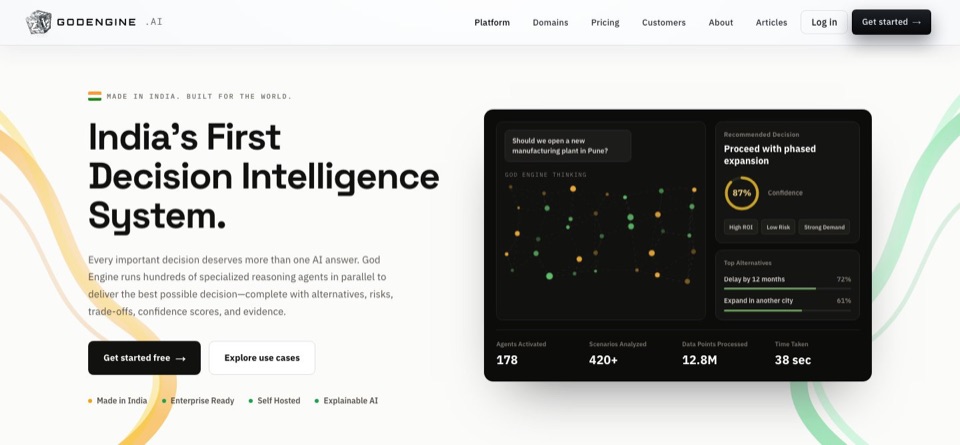
To make better business decisions with AI, you must move beyond conversational chatbots that prioritize fluency and instead use decision intelligence to build structured causal models. This approach allows you to probe multiple scenarios, audit the reasoning behind every claim, and understand the specific risks associated with different choices.
The Risk of Fluent AI Answers
Large language models are excellent at producing fluent text. In a business context, this creates a significant risk during high-stakes work because fluency often looks like certainty. When a chatbot provides a well-structured, confident response, it is easy to mistake a polished sentence for a verified fact.
A single chat reply often hides the complex moving parts of a decision. When you ask a generic question, the AI might give you a single "correct" answer, but it fails to show you what is actually true right now, what causes what, and—most importantly—what it costs to be wrong. For a business owner, a wrong answer isn't just a typo; it is a wasted investment or a failed product launch.
Instead of just answering, you need a system that shows you the model behind the answer. Relying on a single chat window means you are seeing the final output without seeing the logic that built it. To make real decisions, you need to see the entities, the facts, and the connections.
Moving from Chat to Decision Intelligence
Decision intelligence is a different paradigm than standard generative AI. While a chatbot aims to converse, a decision engine aims to model. Decision intelligence puts structure around the model so you can audit the reasoning and ensure the logic holds up under pressure.
Effective decision-making requires breaking a complex question down into its smallest components: entities, facts, and cause-and-effect links. For example, if a shop owner in Mumbai is deciding whether to expand, the decision isn't just a "yes" or "no." It involves entities like "rent," "footfall," "staffing costs," and "competitor proximity," all linked by causal relationships.
A proper decision engine builds a knowledge graph that you can click through to verify the logic. This moves you away from "black box" reasoning and toward strategic reasoning that you can actually use to guide your business. By mapping these links, you can see if the AI's conclusion is based on a logical chain or just a statistical guess.
Probing Scenarios Instead of Seeking One Answer
Real decisions are bets made under uncertainty, not a single "correct" number. If you ask an AI, "Will my new cafe be profitable in six months?", a chatbot might give you a confident forecast. A decision engine, however, treats this as a set of possibilities.
Better decisions come from building a set of plausible scenarios and probing them. Instead of one answer, you should be looking for multiple potential futures. This allows you to ask "what if" questions:
- What if footfall in the neighborhood drops due to new construction?
- What if the delivery partner takes a larger commission?
You must identify what has to be true for a scenario to work and what would break it. This is the core of AI decision making. By understanding the "breaking points" of a business plan, you can prepare for the worst-case scenario before it happens.
How to Audit AI Reasoning
If you cannot trace an AI's conclusion back to its source, you shouldn't use it for business strategy. Every claim in a structured report should point back to an entity, a link in a graph, or a specific source. This transparency is what makes AI reasoning useful for professionals.
You should be able to see exactly which step in a reasoning pipeline led to a specific conclusion. If a report claims that "expanding to Vasai is low risk," you should be able to click that claim and see the specific data points—such as local population density or current rent prices—that led to that conclusion.
To ensure accuracy, you should use "figure checks." A figure check compares numbers in answers against computed facts to ensure accuracy. This is a critical safeguard against the "hallucinations" common in standard LLMs. Rather than asking you to trust the model, the system should show its working so you can verify the math yourself.
The Decision-Making Pipeline
Building a better decision requires a structured pipeline. It is not a single step of "prompting and receiving." A robust decision engine follows a specific flow to ensure the output is defensible.
- Step 1: Breakdown — The system extracts facts and causal links from your initial question, turning a messy sentence into a structured map.
- Step 2: Gathering — The engine collects supporting sources and attaches them to specific facts, ensuring every piece of data has a home.
- Step 3: Scenario Building — The system creates and probes multiple potential futures, testing the strength of the causal links.
- Step 4: Reporting — Finally, it generates a structured report that lays out the options, likely outcomes, risks, and citations.
This process ensures that by the time you read the final report, the "thinking" has already been stress-tested against the data.
Who Benefits from Structured AI Decisions
Structured decision intelligence is designed for people who have to live with the consequences of their choices. This includes:
- Founders: Deciding between entering new markets, making key hires, setting pricing models, or pursuing a new round of funding.
- Finance and Business Analysts: Who need to produce defensible write-ups and scenarios for stakeholders, rather than just providing a single, unverified number.
- Operators: Weighing changes in supply chain or workflow that impact multiple teams simultaneously.
- Researchers: Mapping the complex causes behind a specific market trend or economic event.
The common thread for all these users is accountability. If you have to explain a decision to a board of directors, a bank, or a co-founder, you need more than a chat history; you need a documented reasoning chain.
Protecting Strategic Data
Strategic questions often contain sensitive data—profit margins, payroll details, or upcoming product specs—that you cannot simply paste into public chatbots. Privacy is a non-negotiable priority for high-stakes business intelligence.
A reliable decision engine should allow for routing to self-hosted, private models on your own GPU servers. This means you can benefit from the power of large models without ever sending your proprietary business logic to an outside provider's cloud.
| Feature | Public Chatbots | Private Decision Engines |
|---|---|---|
| Data Privacy | Data used for training | Data stays on your servers |
| Reasoning Style | Conversational/Fluent | Structured/Causal |
| Verification | Hard to trace | Auditable via knowledge graphs |
| Scenario Testing | Limited/Single answer | Multiple probed scenarios |
As the technology evolves, the ability to run these pipelines on private infrastructure will be the difference between a toy and a professional tool. For those handling sensitive strategic data, the ability to route every stage of the pipeline to a self-hosted model is essential.

Questions people ask
What is the difference between a chatbot and a decision engine?
Chatbots provide fluent, conversational answers that can hide errors. A decision engine builds a causal model of the world, showing the facts, sources, and reasoning behind an option.
How can I trust the numbers an AI provides?
You should not rely on trust alone. Use tools that perform figure checks against computed facts and provide citations for every claim made in a report.
Can AI help with scenario planning?
Yes. Instead of giving one answer, AI can build multiple plausible scenarios and probe them to see what must be true for each outcome to occur.
How does AI handle uncertainty in business?
AI handles uncertainty by treating decisions as bets. It maps out different potential futures and identifies the risks and causal links associated with each path.
Is my data safe when using AI for business decisions?
For strategic decisions, it is best to use systems that can route data to self-hosted, private models rather than sending it to public providers.