
The Risk of Fluent Answers
To use AI for business strategy, you must move beyond simple chatbots that provide conversational text and instead use systems that provide structured reasoning. Effective strategy requires breaking down complex decisions into verifiable facts, causal links, and multiple plausible scenarios rather than accepting a single, confident-sounding answer.
Most people approach AI as a sophisticated search engine or a writing assistant. They type a question into a chat box and receive a paragraph of text that sounds authoritative. While this works for drafting emails or summarizing articles, it is dangerous for high-stakes business strategy.
The primary danger is that Large Language Models (LLMs) are designed for fluency. They are excellent at producing text that flows naturally, but in a business context, fluency often looks like certainty. A chatbot might give you a very convincing argument for why you should expand your retail footprint, but that confidence can hide massive logical gaps or unverified assumptions. In a high-stakes environment, a single chat reply can mask significant risks behind polished prose.
Standard AI tools are built to answer questions, but answering a question is not the same as helping you decide. A decision requires more than a response; it requires an understanding of the variables at play and the consequences of being wrong.
Moving from Chat to Decision Intelligence
To make AI useful for strategy, you need to shift from "chatting" to decision intelligence. Business strategy is not a single answer; it is a complex web of moving parts. To navigate this, you need to understand what is true right now, what causes what, and what it costs to be wrong.
Effective AI strategy utilizes what is known as a "resolve pipeline." Instead of jumping straight to a conclusion, the system breaks down your question into its fundamental components: entities, facts, and causal links. This process turns a vague question into a structured model of reality.
Instead of asking an AI "Should I expand?", a decision intelligence approach builds a knowledge graph of the moving parts in your decision. This graph maps out how different elements—like rent costs, local footfall, or competitor pricing—interact with one another. By using ai reasoning to map these connections, you can see the skeleton of your business logic rather than just the skin of a conversational response.
Probing Scenarios Instead of Predicting One Future
One of the biggest mistakes in strategic planning is trying to use AI to predict a single, definitive future. In the real world, decisions are bets placed under conditions of uncertainty. If you ask an AI to tell you exactly what your revenue will be in twelve months, you are asking for a guess, not a strategy.
A superior approach is to use AI to build a set of plausible scenarios and then "probe" them. Probing means testing the limits of a scenario to see where it holds up and where it breaks. For example, if you are a restaurant owner in Mumbai considering a move from a dine-in model to a delivery-first model, you shouldn't look for one "correct" answer. Instead, you should use AI to build three scenarios:
- Scenario A: High demand, low delivery platform commission.
- Scenario B: High demand, high delivery platform commission.
- Scenario C: Low demand, high competition.
Once these scenarios are built, you use the AI to identify what has to be true for each scenario to work. This kind of "probing" allows you to identify the specific triggers that would break your business model before you have actually spent the capital.
How to Audit AI-Driven Strategy
If you cannot trace how an AI arrived at a strategic recommendation, you cannot trust that recommendation. In high-stakes business, "black box" decisions—where the logic is hidden—are a liability. To use AI effectively, you must demand strategic reasoning that is fully auditable.
This means every claim made in a strategic report must point back to a specific entity, a link in a causal chain, or a verifiable source. If an AI suggests that "market demand for organic spices is increasing in urban centers," it should be able to show you the specific data points or trends that support that claim.
Furthermore, you should look for systems that implement a "figure check." This is a process where the AI compares the numbers used in its final prose against the actual computed facts. This prevents the common issue where an AI might state a total that doesn't mathematically match the individual components it listed earlier. By showing its working, the AI allows you to audit the logic rather than just trusting the output.
| Feature | Standard Chatbot | Decision Engine |
|---|---|---|
| Logic Style | Conversational/Fluent | Structured/Causal |
| Output | Single Answer | Multiple Scenarios |
| Verification | User must fact-check | Built-in figure checks & citations |
| Transparency | Black Box | Auditable Reasoning |
When to Apply AI to Your Strategy
AI for strategy is not a replacement for your intuition, but it is a powerful tool for augmenting it. Here is how different roles can practically apply these tools:
- Founders: Use it to weigh heavy choices, such as choosing between entering two different geographic markets, deciding between different hiring plans, or determining whether to pursue a new pricing model or a fresh round of funding.
- Finance and Analysts: Instead of producing a single, static number for a forecast, use AI to create defensible write-ups. You can use it to build a range of scenarios that explain the "why" behind the numbers to stakeholders.
- Operators: Use AI to model the ripple effects of operational changes. If you change a supply chain route, how does that impact warehouse staffing, delivery times, and customer satisfaction simultaneously?
The common thread for all these users is that they will eventually have to explain their decision to someone else—a board, a partner, or a bank. A decision engine provides the explanation along with the answer.
Protecting Strategic Data
One of the biggest barriers to using AI in business is security. Strategic questions often involve sensitive information—unannounced product launches, specific margin data, or upcoming hiring plans. You cannot simply paste this information into a public chatbot without risking your intellectual property.
A reliable decision engine must address this. The ideal architecture allows for routing different stages of the reasoning process to self-hosted, private models running on your own GPU servers. This ensures that your most sensitive strategic "thinking" never leaves your controlled environment. Privacy is not a luxury; it is a requirement for any AI tool used in a high-stakes business environment.
How to Start Using a Decision Engine
Transitioning from a chatbot to a decision engine requires a change in how you frame your problems. You cannot ask "How do I grow my business?" and expect a strategic result. You must be specific.
- Start with a specific decision question: Instead of generalities, ask: "Should we open a second outlet in Vasai this year, or invest in delivery first?"
- Watch the reasoning: Look for tools that stream their reasoning in real-time. You want to see the "resolve pipeline" working—watching the engine pull out entities and build the knowledge graph. This allows you to catch errors in the logic as they happen.
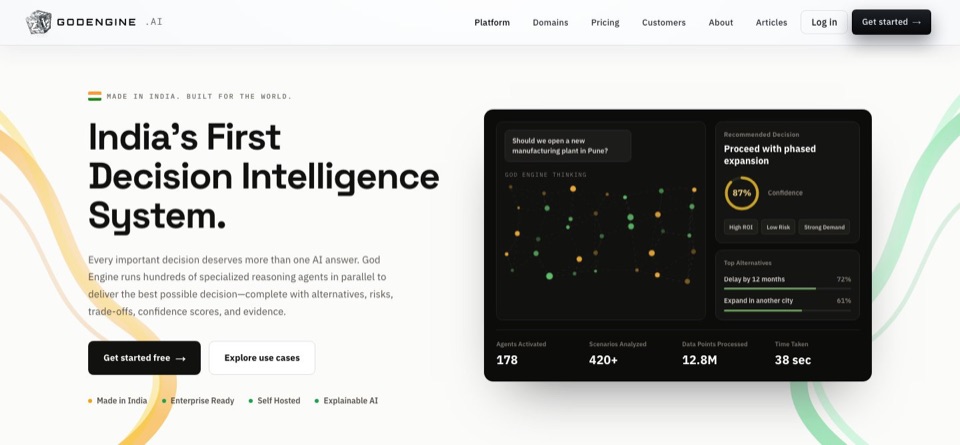
- Demand structured reports: Use platforms like GodEngine that provide a structured report. A good report should include the options, the likely outcomes, the risks, and the citations that prove the reasoning is grounded in fact.
By moving from asking questions to probing scenarios, you turn AI from a toy into a fundamental part of your strategic toolkit.
Frequently Asked Questions
- How is AI for business strategy different from using ChatGPT?
- ChatGPT provides fluent answers that can mask uncertainty, while decision intelligence provides structured reasoning, causal links, and cited sources to help you audit the logic.
- Can AI help with scenario planning?
- Yes. Advanced AI engines can build multiple plausible futures and probe them to see what must be true for each scenario to succeed or fail.
- Is AI-generated business strategy reliable?
- Reliability depends on auditability. You should use tools that show their working and link every claim back to a specific fact or source to avoid hallucinations.
- What kind of business decisions are best for AI?
- High-stakes decisions involving uncertainty, such as market entry, hiring, pricing, or capital allocation, where you must explain the reasoning to others.
- How do I keep my strategic data private when using AI?
- For maximum security, use a system designed to route data to self-hosted, private models on your own hardware rather than public providers.

Questions people ask
How is AI for business strategy different from using ChatGPT?
ChatGPT provides fluent answers that can mask uncertainty, while decision intelligence provides structured reasoning, causal links, and cited sources to help you audit the logic.
Can AI help with scenario planning?
Yes. Advanced AI engines can build multiple plausible futures and probe them to see what must be true for each scenario to succeed or fail.
Is AI-generated business strategy reliable?
Reliability depends on auditability. You should use tools that show their working and link every claim back to a specific fact or source to avoid hallucinations.
What kind of business decisions are best for AI?
High-stakes decisions involving uncertainty, such as market entry, hiring, pricing, or capital allocation, where you must explain the reasoning to others.
How do I keep my strategic data private when using AI?
For maximum security, use a system designed to route data to self-hosted, private models on your own hardware rather than public providers.