
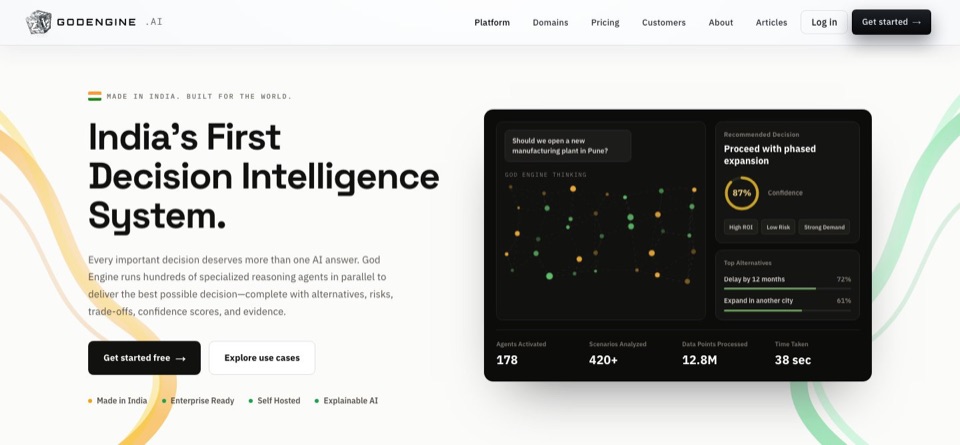
What is Second Order Thinking AI?
Second order thinking AI is a decision intelligence approach that moves beyond simple text generation to map the causal links and downstream consequences of a choice. Instead of just providing a fluent answer, it builds a structured model of the world to show you what happens next.
Traditional Large Language Models (LLMs) focus on fluency. They are designed to sound convincing, which can create a false sense of certainty in high-stakes business environments. If you ask a standard chatbot for advice on a business move, it gives you a polished paragraph that might sound right but lacks a structural understanding of your specific situation.
Second order thinking AI shifts the goal from "what is the answer" to "what happens next." It treats a decision as a complex system of moving parts. It maps entities, facts, and the causal links between them. It focuses on the "what if"—the ripple effects that follow an immediate response.
For example, if a shop owner in Mumbai asks, "Should I hire two more delivery riders?", a standard AI might list the pros and cons of hiring. A second order thinking engine looks at the causal chain: hiring riders increases delivery capacity, which increases order volume, which requires more inventory, which changes cash flow requirements. It maps the consequences, not just the immediate pros and cons.
The Risk of Fluent AI in High-Stakes Decisions
Large language models are excellent at producing fluent prose, but fluency is not the same as certainty. This is a critical distinction for builders and business owners. A model can write a beautiful, professional-sounding report that is factually hollow or logically disconnected from your actual business constraints.
A single chat reply often hides the moving parts that actually drive a business. It hides:
- What is true right now (current state).
- What causes what (causality).
- What it costs to be wrong (risk).
When you rely on a simple chatbot for strategic work, you are essentially betting on the "vibe" of the text. Second order thinking requires seeing the structure behind the text, not just the text itself. This is why ai reasoning must move toward structured models rather than just more "chatty" interfaces.
How It Works: From Questions to Causal Graphs
The engine does not just "think"; it builds. The process begins with a resolve pipeline. When you input a question, the system extracts the entities (people, places, assets) and the cause-and-effect links from your query.
These links are placed into a knowledge graph. This is not just a list of bullet points; it is a visual and mathematical structure of the world's moving parts. You can click through the graph to inspect how one variable affects another. Instead of a wall of text, you get a map of reality.
This approach is central to decision intelligence. By turning a question into a graph, the engine can move from linguistic patterns to logical structures. It gathers supporting sources and keeps them attached to the specific facts they support, ensuring the model is grounded in reality rather than just probability.
Scenario Probing: Testing Multiple Futures
Real decisions are bets made under uncertainty. In business, there is rarely one "correct" answer; there are only different paths with different risk profiles. This is why ai decision making must move toward scenario-based analysis.
Rather than providing one single answer, the engine builds a set of plausible scenarios. It doesn't just guess; it "probes" them. For each scenario, the engine asks:
- What must be true for this scenario to happen?
- What specific event would break this scenario?
- What are the downstream effects if this path is taken?
Imagine a small manufacturer in Coimbatore considering a new machine. One scenario might be "High Demand/High Interest Rates," while another is "Low Demand/Low Interest Rates." The engine probes these futures, helping the owner see which assumptions are the most fragile.
Auditable Reasoning vs. Blind Trust
One of the biggest hurdles in adopting AI for business is the "black box" problem. If an AI tells you to invest your entire budget into a new product line, you cannot simply take its word for it. You need to know why it said that.
Second order thinking AI provides reasoning you can audit, not just answers you must trust. Every claim in a report points back to a specific entity, a link in the graph, or a cited source. If a step in the logic looks wrong, you can trace it back to the exact point where the engine's reasoning diverged from your understanding.
To combat the issue of "hallucinations" common in standard LLMs, the system employs a "figure check." This feature compares numbers in answers against computed facts. It is designed to show its working rather than asking for blind trust. If a calculation is used to reach a conclusion, the engine's logic is transparently laid out.
| Feature | Standard Chatbot | Second Order Thinking AI |
|---|---|---|
| Output Type | Fluent prose/text | Structured reports & causal graphs |
| Logic | Probabilistic (next-word prediction) | Causal (cause-and-effect modeling) |
| Verification | User must fact-check everything | Auditable links and figure checks |
| Perspective | Single "best" answer | Multiple probed scenarios |
Who Benefits from Causal Decision Intelligence?
This technology is built for people who have to explain their decisions to others—whether that is a board of directors, a bank, or a co-founder. It is for those who need defensible reasoning rather than just a "hunch" from a machine.
Key users include:
- Founders: When choosing between markets, deciding on new hires, setting pricing, or deciding whether to take a raise.
- Finance and Business Analysts: When you need to provide a defensible, scenario-based write-up instead of just a single, isolated number.
- Operators: When you are weighing a change that touches multiple teams simultaneously and you need to see the ripple effects.
- Researchers: When you are trying to map the underlying causes behind a specific trend or a sudden market event.
Ultimately, this is for anyone using strategic reasoning to navigate uncertainty. It provides the explanation along with the answer.
Privacy for Strategic Questions
Strategic decisions often involve sensitive data—profit margins, upcoming hires, or expansion plans. You cannot simply paste this information into a public chatbot without risking your competitive advantage.
Privacy is a core priority for a decision engine. The architecture of the pipeline is designed so that different stages can be routed to different models. Specifically, stages can be routed to a self-hosted, private open model running on your own GPU servers. This ensures that your most proprietary strategic data never leaves your controlled environment.
While the ability to route every stage to a private model is currently being built and expanded, the goal is clear: a decision engine must be a tool you can trust with your most sensitive business secrets. A decision engine you cannot trust with your data is not much use at all.

Questions people ask
How is second order thinking AI different from a standard chatbot?
Standard chatbots focus on generating fluent text answers, whereas second order thinking AI builds a causal model to probe the consequences and downstream effects of a decision.
Can I verify if the AI's reasoning is correct?
Yes. Every claim in a GodEngine report is linked to a specific entity, a graph link, or a source, allowing you to audit the reasoning step-by-step.
What are 'scenarios' in the context of AI decision making?
Scenarios are multiple plausible futures built by the engine. Each one is probed to identify what would need to be true for that outcome to occur and what risks might break it.
How does the AI handle complex numbers and data?
The system uses a figure check to compare numbers in answers against computed facts, showing its working rather than asking for blind trust.
Is my data safe when using a decision intelligence engine?
Advanced architectures allow routing the pipeline to self-hosted, private models on your own GPU servers to ensure strategic data remains private.